
Search  for anything...

PECRON Portable Power Station F3000LFP, 3072Wh Solar Generator, 3600W LiFePO4 Battery Home Backup, Fast Charging Power Station Expand Capacity to 10752Wh, Solar Generators for Home Use, Camping, RV

  • Based on 134 reviews
Condition: New
Checking for the best price...
$899.00 Why this price?
Save $100.00 was $999.00

Buy Now, Pay Later


As low as / mo
  • – Up to 36-month term if approved
  • – No impact on credit to apply
  • – Instant approval decision
  • – Secure and straightforward checkout

Ready to go? Add this product to your cart and select a plan during checkout.

Payment plans are offered through our trusted finance partners Klarna, Affirm, Afterpay, Zip, Apple Pay, and Google Pay. No-credit-needed leasing options through Acima may also be available at checkout.

Learn more about financing & leasing here.

Selected Option

Free shipping on this product

Non-returnable. Transportation of this item is subject to hazardous materials regulation

View our full returns policy here.


Availability: In Stock.
Fulfilled by PECRON Direct

Arrives Wednesday, Sep 23
Order within 56 minutes
Available payment plans shown during checkout

Protection Plan Protect Your Purchase
Checking for protection plans...

Style: F3000LFP


Features

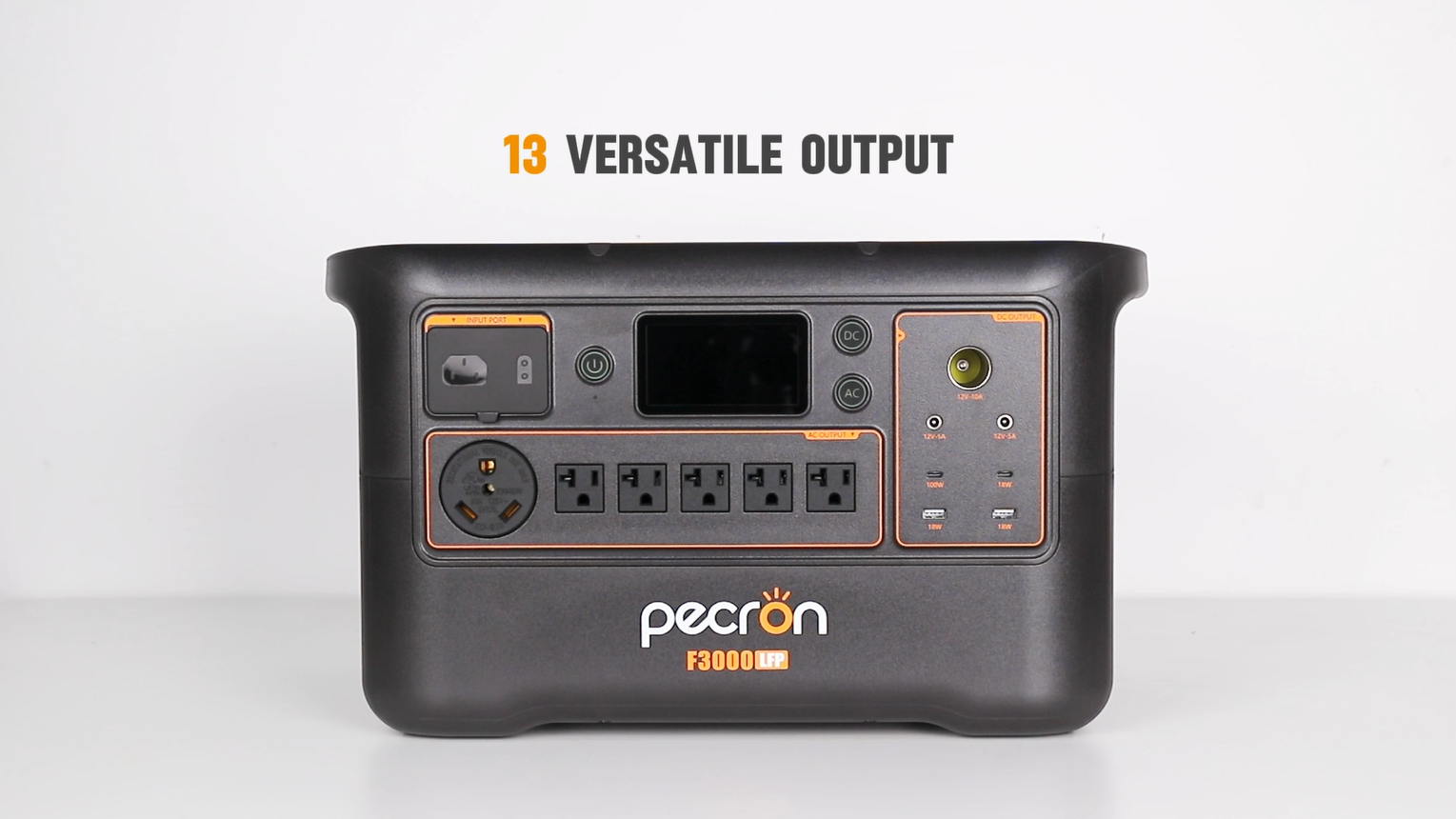
  • 3600W High Power & 3072Wh Massive Capacity Power 13 devices simultaneously with 3600W pure sine wave output, supporting heavy-duty appliances like refrigerators, air conditioners, and power tools. 3072Wh LiFePO4 battery provides emergency backup for 2-3 days of home essentials.
  • 1800W Ultra-Fast Charging in 2 Hours Recharge from 0% to 100% in just 2 hours via AC input (1800W max) 30% faster than others. Triple charging options (AC + solar + car) with solar compatibility (1600W max, 25-120V input).
  • 13 Ports for All Devices 6 AC outlets + 2 USB-C (100W PD for laptop) + 2 USB-A (18W) + 1 carport + 2 DC 5525 Output. Charge laptops, drones, CPAP machines, cameras, and phones at once no compromises.
  • UPS Backup & Smart Control Instant UPS mode (8-20ms switch) protects computers and medical devices during outages. Monitor real-time power usage via APP, make you use electricity smarter.
  • What You Get 2+3 years worry-free warranty and 24hrs/7d friendly customer service. pecron F3000LFP Power Station*1, AC Charging Cable*1, Single port XT60 to MC4 solar charging cable*1, Accessory Bag*1, User Manual*1
  • Please Note: To connect the EP3800-48V battery to the F3000LFP power station, a special F3000LFP battery XT120-M cascade cable is required(sold separately). If you want to add the extra battery, please make sure that you have one XT120-M cascade cable.

Description

Please note: F3000LFP is 120V AC output and input, not 240V. The size of F3000LFP is 19.3*11.6*11.1in. The weight of F3000LFP is around 63.3lb When charging the F3000LFP with solar panels, the voltage provided by the solar panels needs to be bigger than 25V. Because the XT60 port can only accept a DC input ranging from 25V to 120V. Please confirm whether your solar panel have at least 25V working voltage. F3000LFP Power Station F5000LFP Power Station F1000LFP Power Station F3000LFP+300W Solar Panel F5000LFP+FP5000-48V*4 F5000LFP Solar Kit FP5000-48V Extra Battery

Brand: pecron


Wattage: 3600 watts


Fuel Type: Electric


Power Source: Solar Powered


Recommended Uses For Product: Commercial, Home Use


Item Weight: 63.3 pounds


Voltage: 220 volts_of_alternating_current


Output Wattage: 3600


Special Feature: Portable, Fast Charging, Large Capacity, Long Last, Safety, Smart Control, UPS


Included Components: pecron F3000LFP Power Station*1, AC Charging Cable*1, Single port XT60 to MC4 solar charging cable*1, Accessory Bag*1, User Manual*1 See more


Wattage: 3600 watts


Fuel Type: Electric


Power Source: Solar Powered


Recommended Uses For Product: Commercial, Home Use


Voltage: 220 volts_of_alternating_current


Output Wattage: 3600


Additional Features: Portable, Fast Charging, Large Capacity, Long Last, Safety, Smart Control, UPS


Engine Type: Solar


Total Power Outlets: 13


Starting Wattage: 3600 watts


Running Wattage: 3600 watts


Runtime: 24 hours


Brand Name: pecron


Included Components: pecron F3000LFP Power Station*1, AC Charging Cable*1, Single port XT60 to MC4 solar charging cable*1, Accessory Bag*1, User Manual*1


Model Name: F3000LFP


Model Number: F3000LFP


Manufacturer: HuiZhou pecron technology co.,LTD


Manufacturer Part Number: F3000LFP2025


Item Weight: 63.3 pounds


Item Dimensions L x W x H: 19.3"L x 11.6"W x 11.1"H


Frequently asked questions

If you place your order now, the estimated arrival date for this product is: Wednesday, Sep 23

This item is non-returnable:

Non-returnable. Transportation of this item is subject to hazardous materials regulation

View our full returns policy here.

  • Klarna Financing
  • Affirm Pay in 4
  • Affirm Financing
  • Afterpay Financing
  • Zip Pay in 4
  • Financing through Apple Pay
  • Financing through Google Pay
Leasing options through Acima may also be available during checkout.

Learn more about financing & leasing here.

Top Amazon Reviews


  • 100% recommend!
Style: F3000LFP
I have had this for a while now and use it regularly for vendor markets. It is the BEST PURCHASE I've made in quite a while. It's reliable, charges INCREDIBLY FAST with wall outlet, whisper quiet even when the fan is going full speed during charging, has more power than expected, super easy to use... but... it's heavy. I get a bit of a workout loading it into the car every week... but it's WELL WORTH the money and the effort. Hasn't let me down once and I'm saving up to buy more since they can be linked together. 100% recommend! ... show more
Reviewed in the United States on July 20, 2026 by Spicy Cat's Mom

  • Great power to $$ ratio for me
Style: F3000LFP
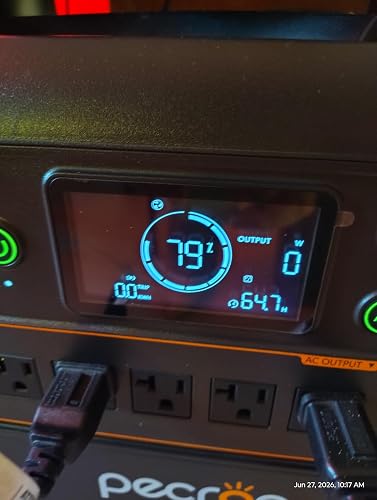
Second edit/update: After a lengthy conversation via messaging here, I have come to understand what is happening with the power consumption while not in use and while in use. Turns out this unit will eat itself at 30w per hour if you left it turned on (main power button). But 0w if turned off. It also uses power if the other buttons are left on (I.e. the Ac or dc buttons). So if you want the best outcome, only turn it on as needed, and it should last pretty well. The other challenge i had was incoming power seemed “slow”. I have now completed a couple tests using only solar and watched the input numbers to calculate exactly how much it adds per hour. It seems to be able to accumulate 420+w per hr from my 400w bifacial panel. That’s good for me :) So adjusting my review back to 5*, and thankful for the patient explanations the company provided this past several days. Highly recommend for customer service 👍. 1st Edit/update. Took it out and used for a few days. The good: it accepts power readily from the solar panel. It’s relatively light for an all in one power bank. There are enough outlets for most id hazard a guess. The not so: it runs the fan - often. The power distribution is odd. I’m running it along side a 2kwh unit that isn’t using nearly as much for the same exact use. I ran the fridge on a 68-75 degree day on both units - 24hrs ea. This unit (Pecron f3000lfp) used just north of 31% of its power with some solar input running during the am and a little of the afternoon (1-1:30pm by the time the sun was over a tree). This means it used a whopping 1200+/-WH over the 24hrs considering the input from solar estimated at 300wh (was prolly more than that in reality). The other (Aferiy) used 26% of its power over the same period, same weather etc. however, the Aferiy is NOT plugged in as it isn’t working to accept solar correctly (bad mppt maybe?). That means it used 500 or so WH. According to the fridge pulling an intermittent 40w. I don’t know if im missing something - but def seems like it’s not as good by a large margin. I’m going to charge them both fully, on AC power, when I get home and test further - not sure how that is but I’m concerned it isn’t up to the claimed specs. Original review: While it’s early days yet, the unit seems to perform well. I did a couple tests to make it draw lots of power and see how it held up. It’s decently consistent in output through DC or AC, albeit a bit hefty on the inverter power consumption. However, it’s not that noticeable and I’ll live with it for the price for 3kwh. Pretty setup friendly even if you don’t have the app. I read the clearly written instructions and was in biz within a few mins. Noteworthy is the input it seems to allow. I will/am using a 400w panel to juice this thing, and at around 1pm, with light clouds spattering the skies, it recorded 425 input (see pic). So that parts great. Lastly, the footprint and size of this is not much different than a 2kwh of another brand. So it’s good in that regards too. It weighs something like 10lbs more than my 2kwh unit.. so that’s great. I will go out on a limb and say I recommend it so far. ... show more
Reviewed in the United States on May 25, 2026 by Dwegs

  • High capacity at a low cost relative to other brands.
Style: F3000LFP
I give the Pecron power station and expansion battery 5 stars because, for the money, it is one of the best values out there by far! Like any product, it has its pros and some (relatively minor, for the most part) cons. I currently own two systems. I have the Pecron F3000LFP and an EP3800 expansion battery. I also have a Bluetti AC200max and B230 expansion battery, which is a few years old, and is now outdated compared to newer Bluetti systems and expansion batteries. Even with the outdated system, the Bluetti setup still has some superior features to the Pecron, despite having over 1/3 less battery capacity and costing much more money per watt-hour. The biggest “pro” of this Pecron system is simply the cost-per-watt-hour ratio. The Bluetti system comes in at around 45 cents per watt hour, while the Pecron system averages out at under 20 cents per WH, which is a huge difference. The Bluetti system has a total of 4096 WH, while the Pecron system has 6912 WH, with the ability to increase that to 10,752 if I add another EP3800. Pecron recently released the F5000LFP and a similarly massive expansion battery, but by my calculations, the cost per WH has increased pretty significantly with those systems compared to the F3000 and EP3800. Regardless of which system you choose, Pecron models are still far less than Bluetti’s in terms of cost per WH. (Side note: I was sad to see that both the F3000 and EP3800 had a price increase of $100 each since I bought mine. That takes the cost ratio to about 25 cents per WH, but the value is still significantly lower than Bluetti systems, even with the increase). The Pecron system is easy to use, with outstanding battery capacity. The drawback to the capacity is that these two batteries are VERY heavy, which limits the "portability" factor. At just under 70 lbs each, you are definitely not going to want to move the F3000 or EP3800 around too much once they are set up. That's not a criticism... it's just a natural result of having so much battery capacity. It's a drawback for me mostly because I have to transport my systems to and from an off-grid location on a regular basis. If you're primarily letting them sit in a single location, it wouldn't be much of a worry. Aesthetically, the Pecron has a much more basic design. All of the ports and outlets are aligned on the front panel, including the PV and AC charging ports. Connections for the cascade cables are on the side. The only ports that are covered on the Pecron are the ports for the AC cord and the PV input. The Bluetti system has rubber inserts that cover the almost every outlet, which offers more protection from dust and moisture. Another difference between the brands is that the AC and PV charging ports are on the side of the Bluetti unit, which is preferable to the front ports of the Pecron, in my opinion. It makes managing the cables and cords much easier, and just looks less cluttered than the Pecron. Both brands include a 30-amp RV output. The Bluetti only has 4 AC outlets, which are arranged in a 2x2 square pattern, while the Pecron has 5 AC outlets in a straight row, with fairly ample space between each outlet. Pecron wins in this regard, because the 5 outlets are much easier to access (especially if you plug in anything that has a larger plug) than the stacked outlets on the Bluetti. The Bluetti has more USB-A connections than the Pecron (4 for Bluetti, 2 for Pecron), but only one USB-C port vs. the Pecron’s 2. Both units have some additional 12-volt outputs, which I’ve never used on either, and probably never will. Functionally, both systems are easy to connect and fairly intuitive to operate. One quibble I have with the EP3800 is that it doesn't come with the correct cascade cable for the F3000LFP. Because I bought both units at the same time, Pecron sent me the correct cable at no charge, but it was back-ordered, so I didn't even get to use the EP 3800 for over two months. Currently, I think Pecron requires you to pay for the necessary cable separately, but it’s reasonably priced. Bluetti accessories are usually very pricey by comparison. Oddly, though, if you add an additional EP3800, it requires a completely different cable, which IS included with the EP 3800. So if you have two expansion batteries, you would have two completely different cascade cables. This is a very puzzling design choice. Aside from the cable complication, setup is easy. You connect the cable, turn on the EP3800, and then turn on the F3000LFP. There are two buttons for AC and DC power, so a quick push is all it takes to activate AC and/or DC power. The Bluetti system requires you to tap the screen, press either AC or DC (or both), and then press "on" or "off.” This is just a few extra unnecessary steps in comparison to the Pecron, so the Pecron system has a slight edge for overall ease of use. On the other hand, the Bluetti system has a FAR more detailed list of options and information that you can access from the touchscreen, compared to the Pecron touchscreen. The Bluetti functions and menus are easy to navigate. Because the Bluetti B230 is a stand-alone battery, the App and touchscreen will display stats for EACH battery when they are connected, which means you can see the state of charge for both batteries independently. The Pecron system, by comparison, is much more limited in what you can access from the touchscreen, and for many functions and features, you have to change settings by entering codes which are found online or in the manual. In addition, when you connect the EP3800, the display shows a corresponding increase in remaining power, but does NOT show the EP3800 as a separate entity. To my knowledge, the only way to check the state of charge on the EP3800 is to look at the LED meter on the side of the unit, which has 5 lights to indicate charge status, so it's not very precise at all. Both Bluetti and Pecron provide apps that you can use to control the functions and access system information, and this is one area where the Bluetti wins hands-down. I was on an off-grid site for a week, and had both systems with me. The Bluetti app is very fast to load and connect to the system, whereas the Pecron app was much more unreliable. I had frequent and annoying difficulty connecting with the Pecron app, because Pecron seems to require an internet connection in order to make a Bluetooth connection with the app. This makes no sense for a solar generator that is VERY likely to be used in an off-grid situation where there is no internet and poor cellular signal. On a 10-day trip, the Bluetti app never failed to connect, whereas the Pecron app consistently failed to connect and/or displayed a message saying that the F3000 was offline, even though it wasn't. I do hope Pecron addresses this significant and highly irritating issue in the near future! The Pecron app and connectivity issues are my least favorite thing about the whole system. Another "con" of the Pecron system is that the user manuals are very uninformative when it comes to settings, functions, display capabilities, and other information. I've learned more about how to use the Pecron from online searches or Youtube than I have from the manual. And when I received the EP3800, it came with a misprinted manual, because mine literally went from page 1 on the first page, to page 10 on the second page. Pages 2-9 were missing altogether in the English portion. They weren't missing in the other languages, but that didn't help me since I'm not bilingual. I was able to download a corrected version, but it still didn't provide very much information on accessing, changing, or adjusting settings compared to what I found by doing online searches. The Bluetti definitely wins on this score, too. Being an older system, the Bluetti can only output a max of 2200 watts (4400w surge capacity) while the Pecron can handle 3600 watts. So definite victory for Pecron here. To be fair, though, there are newer Bluetti models with much higher output thresholds. Another “con” of the Pecron system is that the EP3800 doesn't have a built-in charge controller. It isn’t recognized as a separate unit when you connect it to the F3000LFP. In fact, it has NO capabilities by itself. There are no AC or DC outputs. You can’t even charge it separately. It must be connected to the F3000 (or other Pecron generator) in order to charge or be used. I list this as a con… but the fact is… it’s actually a cost-saving strategy. My Bluetti B230 has some USB outputs and a DC plug, so it can actually charge things on it’s own. Likewise, you can connect a charger to it and recharge it without having it connected to the AC200max. But that’s probably a big reason why the cost of the B230 was significantly higher than the cost of the Pecron EP3800 despite having far less capacity. So it’s a minor quibble. I definitely prefer the cost savings and higher capacity of the Pecron over the extra functionality you get with the Bluetti B230. Some reviews have stated that the fan noise can be very loud on both models, and while that may be true, it depends on how much power is passing through the system. If you're using either brand to run a light load, or are only charging at a few hundred watts, the fan noise will be pretty negligible. But if you are bringing in the maximum power from AC or solar, or running high-wattage devices, it's to be expected that the fans will run at a higher (therefore louder) rate. High power creates high heat, so the fans are going to run harder. I don't think this is a drawback or something to complain about, because the system needs to avoid overheating to keep itself (and you!) safe. I do have one complaint about the cooling fans though, particularly on the Pecron unit, because the vent is significantly larger than the Bluetti's. Neither brand has any type of filter on the vents, so if you are using it in a dusty environment, I'd be concerned about all that dust being sucked in and affecting the internal components. I created my own "workaround" for this issue by cutting a piece of MERV 11 fabric from a home furnace filter, and use it to cover the air vents, if needed. I wish both brands would include some type of replaceable dust filter for the vent system, though. Lastly, a comparison of charging capabilities gives the Pecron system a HUGE edge over the Bluetti system. The Pecron unit only requires attaching a simple cord when charging by AC power, or an xt60 cord for PV charging. The Bluetti system, on the other hand, requires a rather large "charging brick" for AC charging, which has a pretty loud cooling fan of it's own, on top of the fan in the unit itself. This just adds another large component to bring along when transporting. Even worse, the AC200max has a maximum of 900 watts for solar input, compared to 1600 watts for Pecron. The Bluetti B230 has the capability of adding up to 500 watts of solar input, but that requires yet ANOTHER large and expensive charging brick. I haven't looked to see if Bluetti has improved their charging system on newer models, but wow, the Pecron wins by a huge margin in every area when it comes to AC and PV charging capabilities compared to the Bluetti system I have! My one complaint with Pecron's solar charging is that it requires a minimum of 25 volts to charge (vs. 10 volts for Bluetti), so the solar charging will literally cut off at times if there's cloud cover and the voltage input drops below 25. Definite room for improvement there! In simple terms, the Pecron wins by a large margin over the Bluetti system when it comes to capacity, price, and many of its functions. The Bluetti system wins in terms of the more informative display, and the fact that the B230 has its own built-in charge controller and USB and 12-volt outputs. The Bluetti app definitely outshines the Pecron app in terms of features and ease of use, not to mention connectivity. Bottom line? If I had to choose between one system or the other, I would absolutely choose the Pecron over Bluetti for the cost savings alone. There’s a lot to love about the Pecron system and I would highly recommend it, despite some of the issues I mentioned. That said, if the Pecron and the Bluetti had similar capacity and pricing… I would probably choose the Bluetti over the Pecron. But since they don't (and it's not even close!), Pecron is the clear and easy choice. ... show more
Reviewed in the United States on September 1, 2026 by TJR

  • Good price!
Style: F3000LFP
Five months update: This unit has gone through, at least, 40 outages, and so far I've had no issues with it. Average outage lasting around 4 hours each (sometimes more, sometimes less). Original review: I've used this for a few months, the unit feels good and heavy (as you'd expect for something with this capacity), the app requires a login, manuals feel a bit engrishy but still understandable. TL;DR Good unit that's worked fine so far, middling app but it works, manuals it comes with can and should be improved. Noise: It's audible when charging, like having a fan nearby. It is not high pitched or anything so it doesn't really bother me. When charged up the fans spin slower and I don't really notice them unless actively trying to, but for people who care a lot about silence, they are certainly not silent. Reliability: Can't say much about the long term, but I've had a couple of outages and the computer I have connected to it kept working just fine, my monitor didn't turn off either (my monitor has a 80% chance of temporarily turning off during the switch on an ecoflow delta 2 I have around, but that advertises it takes 20ms to switch vs this unit's 10ms so that's not surprising). The first time I plugged this in I was a little worried as the display claimed it was 100% charged but then kept pulling 1500w for around 20 to 30 minutes, but after that it worked normally. Looks like it might have needed a bit of time to calibrate. App: Just like ecoflow, you need to make an account to use the app. Ecoflow's has a better look than this one too. App lets you see how much you are pulling from AC or DC and how much it is outputting to AC and DC, heat, current charge and how long it'll take to charge. The only configuration change I've made is limiting charge speed, which works. It has a so-called eco mode but no explanation of what it actually does, and the other options don't seem as important. You have an option to update its firmware, but I haven't tested this feature as my unit was already on the latest one (at least as of this review). I hope they actually add information about what every option does, as well as a dark mode. ... show more
Reviewed in the United States on February 1, 2026 by simon

  • Strong, Compact, Good Looking Power Station
Style: F3000LFP
Love the compactness and power this unit offers for the price, but the charge controller seems to be a little wonky at times. It works but sometimes while charging from my PV string (5s2p, 100 watt panels), the charging sometimes intermittently drops to zero then returns to normal during a normal solar stream. This is something that I do not see with my other power station (another brand) using the same solar string, producing around 103 VOC and 80V to 90 V under load (9 amps max). Still ...I'll give this unit 5 stars based on its performance and good price, but the charge controller in this unit has me a bit concerned. Otherwise, this unit is amazing with a very powerful, stable inverter and a quality appearance in build. I would still recommend this unit, realizing that my unit is an early build and feel that Pecron will repair/replace if necessary. (7/27/25) As an addendum to what I wrote earlier about the charge controller, I have discovered that the charge controller is working fine. It does not tolerate panel shading if the wattage drops much below 100 watts which is occurring with my PV mid-morning stream at this point in time. This is when it drops out to 0 watts indicated input ...but resumes reliably when the shading abates. This charge controller will accept up to 1600 watts, 125 volts input, so the intolerance to my mid morning 10-20 minute shading is not a problem for me. For the remainder of the day when the panels are in the clear, this unit is rock solid. Could the low wattage dropout be improved? Well maybe so, but as it is, I can easily forgive the unit for this little niggle, for the great performance/value it offers. ... show more
Reviewed in the United States on July 25, 2025 by V H Parks

  • Amazing, super functional, app control, camping must
Style: F3000LFP
We bought this for camping and ended up using it for multiple blackout situations. It’s nice to be able to cook/have hot food and keep your food from going bad by running the freezer and refrigerator. App control (OPTIONAL, NOT REQUIRED) People who have issues connecting their phones to the power station are not following directions. IT DOES NOT TAKE WIFI to connect to your phone. Follow the directions and Bluetooth works as it should. It weighs 70 something pounds so it’s not for the weak to carry around. It’s also fairly compact for what it is and can do. It charges with solar panels (recommended) and AC plug. AC wall plug charges at 1600w. From zero it would charge in 2 hours. It’s the best Power Station I’ve ever owned. For most people it’s a camping MUST!!! Charges electric bike batteries with power to spare. ... show more
Reviewed in the United States on April 4, 2026 by Brandon

  • It's a Beast, Great Product
Style: F3000LFP
I have take this out on 2 trips so far, powering everything from coffee pots, TV setups, charging stations, and lights. I have used the little buy to power the whole camper in 108 degree heat to run Air Conditioning for a few hours and charge it with a 200 watt panel mounted on the truck (which usually gives it about a 50% charge/sunny day). When connected to shore power to charge, this thing easily charges up in a couple hours. On hot days and large loads it runs fans internally to stay alive and has worked like a champ. Great product. Likely to buy the extended battery for this at some point as well to double, maybe triple up. ... show more
Reviewed in the United States on July 18, 2026 by Mike Allred

  • LED or Charger Not Working, Poor Customer Service, Your on Your Own with This One
Style: F3000LFP
My delivered F3000 was fine and it seemed to work well for a few days. I fully charged it then started to use it, recharged it again and then the LED display started to act up giving me different charge level readings when I only had one item plugged in. Then I contacted Pecron and no respose for customer service. I asked for a return on this defective product and have a label ready to sent the unit back but it appears that I will have to pay for the unit to be returned on a a 63 lb Power Station is is going to cost me around $65 dollars. I really am very displeased with this product and response so think twice before ordering ! Update: Pecron sent me a return label. I mailed it back via UPS. UPS has lost the item. I filed a claim with Amazon A-Z guarantee and they are not honoring it stating that they will honor the guarantee (I doubt it) once the seller gets the item back. It's not my fault that the item was lost and get no nowhere with UPS or Pecron. Don't believe the Amazon hype as it is a marketing gimmick and nothing else. I suggest that you do not buy from Pecron. I also suggest you purchase locally if possible instead of buying from Amazon. ... show more
Reviewed in the United States on July 2, 2026 by Amado Diaz JR

Can't find a product?

Find it on Amazon first, then paste the link below.
Checking for best price...