

Search  for anything...
NA

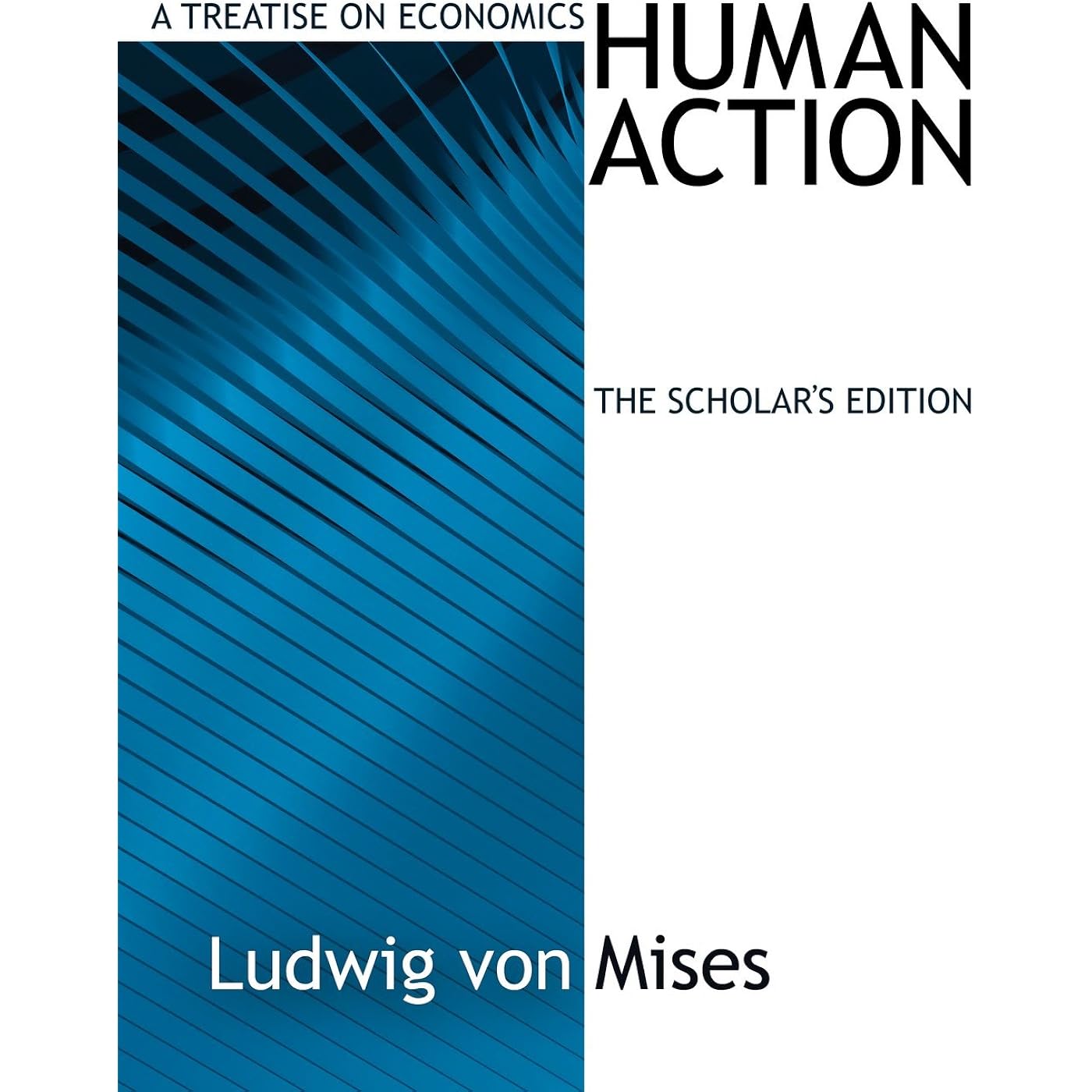
Human Action: Scholar's Edition (LvMI)

  • Based on 324 reviews
Condition: New
Checking for the best price...
$4.99 Why this price?
Save $37.01 was $42.00

Buy Now, Pay Later


As low as $1 / mo
  • – 4-month term
  • – No impact on credit to apply
  • – Instant approval decision
  • – Secure and straightforward checkout

Ready to go? Add this product to your cart and select a plan during checkout.

Payment plans are offered through our trusted finance partners Klarna, Affirm, Afterpay, Zip, Apple Pay, and Google Pay. No-credit-needed leasing options through Acima may also be available at checkout.

Learn more about financing & leasing here.

Free shipping on this product

This item is eligible for return within 30 days of receipt

To qualify for a full refund, items must be returned in their original, unused condition. If an item is returned in a used, damaged, or materially different state, you may be granted a partial refund.

To initiate a return, please visit our Returns Center.

View our full returns policy here.


Availability: 20 left in stock
Fulfilled by Amazon

Arrives within 30 days
Order within 5 hours and 1 minute
Available payment plans shown during checkout

Protection Plan Protect Your Purchase
Checking for protection plans...

Description

Human Action is the most important book on political economy you will ever own. It was (and remains) the most comprehensive, systematic, forthright, and powerful defense of the economics of liberty ever written. This is the Scholars Edition: accept no substitute. You will treasure this volume. The Scholars Edition is the original, unaltered treatise (originally published in 1949) that shaped a generation of Austrians and made possible the intellectual movement that is leading the global charge for free markets. Made available exclusively through the Ludwig von Mises Institute, this edition, Mises's original, is the one to own. Includes the 1954 index prepared under Mises's supervision, the most complete ever published, united here with the book for the first time. The introduction, by Hans-Hermann Hoppe, Jeffrey Herbener, and Joseph Salerno — based on newly discovered archives — tells of the tragic and glorious history of this seminal work, and of its bright future as the manifesto of liberty. This edition is keyed to the world's first and only Study Guide to Human Action, by Robert Murphy, which opens up this book as never before. All told, The Scholars Edition looks exactly like the classic work it is, ready for a lifetime (or two) of use. Mises himself wrote the following by way of explanation of why he wrote the book: Economics does not allow any breaking up into special branches. It invariably deals with the interconnectedness of all phenomena of acting and economizing. All economic facts mutually condition one another. Each of the various economic problems must be dealt with in the frame of a comprehensive system assigning its due place and weight to every aspect of human wants and desires. All monographs remain fragmentary if not integrated into a systematic treatment of the whole body of social and economic relations. To provide such a comprehensive analysis is the task of my book Human Action , a Treatise on Economics. It is the consummation of lifelong studies and investigations, the precipitate of half a century of experience. I saw the forces operating which could not but annihilate the high civilization and prosperity of Europe. In writing my book, I was hoping to contribute to the endeavors of our most eminent contemporaries to prevent this country from following the path which leads to the abyss. The Scholars Edition of Human Action is the definitive edition of this great work and foundation of every library of freedom. ISBN 2 To Search for Mises Institute titles, enter a keyword and LvMI (short for Ludwig von Mises Institute); e.g., Depression LvMI Read more

Publisher ‏ : ‎ Ludwig von Mises Institute


Accessibility ‏ : ‎ Learn more


Publication date ‏ : ‎ March 30, 2009


Edition ‏ : ‎ 2nd


Language ‏ : ‎ English


File size ‏ : ‎ 1.7 MB


Screen Reader ‏ : ‎ Supported


Enhanced typesetting ‏ : ‎ Enabled


X-Ray ‏ : ‎ Not Enabled


Frequently asked questions

If you place your order now, the estimated arrival date for this product is: within 30 days

Yes, absolutely! You may return this product for a full refund within 30 days of receiving it.

To initiate a return, please visit our Returns Center.

View our full returns policy here.

  • Klarna Financing
  • Affirm Pay in 4
  • Affirm Financing
  • Afterpay Financing
  • Zip Pay in 4
  • Financing through Apple Pay
  • Financing through Google Pay
Leasing options through Acima may also be available during checkout.

Learn more about financing & leasing here.

Top Amazon Reviews


  • James Inman
Format: Paperback
Rather than review the content of Human Action, I'd like to expound how incredibly awesome this set is. It comes softback in four volumes (parts 1-3, part 4, and parts 5-7, including a fourth volume with an appendix, index, and glossary) within a sharp looking box. The quality of the set is on par with the American Library series, sans tissue paper thin pages. This is definitely a high quality set, and I've had many compliments as it sits on my bookshelf. The content isn't aimed necessarily at the layman, but with the internet's help, I digested the 7 parts over 3 months. It is an incredible and insightful read that I recommend any Patriot, Historian, Economist, or God-Fearing American should read. edit: I don't remember writing this review, and although I won't remove any stars, I will instead recommend James Inman's Greyhound Diary as a slick alternative. ... show more
Reviewed in the United States on April 14, 2010 by B.K.

  • Are we free to choose?
Format: Paperback
Perhaps it is best to start at the end instead of the beginning of this book.How is our freedom to choose restricted?1.physical laws, 2.individual disposition,and 3.the interconnectedness between means and ends(praxeological law).The last sentence of the book is very important:"But if they fail to take the best advantage of it and disregard its teachings and warnings,they will not annul economics,they will stamp out society and the human race."Sure,this book is the magnum opus of all his work.Did he take giant steps after the studies of Menger and Bohm-Bawerk or did he rest on the shoulder of giants?The Austrian Subjectivists were descriminated against by the German Historical School for many years academically.What they needed was the power to think clearly and to discern in the wilderness of events what is essential from what is merely accidental.The power of ideas go beyond force and might.Contriving the outcome will make truth temporary for such purposes.It's not just about getting over the uneasiness,but how about just being human?That's really what von Mises is all about here.This applies to everybody from the poorest to the richest.If everybody in between applies to a bell curve,so be it. His initial inclination to government intervention is negative.He views it as propaganda.He also recognizes that if social conventions are such,it is possible that we would tolerate it,albeit,with obvious economic dislocations.Governments have to tax so they can spend.They might support minimum wages and maximum prices so workers and producers make more money.The problems are not only debatable. Postlegislative aftermath is right up many economist's alley.von Mises can answer every argument of Karl Marx except one.When the powers that be in a society thrive on the "accidental,"they will only find the seeds of their own destruction.This will not be economical significant. Utterly unremarkable.He takes less time showing how the fall of the Roman Empire was legislatively enabled than Gibbons did.Then,Italy was predominantly an agricultural power heading for feudalism.Let me get to the best part though.von Mises work here does go head and shoulders above his contemporaries in regards to catallactics.That is commodity prices at both spot and future.To a lesser degree there are also option pricing.You can imagine him inventing a machine that allows you to watch supply and demand interact with prices.Bells and whistles for government intervention,etc.Yes,a finely tuned machine.In addition though,it would be worth mentioning that some of the ideas of "creative destruction" is akin to some of von Mises thoughts and ideas.He would call it exploding the fallacy.This is probably a positive way of lightening up,if you will.I suppose I should also mention the appendix:A Critique of Bohm-Bawerk's Reasoning in Support of His Time Preference Theory.von Mises first mentioned this idea in 1912 in his Theory of Money and Credit.He hadn't thought it through at that time.He likens it to the old adage:"a bird in the hand is worth greater than two or three in the bush."This basically means that something ready to be consumed now is worth more now than in the future.He goes one step further by saying there are no exceptions to this.I really should directly quote him because his logic is excellent:"In acting,one must always value a satisfaction at an earlier point in time more than the same kind and amount of satisfaction at a later time.If this were not so,then it would never be possible to decide in favor of a present satisfaction.Whoever uses or consumes anything,whoever seeks by acting to relieve to a greater or lesser extent a felt uneasiness is always expressing a preference for an earlier over a later satisfaction.Whoever eats and consumes anything is making a choice between a satisfaction in the immediate future and one in a more distant future.If he were to decide differently,if he were not to prefer the earlier to the later satisfaction,he would never be able to consume at all.He could not even eat and consume tomorrow,because when tomorrow became today,and the day after tomorrow became tomorrow,the decision to consume would still call for a valuing an earlier satisfaction more than a later satisfaction.Otherwise,consumption would have to be delayed still further."What sort of economic activity was he talking about.Well,in his time he thought we'd be buying iron and gold.We hadn't really started fighting over oil again for a few thousand years.Examples of commodities for von Mises purposes are just that-examples. Special note:There are some examples where von Mises used examples that could be considered ethnic derogatory.Some people were so good at doing something,everybody went to them to get it done.This could be broken down on an ethnic basis for that reason alone.Can you imagine what he would of said if he was alive when Tata bought Jaguar from Ford?His use of the term "actor" is even more interesting.An economic actor is somebody that might buy or sell but are we really getting into his or her underlying characteristics?Probably not.The intent is to make a profit.They will act accordingly regardless of success or failure. ... show more
Reviewed in the United States on May 11, 2015 by shazam

  • Few typos
Format: Kindle
There were a few typo's, but this book was outstanding. My favorite part of the book was the discussion on interest rates, and profits. It is quite long book, but very good all the way through.
Reviewed in the United States on March 5, 2022 by Book Buyer

  • A true Magnum Opus
Format: Kindle
I couldn't praise this book adequately. There are not enough superlatives in my vocabulary to convey my high regard for the work of Ludwig vonMises. He uses the term Praxeology to describe this science of Human Action. It deals primarily with the the application of proper means to attain the ends that individuals seek. Economics becomes part of a broader study of the acting individual. This book is not easy to read but each chapter (there are 39) is broken down into sub-titles, each just several pages long. Every possible subject is covered: means and ends, subjective nature of valuation, exchange, prices, wages, government intervention, freedom, taxation, currency, credit, and so much more. As I say, it is not an easy read but if you approach it with patience, you will be rewarded in better understanding how the world around you functions. You will see also, the detrimental effects that result from government interference in economic affairs. This book has given me a totally new outlook on what is going on around me. Inspiring!! ... show more
Reviewed in the United States on December 26, 2012 by Robert E. Gray

  • Pretty much everything
Format: Kindle
This is Mises' magnum opus. In this one volume, he presents a comprehensive view of economics as the mechanics of all human (inter)action. Not for anyone looking for quick answers or an easy read, but it is not a dry an tedious read. Far from it, this is engaging in its presentation, and overwhelming only because of its scope. ... show more
Reviewed in the United States on January 26, 2018 by William Meyer

  • Masterful Economics, Wanting Philosophy
Format: Paperback
Human Action, originally published in 1949, is regarded as Ludwig von Mises’s magnum opus. The work is gripping and engaging, and its commentary is wide reaching. Mises intersplices his famous work of political economy and action theory (praxeology), where he considers economics as a sub-discipline of praxeology), with evolutionary science, philosophy, political commentary, and literature. Thus, it is easy to get seduced by Mises’s seeming mastery of many subjects when, in reality, his book is best when it stays on the most immediate subject matter (being a treatise on economics) but wanders into territory easily scrutinized. As such, the economics is a 5, but the other commentary (especially philosophy) at best a 3. Mises is no student of the human condition, which makes his more general philosophical claims concerning man’s nature weak. His commentary on economics, however, is deeply insightful and it is of upmost important for people to actually read the Austrian economists so as not to have the caricatured straw man of them ingrained into their mind by folk who have not actually read them and think a 5 minute session on Wikipedia allows them to be authoritative commentators on Austrian economics. As a former student of economics (B.A. in economics among other subjects), this is the one book that university economic students should have read when going through their education! Mises, though considered heterodox, really takes a hammer to the conventional wisdom of the orthodox economists. He demolishes, one by one, the standard myths that Econ 101 students learn: Homo Economicus (the economic man), social and private capital, practical utility (if true humans should value iron more than gold but they don’t; iron is far more “practical” than gold is), and division of labor among much more. In fact, Mises goes to great lengths to show how it is only a market economy that has true labor specialization, optimization, and division -- reflecting man’s natural differences in physical and physiological gifts. Mises is not “anti-labor” as is often the straw man established against the Austrian economists. Mises is probably the most pro-labor economist there is (or as he might argue, true labor). He recognizes labor as not simply a material and physiological endeavor, but a moral and spiritual one too! Everyone is a laborer. How true (and commonsensical). Mises is also critical of the two-faced hypocrisy of orthodox economics. We all learn that there is a scarce amount of resources. But most ideological economists (of the institutional, Marxian, and technological stripe) don’t really believe in the scarcity of resources. As he shows brilliantly, credit economists thing they can overcome the scarcity of resources by pumping an economy with endless credit (thus increasing debt--hmm, sound familiar?). Marxists believe scarcity is only a byproduct of historical dialectical conflict: in the end of history and the communist utopia there is nothing but abundance! Technologists believe that through increases in technological science we can minimize the waste of scarcity; we see this through those economists today who believe technology will meet the human crisis of scarcity and delay the reality of scarcity. So the university economics we all learn wants to have its cake and eat it too! (There will be more cake, always.) While proclaiming scarcity, deep down, the so-called orthodox economic schools don't really believe it. As such, they are unscientific and construct an economics based on imagination rather than what is actually real. (And as such they become ideologies.) As Mises brilliantly shows, all human action is done with imperfect information (uncertainty) and the intuitive recognition of scarcity. This is what drives man to action. Rational man, for Mises, is a man compelled to act to alleviate his uneasiness through any means he considers as best suited to assuage his uneasiness. Between the lines of Mises’s economic commentary is his criticism of propagandist historians and ideologues. Here Mises is on the top of his game with regard to insightful commentary apart from economics (strictly speaking). His criticism of historicism, Marxism, and ideology is on point and deeply relevant in today’s day and age. He shows why Marxists are “irrational” in their assault against the supposed “madness of reason.” A slew of books published in the last 40 or so years attack human rationality that undergirds classical economics (which Mises is not uncritical of though he sees himself as a builder of the classical tradition). Cultural Anthropologist David Harvey has recently published “Marx, Capital, and the Madness of Economic Reason.” Michel Foucault, the most famous of the intellectually immature and shallow postmodernists, wrote Madness and Civilization, with his famous line “the ultimate language of madness is that of reason.” Understanding this “revolt against reason” as a “revolt against [competitive] economics” is of the upmost importance for the 21st century. Likewise Mises shows the problems historians have with regard to understanding economics: they just see isolated events and try to construe a talking point based on ideological presuppositions. That said, Mises falls into very weak territory when he begins to discuss the supposed brilliance of liberal philosophy. Mises’s understanding of man is decisively against the classical liberal understanding of man. Mises believes man is social whereas the classical liberals like Hobbes, Locke, and Spinoza, believed man to be naturally a-social and forced into sociality through the miserableness of the state of nature. Mises sees man through the prism of vitalism and condemns those who seek to animalize man to the noble savage: That true man is the man of instinct like all other forms of life. In this regard Mises is more Aristotelian and Abrahamic in his understanding of man than liberal. The liberal philosophers of the so-called Enlightenment saw man as nothing more than an artificial body of matter in motion. Or, more bluntly, as La Mettrie said - who was a faithful disciple of Bacon, Hobbes, and Locke - “the man machine.” Today we see this antiquated view of man still peddled by scientists like Richard Dawkins who described man as a “survival machine” and “gigantic lumbering robot” in “The Selfish Gene.” Mises's view of man is not within the liberal tradition's understanding of man. Mises’s critique of universalism is not to be missed, but he fails to see how the classical liberalism of the monistic philosophers functionally exhausts itself into its own universalism (at least in this work of his). Since the state of nature is bad, and conflict is bad, because conflict causes harm (per Hobbes, Locke, and Spinoza), we need to propel ourselves out of this miserable state of nature which is an alleviation of harm. Mises stands on schizophrenic foundations here. He recognizes that self-preservation (the want to assuage uneasiness) is central to economic action. So he agrees with the classical liberals here. Insofar that he sees this as the underlying foundational of all economics, he also agrees with the classical liberals insofar that they saw self-preservation as the common denominator of human nature (thus lowering the bar of the human condition and human life). But since men leave the state of nature and form a multiplicity of commonwealths, wherein conflict among these commonwealths is guaranteed by the Lockean law of self-preservation, there are only two logical ends of the classical liberal vision (which we are seeing today): universal (international) law that all nations become subject to or the establishment of the universal world state to prevent conflict. Yet, in an earlier work on aptly titled “Liberalism” (1927), Mises wrote that the liberalism would create the “world superstate really deserving of the name” [if liberals] “succeed in creating throughout the world...nothing less than the unqualified, unconditional acceptance of liberalism. Liberal thinking must permeate all nations, liberal principles must pervade all political institutions” which would create, through law, the the conditions of world peace. So does Mises himself not embrace a sort of abolitionist and emancipatory universalism that he recognizes as inherent in the liberal tradition that he otherwise condemns among non-liberal political philosophies? In "Liberalism" he bluntly acknowledges the universalist ambitions of liberalism. But in "Human Action" he condemns universalism. (As far as I'm aware Mises did not have change of heart in the 22 year period of difference between these two books of his.) Although Mises identified as a liberal he is something more unique when examined in totality. His devotion to economics lends himself nicely to liberalism as economism is the foundational hallmark of liberal philosophy going back to Francis Bacon and running through Hobbes, Locke, and Mill. Yet, his rejection of the liberal anthropology of reductionist materialism, monism, and the artificial constitution of man, and in his defense of vitalism and the a priori rather than a posteriori approach to epistemology, Mises finds friends among the more ancient Greek, Roman, Jewish, and Christian philosophical traditions. Here in lies one of the conundrums with Mises. His defense of market economics (as the uncoerced interaction between humans to assuage uneasiness) is something that has actually drawn market socialists and laborites to the Austrian cause (since in the most reductionist sense Austrian economics is simply the science of human action, cause and effect). Mises astutely recognizes how catallactic competition is the characteristic feature of a market economy and how this competition drives dynamism, wealth-creation, greater choice and opportunity (thus greater degrees of freedom in Mises’s definition) and threatens monopolization. He astutely penetrates the totalitarian impulse as one that wants to eliminate all competition and establish monopoly - but this fails because of the social nature of man where humans are subject to “Hegemonic Bondage” that destroys contractual bonds and relations as found in a free and market society. Mises is skeptical to outright critical of the mathematical economists who see economics as a derivation of mathematics; but a mathematical worldview was essentially the metaphysic that undergirded mechanical liberalism. Had he studied the classical liberals more carefully, all of whom deplore competition because it causes conflict, thus needing to establish the universal monopoly to drive out competition and ensure world peace, he should have seen the internal logic of classical liberalism leading to driving out small competition and ensure a monopolization of power and control (things Mises ardently argues against). As an analyst of market exchange, interpersonal interaction, and the praxeology of economics, Mises stands alongside a storied few other economists as a truly great economist (I would place him alongside the likes of Smith and Bastiat). His understanding of the problems of the imaginary construction of university economics is something that every student of economics who was a student of economics at university should be exposed to. You will see many of the “laws” of economics you learned in Econ 101 and Econ 102 in a new, truer, and realer light. His dialoguing with many 19th and 20th century philosophers, economists, and sociologists is also wonderful and worthwhile, and Mises shows no mercy in exposing the shallow thought and absurdities of the critics of economic reason (which applies to their heirs). Furthermore, Mises’s reflection about how the totalitarians will destroy language to advance their goals because common sense prevents the realization of their dreams was way ahead of the curve given today’s political climate. Students of philosophy, however, will find Mises’s asides onto philosophical matters lacking, at other times extremely weak. This is offset by stronger philosophical discourses on the problems of the Historical School, his firm understanding of epistemological problems, which leaves Mises as an expositor of philosopher as akin to a dilettante; showing above average knowledge and insight in some areas and poor knowledge in others. But this is a work of economics, a treatise on economics, a treatise on human action. Here Mises shines. Yet, although a treatise on economics, Mises does venture into other waters where he is less sharp and brilliant. To that end the reader of Mises who has less familiarity with philosophy should not be seduced by everything Mises writes about on philosophy. The economic student, however, should not miss the opportunity to read Mises. His “cold” analysis of economics - the science of human action, interaction, and exchange, is nothing short of masterful. On economics alone, one should read Mises to leave the Cave of economic opinion and shadows that passes itself as law. ... show more
Reviewed in the United States on July 15, 2018 by Paul Krause

  • Obviously a classic but an amazing read every capitalist should absorb
Format: Kindle
What else an be said about a classic, I am in no position to critique the writing of the master work from Mises. This Kindle version is great and a great price and it makes reading a book this long easy to pick up and put down when you have spare time. Highly recommended !!!!
Reviewed in the United States on March 29, 2014 by Rob Kirk

  • The Essential Work of Austrian Economics
Format: Kindle
In Human Action, you find Ludwig von Mises at the peak of his powers. From his demolition of socialism due to the impossibility of managing production without a price structure, to his critique of intervention, to his explanation of the mechanics behind monopoly, inflation, profit, and rent, von Mises never fails to offer lucid explanations. This book clears away the detritus of 50 years of Marxian and Keynesian distortion. Read this work along with Reisman's Capitalism and Hayek's Constitution of Liberty and you will have a grasp of political economy that exceeds 99% of modern thinkers. ... show more
Reviewed in the United States on May 14, 2014 by Alexander P. Macris

Can't find a product?

Find it on Amazon first, then paste the link below.
Checking for best price...