




Search  for anything...
EVO

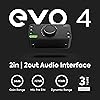
Audient EVO 4 USB Audio Interface

Based on 911 reviews
Condition: New
Checking for the best price...
$158.00
Save $111.99 was $269.99

Buy Now, Pay Later


As low as $26.33 / mo
  • – 6-month term
  • – No impact on credit to apply
  • – Instant approval decision
  • – Secure and straightforward checkout

Ready to go? Add this product to your cart and select a plan during checkout.

Payment plans are offered through our trusted finance partners Klarna, Affirm, Afterpay, Zip, Apple Pay, and Google Pay. No-credit-needed leasing options through Acima may also be available at checkout.

Learn more about financing & leasing here.

Free shipping on this product

FREE 30-day refund/replacement

To qualify for a full refund, items must be returned in their original, unused condition. If an item is returned in a used, damaged, or materially different state, you may be granted a partial refund.

To initiate a return, please visit our Returns Center.

View our full returns policy here.


Availability: Only 1 left in stock, order soon!
Fulfilled by Amazon

Arrives Saturday, Oct 31
Order within 16 hours and 19 minutes

Available payment plans shown during checkout

Protect Your Purchase

Easy claims online, fast replacements, no fees

Checking for protection plans...

At a glance

Condition
New
Model
EVO4
Dimensions
2.64"D x 5.51"W x 2.64"H
Weight
0.6 kg
Supported Software
ios
Operating System
Windows
Audio Input
USB
Warranty
3 year manufacturer.
Works with
Personal Computer

Features 5

  • Compatible OS: MacOS, Windows, iOS (requires USB hub that can be powered) / 2 x EVO microphone pre
  • High Definition High Performance AKM Converter/Sample Rate: 24bit/96kHz/Smart Gain
  • Smart touch point/JFET instrument input/speaker output/headphone output
  • Super Rotency / Loop Back Function / USB 2.0 Bus Power / +48v Phantom Power

Description

Audient EVO 4 Audient EVO 8 Audient EVO 16 Audient EVO SP8 Can I use a Phantom Powered Microphone with EVO 4? Yes! Both of the EVO 4 preamps can provide 48V phantom power for use with condenser microphones. Can I connect the EVO 4 to a USB-A port or a USB-C port? The EVO 4 is entirely bus powered and will work with either a USB A or USB C port. Does the EVO 4 have enough gain for low output microphones such as the Shure SM7B? With 58dB of gain on each preamp, there’s more than enough gain to drive microphones such as the SM7B. Will the EVO 4 have enough power to driver my high impedance headphones? The EVO 4 features a powerful headphone amp, that can drive headphones all the way up to 600 ohms and greater! Will the EVO 4 work on iOS and iPadOS? The EVO 4 is class compliant, meaning you can run this with your iOS devices for recording on the go.

Specs 16

Brand Audient
Supported Software ios
Connectivity Technology USB
Number of Channels 2
Operating System Windows
Audio Input USB
Maximum Sample Rate 96 KHz
Item Dimensions D x W x H 2.64"D x 5.51"W x 2.64"H

Frequently asked questions

If you place your order now, the estimated arrival date for this product is: Saturday, Oct 31

Yes, absolutely! You may return this product for a full refund within 30 days of receiving it.

To initiate a return, please visit our Returns Center.

View our full returns policy here.

  • Klarna Financing
  • Affirm Pay in 4
  • Affirm Financing
  • Afterpay Financing
  • Zip Pay in 4
  • Financing through Apple Pay
  • Financing through Google Pay
Leasing options through Acima may also be available during checkout.

Learn more about financing & leasing here.

Top Amazon Reviews


Powerful interface nicely bridging the gap between pro and consumer audio
Audient has packed the EVO 4 with quite a lot of functionality for such a small box. It has far more use cases than I will probably ever scratch the surface of... but that's okay because it didn't cost me an arm and a leg to get all the extras. The cheapest XLR to USB interface you can really find that's worth getting is probably the Blue Icicle which is half the price of the EVO 4 - but all it does is convert and amplify the analog signal to digital. With the EVO 4 you get that plus a second XLR input channel, a JFET instrument input, and 1/4in TRS stereo out for speaker/headphone monitoring. Additionally, you can mute the channels by long pressing the numbered buttons. The smart gain feature is a great innovation for getting levels set up quick during your sound check without having to worry about the possibility of clipping. I occasionally will pick up one of my two guitars, so it is nice to now have a device that makes it very simple to record if I ever find myself improvising something that I'd like to remember how to play later. My primary use is just as the interface for my XLR microphone for communication purposes while online gaming and it comes crystal clear through the preamps on this device with low to no background noise being picked up. I don't have any kind of sound treatment in the room I use it in and the sound from my PC tower fans are not even noticeable recording at 75% to 80% gain. The same set of LEDs around the digital knob in the center relay various information such as volume control, monitoring L/R balance, and when your input device is in use - the levels it is reaching for the channel you selected. If it lights up the right most LED then you are probably getting clipping and have the gain set too high. Audient provides access to the compact DAWs Cubase (PC/Mac) and Cubasis (iOS) LE 2 and some VST synthesizers if you register your product on their site, which is a nice set of freebies for some aspiring songwriters or producers to add to their arsenal. The only complaint I know people have is that you can't use speakers and headphones for monitoring at the same time, because plugging in headphones will automatically mute the speaker output channels, but this doesn't really affect me personally for how I'm going to be using it. You get 2 recording channels but it's worth noting that the EVO 4 creates an input selection that mixes those together as 1 channel for you if you'd like, plus provides both mono and stereo loopback channels for recording your PC's audio output. The 1/4 TRS JFET input routes only to channel 1, and it takes priority over XLR port 1 and thus automatically mutes that signal when in use. Overall, I don't think you can go wrong with this unit if you just need to record a couple of mics for a podcast, or vocals and an instrument for your original music or a cover song. It may be overkill if you want to use it for something like teleconferencing for work because let's face it, most people aren't going to notice how much better your microphone sounds than everyone elses'. But hey, someone might and they can be your second new best friend, after the EVO 4. ... show more
Reviewed in the United States on May 5, 2020 by Steve

This little device is premium, and offers so much at a great price.
This is my 3rd interface in 20 years. My first was an M-Audio Mobile Pre, and the second was a UA-25ex by Roland. When I get something that works, I use it until it no longer does. The UA-25 was great for it's time, but it has never had support for Windows 10 (no official drivers), and was dropping out several times on a daily basis. I have a decent PC and it shouldn't have been a problem. While searching for a new interface, I came across overwhelmingly positive reviews of the Evo 4, so I picked one up, and have no regrets. For context, I make beats and record vocals, and use Studio One as my main DAW. One of the main, if not the only, complaints that came up in every single review I watched was the build quality. Honestly, it isn't bad at all. It isn't steel like most of the more well known, or even common interfaces these days. It's plastic, but sure doesn't feel like plastic. My Mobile pre was plastic, and you could tell it was plastic just by looking at it. I've plugged both my XLR cable/mic into it, and headphones, they all snap in very nice and secure. The Evo also feels really heavy. It has a nice weight to it. So please don't let the complaints of the build quality turn you off. The device drivers are working well, which is probably the most important thing to me next to the sound quality itself. Both the Mobile Pre and UA 25 stopped receiving driver support and ended up giving me trouble. I have not had a single drop out, and have done some recording as well, with no issues at all on the Evo 4. There is also companion software which can be used to update the firmware. This is a modern interface indeed. Hopefully, they will continue to support the device on future versions of Windows. Feature wise, the interface has a couple of punches that I like: smart gain, which automatically sets the gain of an input based on the incoming signal, and smart mute, which mutes the main output when headphones are connected. I tried out the smart gain, and got great results. It was also really easy to do: push the green button, then the input channel you are recording into, and the green button again. It will then set the gain, which you can adjust when it's finished. I like the smart mute, as a solo artist, because I was always forgetting to turn off my monitors before recording vocals. I could see how that would not benefit an engineer, or any case you needed to monitor on speakers while someone else had headphones in. The sound quality is great. I don't really know much about pre amps, dac, and all the technical stuff that goes into an interface, so I had to take what reviewers said about it, and it's definitely a selling point across the board. Especially for the price. Input monitoring works fine, with controls to mix the signals. The other interface I was looking at had input monitoring, but no mixing control, unless you bought the next version up. Finally, the overall design of the device is interesting as mentioned. There are no dedicated knobs. Just one knob that will control the signal based on the button pressed. I was concerned I wouldn't like it as it so not traditional to any other device on the market, or one I was familiar with. However, it is so easy to use, and will not be a problem. I also like the big dial on the top, that also has led lights that act as a gain meter to both input and output signals. So I have no complaints on the design. TLDR: For the price, this interface is unbeatable. You get great sound quality, with an excellent feature set. More than enough to get you started and stay within a tighter budget. Build quality is fine, despite reviews. Of course steel is always better than plastic, but this feels very premium. This is my first Audient product, but I would definitely buy from them again. ... show more
Reviewed in the United States on July 19, 2021 by C.W.

Perfect for a small home studio
The Audient EVO 4 is an amazing interface for its price. Super clean preamps, zero-latency monitoring, and a compact design that fits perfectly on a small desk. The Smartgain feature is very convenient — just press one button and it sets the input level automatically. Build quality feels solid, and the sound is transparent and detailed. Ideal for producers, vocalists, and musicians working from home. Highly recommended! ... show more
Reviewed in the United States on October 27, 2025 by David

The best budget audio interface!
Go to any music forum and ask about music recording and budget interfaces, and you'll get tons of answers - "just get a Focusrite 2i4" or "don't waste your money on cheap interfaces and buy <insert expensive interface here>." Those people have never heard of Audient. I've had many interfaces over the years, from MOTU, to Focusrite, and many others budget and expensive. But I decided to scale down from my Focusrite 18i20 to an iD14 after hearing some rave reviews over the unit. The dreams of using my home studio to record big projects never really took off, and my studio is quite noisy anyway, so a ton of microphones never really suited my needs - a couple stereo inputs was ample. The iD14 blew me away. It was clearer, cleaner, and more natural sounding than interfaces I had used that cost multiple times as much. But this is a review for the EVO 4. Compared to the iD14, it doesn't have the Burr Brown AD/DA converters, but... dang. It sounds every bit as good. Inputs are clear and natural. Once you get used to the relatively simple interface the device has, you have everything you need easily. And the auto-gain settings are actually quite good, especially in an age where you don't have to reach near-clipping to get a clean signal. It does lack per-channel phantom power (it's either always on or always off), but, unless you're trying to pair a condenser mic that requires it and a dynamic mic that doesn't, that's not a huge deal. It also lacks XLR/combo jack outs, so you do need to use a TRS cable to connect your monitors - again, not a dealbreaker, but be aware of how your monitors connect. You also won't find pad switches for the inputs, which, in a recording environment, really isn't that huge of a deal either, as long as you can control the output volume of your devices. That said, any of those things could be a dealbreaker to those that need it - in which case, I'd say to look at the iD line of interfaces. The EVO 4 documentation also says it will not work without a powered USB hub, but I've gotten it to work easily (though without phantom power) with my iPad Pro 1st gen 12.9" with the camera connection kit. I only have a few issues with the EVO 4, which is why it only gets 4 stars instead of 5. First, upon taking it out of the box, it does have a very heavy glue-like smell. That goes away pretty quick, but it is a bit off-putting. Second, the form factor is kind of terrible for using as a permanent desk interface - it's almost too tall, and, because it's plastic and lightweight (which does make it great for travel), cables can easily pull on the unit or weigh it down. Third, a neat trick is that, if using it with a Mac (I cannot confirm on a PC), it works natively with the volume up and down buttons, which is really awesome, but it doesn't respond at all to the mute button. Lastly, I'd love some kind of control over the LEDs on the device itself - having it always showing the output is a bit distracting with the bright white LEDs (vs. dimmer green/yellow/red LEDs on other devices), and that feature cannot be turned off or even dimmed. The iD14 still remains my primary recording and listening interface, but the EVO 4 will hold a place in my bag of tricks for recording on the go (either with my laptop or iPad) or as a backup due to it's easy-to-use interface, smaller and lighter form factor, and excellent sound quality. ... show more
Reviewed in the United States on February 4, 2021 by nope

For a budget audio interface, this does the job really well!
I think it's clear that one has to get their expectations to be realistic. If you're expecting this $140 unit to be exactly as good as one of the industry leaders that costs five to ten times as much, you'll probably be let down. If you need a very specific monitoring setup that this device does not support, it makes little sense to try and save money here, and you should just purchase another device that does do what you need. That being said, for stereo recording from two microphones, this device does the job very well, with a relatively clean signal and fairly simple software. I use it in a fully mobile recording setup with a MacBook Air M1 running Big Sur and Logic Pro in a concert hall with orchestral musicians to produce symphonic backing tracks for a variety of applications, and it's exactly what I was looking for. Small, simple, and bus-powered. I have a variety of nice microphones available to me these days, but am happy with the results that I get from even inexpensive mic pairings like the Audio-Technica AT2020 cardioid condenser and the MXL R144 ribbon, and for my music students who are getting into recording for the first time, they are able to put together a functional setup for their machines for under $400 including the interface, mics, cables, and stands. ... show more
Reviewed in the United States on January 16, 2021 by Gene Wie

Really clean
I am impressed by the clean pre amps found here. The unit is minimalistic in all aspects but really easy to use if you have some experience. Mind you I bought this as my portable set up interface and I do have a much larger Apogee in my studio and I can say in terms of sound quality this little unit is not too far behind. It gets the job done and provides all the sound qualities a professional set up requires. Only little drawback is the plastic construction although I must point seems sturdy enough but I would prefer metal enclosure. The autogain feature provides help in some instances but in my experience so far it is not usable for every application and requires, when used, mixing treatment and mastering to optimize the final levels. That being said it helps in the gain staging process. The unit is an excellent buy if you are careful with your gear, if you are a bit rough then I would suggest to get something built with metal enclosure. ... show more
Reviewed in the United States on November 21, 2022 by Ραμσουέ Λόπεζ Τόρρες

Big Dial = Big Deal
If you plan to use for Zoom/Facetime calls having that big dial to quickly adjust Mic output is really great. I just crank it down when I want my mic not hot. As far as I can tell this is the only such device (other than one by zoom) with this set-up. I also use this to record voice-over with an AT4040 mic and it's very quiet and easy to use on my Mac. I have also plugged in a guitar and keyboard to test it and that also works well. Drives my Sony MDR-7506 phones just fine but may have trouble with certain headphones. Overall, I love this thing. If I was using exclusively for music I may have gone Motu though. ... show more
Reviewed in the United States on November 9, 2020 by Andrew M.

Faulty drivers, zero support from Audient = useless product
've spent 5 months or so with an EVO-4 due to my Metric Halo setup not being 3D yet and not compatible with my M1 Mac Mini. The EVO 16 appears to have the same drivers and hardware so my comments should apply here... The EVO unit has a persistent and extremely annoying problem with crackling noises. Specifically when I'm listening to quiet sounds, like a soloed piano track with space in between the notes. I've seen other users mention this in reviews of the EVO 16. At first I thought the drop outs were being caused by CPU spikes or something but no, it consistently only happens with quiet sounds, even in a project with a single low-CPU vst, as others have experienced. The only other major flaw, in my view, is the fact the headphone jack disables the line/monitor outputs. I do not like having to constantly unplug/plug in the headphones to switch between cans and my monitors. And this also makes it impossible to use the outputs as line outputs for other purposes besides monitors while using headphones at the same time. Therefore, the EVO-4 cannot be used silently with my Sub Pac. I also cannot send audio to an external hardware FX processor while monitoring with headphones, NOR while using studio monitors (since there's only 2 line outs...). Essentially rendering the unit useless for this application. Because the headphone jack is hardwired to mute the line outs, the potential utility of the device is reduced (significantly!) in a way that could have been easily avoided. On the positive side, putting aside these two MAJOR problems, the unit is very nice. Love the form factor, the knob and visual feedback is fantastic. The AD/DA conversion quality itself (crackling aside) is fine, not a hugely noticeable downgrade from my Metric Halo units which is basically a compliment considering the difference in price. The inputs are nothing fancy but perfectly fine for tracking synths. If the unit performed it's basic function as a competent DAC, I'd be willing to let the headphone jack thing slide and be a happy customer. Unfortunately, that is not the situation. The crackling issue described earlier is a fatal flaw preventing the device from reliably performing its most basic essential functions, rendering the EVO-4 virtually useless for serious purposes of any kind. Even for basic personal use, the crackling is so annoying that it significantly interferes with my creative process. A MAJOR distraction that makes basic critical listening tasks virtually impossible. Been attempting to resolve the crackling issue with Audient support for months now with nothing to show for it. They responded at first, but after I sent them my computer's system report and described the issue in detail, they stopped responding. I have sent them 4 emails in a row, (all very polite) and even opened a new ticket, which I know they saw because they merged it with the original support ticket, but still no response. They are ignoring me. My speculation is that this is probably a known issue that they do not intend to resolve. Perhaps they somehow do not consider it a problem, but rather a "compromise" I'm apparently supposed to accept? Maybe due to embarrassment, they can't be bothered to send me a message informing me as much? I found another user who said he had a beta version of the firmware which resolves my problem. I was able to obtain the update file from this user. However, there are no instructions online on how to perform a manual firmware update! They say to "contact support" to receive instructions on manual firmware updates. I know from my previous experience that attempting to do so will likely be a dead end, since they are already ignoring me. If it weren't for this problem I'd consider it a 9/10 product for the price, and I'd be strongly considering purchasing the EVO 16. However, with the crackling issue unresolved, the product barely even qualifies as functional in my eyes, knocking the score down to a 2/10. This negative experience has convinced me that I'm going to have to spend a bit more and purchase a new audio interface from a manufacturer known specifically for high quality audio drivers in particular. Clearly, this is the most crucial feature in any audio interface. None of the other features matter in the slightest if the unit cannot perform its basic function of outputting sound reliably, without glitching and without being made obsolete by new trends in computer data ports. (as has happened with my firewire-dependent Metric Halo interfaces...) Since Metric Halo 3D cards are still out of stock indefinitely (and because 3D actually seems to have remained in beta for 6+ years!...) I'm looking at selling my MH LIO-8 2D, MH 2880 2D and the Audient EVO-4, and replacing them all with an RME FireFace UCX II. Hopefully then my audio interface woes will be solved for good. ... show more
Reviewed in the United States on October 20, 2022 by Dylan Reznick
Checking for best price...