
Search  for anything...

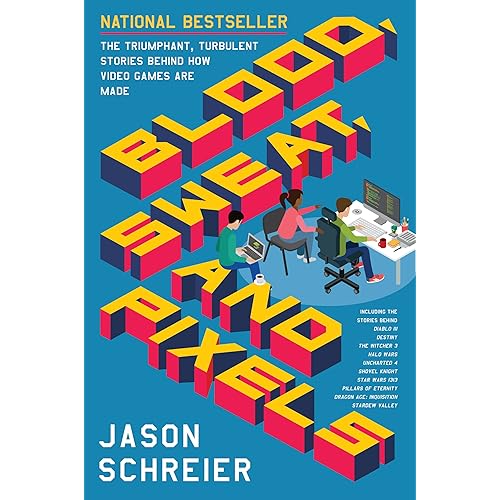
Blood, Sweat, and Pixels: The Triumphant, Turbulent Stories Behind How Video Games Are Made

  • Based on 5,355 reviews
Condition: New
Checking for the best price...

Buy Now, Pay Later


As low as $6 / mo
  • – 4-month term
  • – No impact on credit to apply
  • – Instant approval decision
  • – Secure and straightforward checkout

Ready to go? Add this product to your cart and select a plan during checkout.

Payment plans are offered through our trusted finance partners Klarna, Affirm, Afterpay, Zip, Apple Pay, and Google Pay. No-credit-needed leasing options through Acima may also be available at checkout.

Learn more about financing & leasing here.

Free shipping on this product

This item is eligible for return within 30 days of receipt

To qualify for a full refund, items must be returned in their original, unused condition. If an item is returned in a used, damaged, or materially different state, you may be granted a partial refund.

To initiate a return, please visit our Returns Center.

View our full returns policy here.


Availability: 20 left in stock
Fulfilled by Audible,

Arrives Oct 29 – Nov 2
Order within 21 hours and 9 minutes
Available payment plans shown during checkout

Protection Plan Protect Your Purchase
Checking for protection plans...

Description

Developing video games—hero's journey or fool's errand? The creative and technical logistics that go into building today's hottest games can be more harrowing and complex than the games themselves, often seeming like an endless maze or a bottomless abyss. In Blood, Sweat, and Pixels, Jason Schreier takes listeners on a fascinating odyssey behind the scenes of video game development, where the creator may be a team of 600 overworked underdogs or a solitary geek genius. Exploring the artistic challenges, technical impossibilities, marketplace demands, and Donkey Kong-sized monkey wrenches thrown into the works by corporate, Blood, Sweat, and Pixels reveals how bringing any game to completion is more than Sisyphean—it's nothing short of miraculous.Taking some of the most popular, bestselling recent games, Schreier immerses listeners in the hellfire of the development process, whether it's RPG studio Bioware's challenge to beat an impossible schedule and overcome countless technical nightmares to build Dragon Age: Inquisition; indie developer Eric Barone's single-handed efforts to grow country-life RPG Stardew Valley from one man's vision into a multi-million-dollar franchise; or Bungie spinning out from their corporate overlords at Microsoft to create Destiny, a brand new universe that they hoped would become as iconic as Star Wars and Lord of the Rings—even as it nearly ripped their studio apart. Documenting the round-the-clock crunches, buggy-eyed burnout, and last-minute saves, Blood, Sweat, and Pixels is a journey through development hell—and ultimately a tribute to the dedicated diehards and unsung heroes who scale mountains of obstacles in their quests to create the best games imaginable. Read more

Listening Length ‏ : ‎ 7 hours and 58 minutes


Author ‏ : ‎ Jason Schreier


Narrator ‏ : ‎ Ray Chase


Publication date ‏ : ‎ September 5, 2017


Language ‏ : ‎ English


Publisher ‏ : ‎ Harper Paperbacks


Version ‏ : ‎ Unabridged


Program Type ‏ : ‎ Audiobook


Best Sellers Rank: #17,904 in Audible Books & Originals (See Top 100 in Audible Books & Originals) #8 in Entertainment Industry #15 in Video & Computer Games #20 in Computer & Video Game Strategy Guides


Frequently asked questions

If you place your order now, the estimated arrival date for this product is: Oct 29 – Nov 2

Yes, absolutely! You may return this product for a full refund within 30 days of receiving it.

To initiate a return, please visit our Returns Center.

View our full returns policy here.

  • Klarna Financing
  • Affirm Pay in 4
  • Affirm Financing
  • Afterpay Financing
  • Zip Pay in 4
  • Financing through Apple Pay
  • Financing through Google Pay
Leasing options through Acima may also be available during checkout.

Learn more about financing & leasing here.

Top Amazon Reviews


  • Accessible to avid and casual gamers alike. Highly recommended.
Format: Paperback
"Oh, Jason," he said. "It's a miracle that any game is made." Finally, a book that captures the complexity of game development that anyone can pick up and enjoy. Jason Schreier of Kotaku spent two years traveling around the world to score in depth interviews with the industry's most renowned gaming studios. Drawing from sources speaking both on and off the record, Blood, Sweat, and Pixels provides a rare glimpse into the pain and passion that go into bringing a modern video game to market. In ten absorbing chapters Schreier covers the downright grueling development process behind such hits as Blizzard's Diablo III, Naughty Dog's Uncharted 4, CD Projekt Red's The Witcher 3 and, of course, Bungie's Destiny. Speaking of Destiny, it was Schreier's crucial 2015 exposé that laid the groundwork for this wonderful little book. (Portions of his chapter on Destiny are taken directly from that article.) As fans of the blockbuster series will remember, that Kotaku piece brought Destiny's murky origin story to light. Importantly, it provided the necessary background for understanding how the company that gave us Halo could have produced — at least at launch — such a lackluster title. Subpar development tools, a strained relationship with publisher Activision, and the complete reboot of the story (following the departure of lead writer Joe Staten) a year out from release had much to do with it. As a source tells Schreier, “A lot of the problems that came up in Destiny 1...are results of having an unwavering schedule and unwieldy tools." What we learned then from Scheier's keen reporting, and what comes across clear as day in his first book, is that making games is incredibly hard and almost impossibly demanding. Harder, perhaps, than any other creative medium. Thanks to their interactive nature and sheer potentiality, games are capable of delivering the boundless, memorable experiences we've come to love. But it's those same elements that make them such a chore to create, even for seasoned veterans. One of the designers at Obsidian (of Fallout: New Vegas fame) he interviews puts it this way: "making games is sort of like shooting movies, if you had to build an entirely new camera every time you started." Indeed, the tools and technologies used to develop the latest games are constantly in flux, as is the creative vision of the producers and directors at the top. A change in either area can prove hugely disruptive to the overall process — a process that hinges on pushing a marketable product out the door by an agreed upon deadline. It's that constant give and take between concept and technology, between developer and publisher, that defines the medium. Internal conflicts can also run a project off course. Artists and programmers might spend months, years even, sketching and coding characters, environments, quests, set pieces and combat mechanics, only to see it all thrown out as a result of higher-ups taking the game in an entirely different direction. When Naughty Dog replaced Uncharted 4's creative director Amy Hennig in 2014 — roughly two years into the game's development — the story was more or less scrapped. That meant that cut scenes, animation, and thousands of lines of recorded voicework on which the studio had already spent millions of dollars got the axe, too. For an artist emotionally invested in their work, this can be heartbreaking and demotivating. In other cases, such as the abortive Star Wars 1313, a decision by the publisher can bring it all crashing down. As Scheier recounts in the closing chapter, LucasArts, formerly a subsidiary of Lucasfilm, began work on a new action-adventure Star Wars game in 2010. The game debuted at E3 in 2012 to wide critical acclaim. Shortly afterward, the company was acquired by Disney. By 2013, Disney had shuttered the studio and canceled every one of its projects. For all the work the dedicated crew at LucasArts poured into their pet project, Star Wars 1313 was never meant to be. Given the many technical hitches, logistical nightmares, corporate pressures, and unforeseen obstacles that threaten success, it's no small wonder that any games are shipped at all. As Schreier points out, there's hardly a game on the market today that doesn't run up against insane crunch periods and dramatic setbacks over the course of its development. Whether it's a small team working on a 2D side-scroller à la Yacht Club Games' Shovel Knight or a massive effort spread across hundreds of staff in the case of BioWare's Dragon Age, producing a quality game in today's highly competitive environment is by any measure a herculean effort. Virtually every insider consulted for the book talks about how taxing the job can be on one's physical health and personal relationships. Burnout is common. And even with working around the clock for months on end — often sans overtime pay, as it's not required in the US — games rarely come out on time. Delays and cancellations are a feature, not a bug. To be sure, any successful career in game development is built on passion and an enthusiasm for creating unique playable spaces, but it's one that comes with significant costs that only the truly dedicated may be equipped to endure. Closing Thoughts Leave it to Jason Schreier to shatter any utopic notions about game development. Behind the glossy visuals and destructible environments we take for granted on screen lies a hellish landscape of Sisyphean creative challenges and brutal working hours. As the title suggests, Blood, Sweat, and Pixels constantly reminds us that game production is as much about self-sacrifice as it is about crafting quality interactive experiences. And if these breezy oral histories are any indication, it's a principle that holds true whether you're a bootstrapped indie developer beholden to Kickstarter donors or a lowly cog in the big-budget corporate machine. Schreier is a most welcome guide, bringing more casual readers up to speed on esoteric conversations ranging from rendering paths and game engines to bug testing and content iteration times. It's a testament to his talents that the book never seems to flag, even when exploring games I didn't particularly care about. While I wish Schreier had ventured more deeply into the ethics of crunch culture, his penchant for meticulous, well researched investigative journalism is on full display here. If you have even a passing interest in gaming be sure to pick this one up. I came away with a better understanding of the personal sacrifices and creative compromises that appear to go hand in hand with making video games, and a newfound perspective on increasingly commonplace monetization strategies like paid downloadable content (PDLC) and microtransaction (MTX) systems. Above all, it left me with a more profound appreciation for my most cherished hobby. ... show more
Reviewed in the United States on February 16, 2018 by Daniel Bastian

  • Recommended for those interested or involved in the game development industry
Format: Paperback
I've been making games for 10+ years as an independent game developer, doing freelance work and working on my own projects. I knew a bit about what went on in larger studios, but I still learned a lot from this book. It was really interesting and enlightening hearing all the different stories behind the development of all 10 games that were covered. Even though I'm glad I read it, I found the writing to be unrefined. Information is sometimes presented out of order in a way that feels awkward. I recall a point where the book spoke about an E3 demo going really well which raised the developers' spirits, but two paragraphs later the book revealed that the E3 demo was actually heavily scripted which made the developers feel uneasy. There was also quite a bit of redundancy, especially between chapters, but not exclusively. The book assumes you know nothing about video game development, or even computers (it explains what RAM is). This is great for people who are just curious about the industry, but it somewhat limits how much of the nitty gritty the book could really cover. However, it may have struck about as good a balance as one could hope for. The book is carried by the compelling behind the scenes stories that Jason Schreier got access to, not the writing. As such, I found the introduction to be weak in comparison to the rest of the book. He did do a reasonable enough job though, and I'm glad he decided to put in the effort to make this book. Despite its flaws, I'd still recommend this book to anyone remotely interested in game development. You'll learn a lot about the industry, and it's only around 270 pages long. ... show more
Reviewed in the United States on March 14, 2019 by Cory M.

  • Must read for any creator
Format: Paperback
I often find journalism boring. And I find it far between good articles when it comes to game coverage. But in Blood, Sweat, and Pixels there are 10 excellent chapters covering the challenges, triumphs, and defeats in the making of 10 different games. There are two things, in my opinion, that make this book great. The first thing is Schreier's fantastic writing style. Schreier focuses on individuals and their tale in the creation of a game, making it very close and personal to read. It's not about a big, ambiguous organisation you can't identify with. It's a hot blooded human like you, and Schreier mixes description and dialogue in a way that makes them all come alive. Secondly, Schreier masters the element of curiosity and teasing. He tells the story slowly, constantly teasing that something is about to happen, making you gobble up page after page just to know what happens next. Schreier also has a knack of opening and closing each chapter in an excellent way. This is by far two of the hardest elements in writing. Sucking the reader in, and delivering an ending you can agree on, that leaves you with a feeling of satisfaction. Schreier opens and closes ALL 10 chapters to an A+. That is extraordinary in my opinion. So... Besides Schreier's excellent writing, each chapter is uniquely interesting and never boring, because the games, people behind them, and the circumstances are so different. The chapter on Stardew Valley focuses on the story of an one-man army, starting from scratch, and follows his adventure and obstacles to make a game he wanted to play himself. The chapter on Diablo 3 focuses on the weight of carrying the legacy of the legendary Diablo 2, how things can go very wrong, and the fight to turn the ship around and re-imagine Diablo 3 into what it should have been from the start. Each chapter is just so different and interesting. Some game developers fight with impossible deadlines, others try to free themselves of the shackles of their publisher, others make promises they suddenly have to deliver on, and others simply yearn for creating something new, instead of doing the same game over and over again. I must say this is the best book I have read in a long time. If you need inspiration, and maybe feel a bit helpless in your own creative struggle, regardless of your chosen field, this book will remind you that you are not alone, and regardless if you make it or not, that it is well worth the effort spent. 5 out of 5. Please read this. And a big thanks to you, Mr. Schreier. ... show more
Reviewed in the United States on September 28, 2017 by Martin Jul Hammer

  • I don't know how this book is exhilarating, but it is.
Format: Kindle
... I mean, I actually pumped my fist in the air and said "YES!" when reading the reactions of those plucky Polish upstarts when they finally got the validation of having their industry-changing, bar raising efforts validated by the rest of the gaming world. C'mon, it's great stuff! Schreier is one of the few - what I would consider - "true" journalists covering video games today, in the sense that he actually investigates and corroborates his stories among multiple sources. Taking that into consideration and coupling it with the skill to deliver those stories so well is a solid part of why this book is so good. I've got a few years of game development in my past at studios both gargantuan and tiny, and that gave me enough background to be able to connect to these stories in a meaningful, touching, and even a little bit nostalgic, way. I don't expect the book to have the same impact on everyone as it did me, but I can assure you that each chapter rings true, and comes across as authentic. There's no hyperbole here in the descriptions of just how grueling crunch can be. Jason does a good job of relating the varied stories clearly, without interjecting his own views or opinions. He realizes these stories aren't his to share through his own lens, but instead that they belong to the developers who experienced them. As such, he keeps his views largely out of the way, serving simply as the conduit through which the devs' experiences can be delivered directly to us. And he manages to do so in a highly readable style. I still haven't decided if ending the book with the last two chapters in the order that he did is a master stroke, or a bastard stroke though. Reading about the heights of triumph for CD Projekt RED, only to tumble down through the tragedy of LucasArts as a finisher truly is a rollercoaster. It sucks to have ended on such a note, but it elicits an emotional response that, I suppose, goes to show just how deep the book's hooks were in me. It's left me feeling like there needs to be some reconciliation, some sense of completion, like a melody ending halfway through its last measure, as opposed to ending on a high, uplifting note. But that's the nature of game development - it doesn't always have a happy ending. Still though, I guess that means he better get started on the next collection of stories sooner rather than later. Heaven knows there's certainly plenty more game dev successes and tragedies to be told. I stopped pre-ordering games a long time ago, but is it too early to pre-order Schreier's next book? ... show more
Reviewed in the United States on November 3, 2017 by Rawdge

  • Very good
Format: Paperback
only done 2 chapters but I'm hooked. Each chapter is a game title and revolves around that games development but the story is told in an enjoyable way so it doesn't feel like you're reading an educational book
Reviewed in the United States on August 29, 2026 by Kyle

  • Interesting Book
Format: Kindle
I read this as a new entrant in the video games industry curious about the stories of other games. It was an easy read and helpful in understanding risks video game projects endure, but I was warned ambiguously by coworkers that it sometimes 'shows only one side' or expresses 'a sensational version of events'. I personally appreciated footnotes that indicated when people mentioned declined to be interviewed. I imagine that piecing together history largely from interviews naturally comes with certain challenges. Regardless, I enjoyed the book and got what I was looking for out of it. I was expecting more clarity around the magnitude of crunch, and maybe a bit of analysis around the drivers (beyond attempting to hit an arbitrary date when delivering a game). The factors were certainly there, but in anecdotal evidence as opposed to analysis. In fact, for what it's worth, this book was not designed to analyze - it's focused on telling the stories of games as told by timelines and interviews. I'd say its target audience is the average gamer who would be curious about the history of their favorite game. From that lens, it was certainly an exciting, if a potentially incomplete, look behind the veil. ... show more
Reviewed in the United States on November 26, 2018 by E. B.

  • I REALLY hope there's a followup!
Format: Paperback
I gotta say, I'm a sucker when I comes to a biography or documentary. ESPECIALLY one that delves into the world of game creation. I'm a avid read of Kotaku, so when this gem popped up in the "about me" at the end of a Jason Schreier article, I knew I had to check it out! I will say that I'm not typically as interested in the "AAA" game development process as I am an indie game, but these chapters give enough information that I found reading those almost as interesting. But that's me,...nothing to do with Jason's writing style. That beings said, my two favorite chapters were "Stardew Valley" and "Shovel Knight". I'll admit, Stardew Valley really isn't my style of game (I tried it once), but the story behind it was amazing! Also, Shovel Knight I've never actually played, but this book made me get the game, so it does a really good job there! Each chapter tells a different story of the "creation" of a particular game. It doesn't go into all the details about what programs are used of where the workers got start in the industry (does tell backstories of a few during different chapters, but no particulars). It basically starts from where the game idea began and how it unfolded,...for better or worse. I can only hope that Jason Schreier continues with more of this in the future. I'd love to hear about Five Nights at Freddy's, Ori and the Blind Forest, and Inside! Final Verdict: If you enjoyed Indie Game: The Movie, this is a must read! If you enjoy reading anything about the creative process of video games, this is a must read! You know what, just read it! You won't be disappointed! ... show more
Reviewed in the United States on December 29, 2017 by ahoffoss

  • ... often happens behind the scenes of some of our favorite games. The torturous
Format: Kindle
Jason Schreier's treatise on the crazy world of game development pulls back the curtains on what often happens behind the scenes of some of our favorite games. The torturous, complicated, and turbulent world of making a video game is put on display, as we get an insider's glimpse of the politics, the people, and the industry. Most people are unaware of how difficult it is to actually bring a game to market successfully, let alone realizing that doing so usually requires many weeks, if not months, of 80- to 120-hour workweeks for entire teams of people. After finishing the book, the tagline for ABC's iconic Wide World of Sports from the 70's seemed to fit perfectly for the developers, engineers, artists, designers and product leads that gave so much - "the thrill of victory, and the agony of defeat." Jason Schreier is news editor for the gaming website Kotaku, and has also provided articles related to video games to major media outlets, such as Wired, the New York Times, and the Onion. As such, he is able to provide a knowledgeable take on the subject, deftly walking the line between explaining concepts and situations for the uninitiated that most gamers would already know, and still being fascinating and interesting to both. His writing is solid, and easy to follow. Schreier's book consists of the in-depth story behind the making of 10 popular video games. Often the stories read like fiction, with heroes and villains, twists and turns, sacrifices of unbelievable proportions, and evil empires, er, corporations. Sometimes they end good, sometimes not. And sometimes your not sure. You'll have to decide if the price paid by all involved is worth the final product. Because the price is often more than you realize when you boot up your favorite game for a few minutes of escapism. Even though I've given the book a 3 rating, please don't take this as meaning it is a bad book. Quite the contrary. On my scale this means it is still very much worth your time. But at the end of the day, it reads like 10 very good separate, but thinly related, articles, as opposed to a strong and deep book. --------------- I noticed Amazon and Goodreads have a slightly different meanings to their 5-point scale. I thought it was odd to have a different rating for the same book on two different sites, so I came up with my own scale below. For the record, it is fairly close to Amazon's scale, but allows me to be consistent between the two sites. 5 - Fantastic. Life-altering. Maybe only 25 in a lifetime. 4 - Very good. 3 - Worth your time. 2 - Not very good. 1 - Atrocious ... show more
Reviewed in the United States on June 1, 2018 by J. Foster

Can't find a product?

Find it on Amazon first, then paste the link below.
Checking for best price...