
Search  for anything...

Hantek 2D72 Handheld Oscilloscope 70MHz Waveform Generator Multimeter 3 in 1 Multifunction Tester 2CH+AFG+DMM

  • Based on 269 reviews
Condition: New
Checking for the best price...
$178.59 Why this price?
Save $9.90 was $188.49

Buy Now, Pay Later


As low as $29.77 / mo
  • – 6-month term
  • – No impact on credit to apply
  • – Instant approval decision
  • – Secure and straightforward checkout

Ready to go? Add this product to your cart and select a plan during checkout.

Payment plans are offered through our trusted finance partners Klarna, Affirm, Afterpay, Zip, Apple Pay, and Google Pay. No-credit-needed leasing options through Acima may also be available at checkout.

Learn more about financing & leasing here.

Selected Option

Free shipping on this product

FREE 30-day refund/replacement

To qualify for a full refund, items must be returned in their original, unused condition. If an item is returned in a used, damaged, or materially different state, you may be granted a partial refund.

To initiate a return, please visit our Returns Center.

View our full returns policy here.


Availability: Only 6 left in stock, order soon!
Fulfilled by Amazon

Arrives Friday, Aug 28
Order within 13 hours and 25 minutes
Available payment plans shown during checkout

Protection Plan Protect Your Purchase
Checking for protection plans...

Style: 70MHz 2CH+DMM+AFG


Features

  • No Standalone lithium batteries are sold with the product
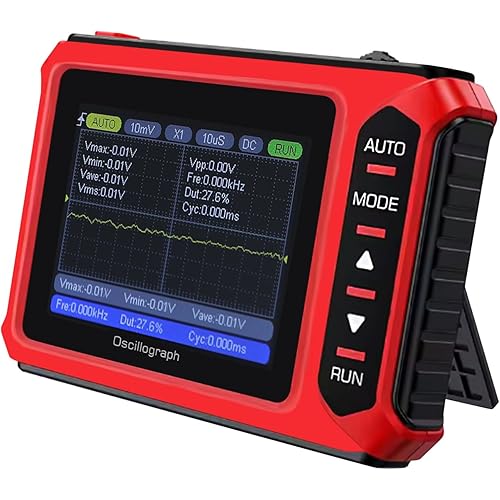
  • Multifunctional Handheld Oscilloscope70MHz bandwidth with 2CH channels. 250MSa/s sampling rate for Single-channel and 125MSa/s for Dual-channel. 10mV-10V vertical resolution for waveform generator. Competent in voltage, current, resistance, diode, capacitance, and continuity tests of AC/DC.
  • 3 in 1 Automotive OscilloscopeOscilloscope, multimeter, and waveform generator all in one. Features automatic frequency and amplitude measurements, cursor measurement auto-calibration waveform recording functions, and overload protection.
  • User-friendly InterfaceVersatile functions with an easy-to-read display and intuitive controls. Switch to different modes and functions swiftly with simple buttons. Automatic adjustment with Auto Set Key, which can adjust the horizontal and vertical scales as well as trigger coupling, type, position, slope, level, and mode automatically.
  • Solid HardwareEquipped with a high-resolution LCD screen that stays clear under bright light. The one-piece shell can resist strong impacts and heat. The retractable stand allows convenient placement in any working scene.

Description

Automatic Measuring Function Adjustable Key Tone Adjustable Backlight Brightness and Duration Adjustable Auto Power-off Time Digital Voltmeter Function One key page out, quick compare two groups of reference waveforms + 6 groups of waveforms storage Available for DC/AC Available for voltage, current, resistance, diode, capacitance and continuity tests ATTENTION: There's a film on the screen, where scratches may be present. Please peel it off before use. 250MSa/s Sampling rate, 12 bits vertical revolution; Generates 4 kinds of waves; Sine: 1Hz~25MHz Square: 1Hz~10MHz Triangular: 1Hz~1MHz Trapezoid: 1Hz~5MHz Frequency Revolution: 1Hz Output impedance: 50Ω Oscilloscope powerful functions Waveform generator(only for 2D42 and 2D72) Multimeter We are a measuring instrument salescompany that insists on service andseeks quality products at low pricesfor our customers around the world.We found Hantek, whose equipmentwas a perfect match for ourphilosophy. Now, we work closelytogether, and with this seriousnessand persistence, we are now theleading distributor of the Hantekbrand in terms of sales volume onAmazon, and will continue to provideexcellent service to our customers.

Brand: Hantek


Power Source: Battery Powered


Style: 70MHz 2CH+DMM+AFG


Color: Black


Item Weight: 400 g


Power Source: Battery Powered


Measurement Type: Multimeter, Voltmeter


Style Name: 70MHz 2CH+DMM+AFG


Color: Black


Item Weight: 400 g


Item Dimensions: 3.94 x 7.87 x 1.57 inches


Specification Met: General Safety and Quality Standards


Brand Name: Hantek


Model: 2D72


Manufacturer: Hantek


Part Number: FBA2D72


Frequently asked questions

If you place your order now, the estimated arrival date for this product is: Friday, Aug 28

Yes, absolutely! You may return this product for a full refund within 30 days of receiving it.

To initiate a return, please visit our Returns Center.

View our full returns policy here.

  • Klarna Financing
  • Affirm Pay in 4
  • Affirm Financing
  • Afterpay Financing
  • Zip Pay in 4
  • Financing through Apple Pay
  • Financing through Google Pay
Leasing options through Acima may also be available during checkout.

Learn more about financing & leasing here.

Top Amazon Reviews


  • Basic Features, but excellent specifications for the price
Style: 70MHz 2CH+DMM+AFG
TLDR: This is a scope with basic features but comes in at a very low price and (unlike many other cheap scopes) the core hardware meets the advertised specs. A good second scope, in my view. OK as a first scope if portability and price are critical aspects. Specifications Getting a true bandwidth measurement requires equipment that I do not have. I do have an OK 50 Mhz generator though and see little attenuation (well under 3 db) when feeding in a 50 Mhz signal. Photos of 1Mhz and 50Mhz are attached for comparison. I would say that the specified 70 Mhz analog bandwidth should be easily achieved. That said, with 250 Msamples/sec, I'd say 50 mhz is a good practical limit for single channel or 25 Mhz dual channel (125 Msamples/sec when dual channel). That's application-specific as it depends on how many samples-per-cycle you consider acceptable. Signal Generator The optional signal generator is basic but it performs its functions well. Attached photos include: - 1 Mhz sin 2V Pk-Pk driving a 50 Ohm load. Looks great. - 25 Mhz sin wave (the limit) with the same specs. A bit of attenuation but not bad. - 1 Mhz square wave with the same specs. Looks excellent with no ringing. I also measured rise time at 6.5 ns, which is excellent considering it's an overall system measurement (cables, oscilloscope, etc) - 10 Mhz square wave (the limit). As expected, it's starting to fall apart a bit at the limit. - An example arbitrary waveform: If you connect PC software, you can program your own waveforms but I have not tried. Overall PROs - Portability. Useful for applications like cars, appliances or other field applications. - It meets its specifications: Note that there is a lot of false advertising from competitors at this price point. - Price: It's very low, but watch for inflated sales prices. - Build Quality: Very impressive at the price point. They even include a nice carrying case and a bunch of useful accessories. You only get one proper probe but a second one will only cost $10 or so. - Not grounded. A bench scope is grounded which is a mixed bag in that you need to be mindful of what the ground clip touches when measuring grounded equipment (i.e. don't try measuring grounded equipment). With this Hantek, the common is floating so you are ok doing low voltage work (high voltage work still needs a differential probe for safety). Also note that the two channels of this scope are not isolated from one another (again, a differential probe is needed for this application). - Multimeter. The multimeter is basic, but it has what you need for most work. I compared it against my Fluke 115 and Brymen 869 and all three agree with one another. - Signal generator (depending on the model): See above - 18650 cells. That means cheap/easy replacements when the batteries are ready to be retired. You are giving up (verses a bench oscilloscope): - Memory depth limited to 6000 points (or 3000 per channel). This is very little memory compared to a benchtop scope. It's ok for viewing live waveforms but you don't get a nice history function, no magnify feature and there is not enough memory for quality XY plots. - Triggering and signal stability not to the level of my bench scope. Still usable. - Limited triggering. You get rising, falling, and either edge. No holdoff time. - Limited Automatic Measurements: You just get the basics of live frequency, min voltage and max voltage. No rise time, pulse width, etc. No statistics over time. - Screen is small: The smaller screen helps portability, but larger screens are nicer to work with. - Interface is more clunky. I don't think this is a deal breaker but there is more menu diving and multiple button presses to complete common tasks. Benchtop scopes generally have similar interfaces to each other so once you learn one you can mostly drive others. This one doesn't work the same so you'll need to look over the manual. - Serial decoding - no CANN, I2C, SPI, etc. These are really useful but you can get a second dedicated device relatively cheaply to cover these cases. - No FFT, although many bench FFTs are a bit of a gimmick as well. ... show more
Reviewed in the United States on September 19, 2020 by Matthew Wachowski

  • Fantastic portable system.
Style: 70MHz 2CH+DMM+AFG
Where has this been my whole career. This does 90% of what I need when making electronics prototypes and is also fantastic in the field. Hantek, thank you for making such a fantastic portable system that is accessible price wise.
Reviewed in the United States on June 20, 2026 by Johnny

  • Useful
Style: 70MHz 2CH+DMM+AFG
Update: Somehow I recently discovered and then purchased the Owon HDS272S. Credit to Hantek for creating this market segment but Owon is clearly the better buy right now. Though there are some pros and cons. Hantek Pros: -More rugged feeling -Bigger semi-rigid case (Owon case barely fits accessories) -A couple AWG operating points the Owon can’t do (faster square wave) Owon Pros -Bigger screen, more memory, faster waveform updates -Faster and better interface overall -More measurements, better measurement display -AWG can go to lower voltages -Lower noise on small signals (see picture) -Better DMM, fused current Old Review: I'm a EE who designs circuit boards and uses scopes regularly. I've used other Hantek handhelds, Siglent and expensive Tek and Agilents. I finally decided to buy a scope for myself and this is what I chose. Knowing I don't have much time for home project I didn't want to spend much. For the price and features (AWG) this looked like a good start. If I ever added a bench scope this would still be useful (battery scope are isolated by nature which can be a big benefit). I spent a little time comparing this scope to 1Ghz Agilent and have some takeaways. Overall the waveform generator is solid up to the allowed frequencies. The Sin attenuation at 25MHz was maybe 30% (expected) and the waveform looked good. Square wave had some overshoot but solid rise times (compared to period) at 5Mhz. Overall pleased with the AWG. The scope performance was ok except for one main issue. My unit has a frequency dependent offset problem that's worse on channel 1. As the measured frequency increases above 1Mhz an offset develops. When the Agilent scope was reporting a +/-2.8V sin wave the Hantek was saying +3V/-2.6V. I saw this problem playing with the scope alone but wasn't sure if it was the scope or AWG until comparing against the Agilent- it's the scope and further experimenting showed its worse on one channel. Self cal didn't fix it. Otherwise scope performance isn't bad. The trigger isn't as solid as I'd like - its always jumping between 2 pixels. Low amplitude performance (0.1V sin wave) compared decently against the Agilent and overall amplitude accuracy across frequency (up to the AWG 25Mhz max) matched the Agilent well (setting aside the above mentioned offset error). Functionality is simple and covers the bases well enough. Its disappointing there aren't more measurements like RMS (measurements are all or nothing and there are only 3 each) but otherwise It's not missing much I was expecting. Using it is easy enough with a few quirks (I can never remember what up/down does vs left/right). Overall I'm happy I bought this and its a useful tool. If it wasn't for the previously mentioned offset problems and a couple other quirks (sketchy unfused 10A DMM current) it would get 5 stars. As it stands this is 3-4. I'm giving it 4 for the value. Final tip, if you're on the fence probably go with the 42Mhz version. With this sample rate the higher bandwidth will rarely be useful (and not possible when simultaneously sampling 2 channels). ... show more
Reviewed in the United States on July 13, 2021 by Chris

  • Wish I found this unit years ago.
Style: 70MHz 2CH+DMM+AFG
Great device with a lot of little things other units I tested just did not have or work very well. It has rechargeable battery's that are easy to get to and replace and find online. Unlike some units in this price range you can use all 3 modes at the same time. The AUTO mode works great while still letting you tweak things to your liking. The user interface is super easy but still gives you a lot of options. Double click a button pops up menu 0-9 so you can type in the freq and so on. No need to hold down for ever to get from 20 to 20k. You can recharge the batt and use the unit at the same time. !! DANGER, you are EARTH GROUNDED when charging with a pc or charger with 3 prong power plug !! !! PLEASE read up on this on YT before you charge and use at the same time !! This was my 4th unit that I tested before finding this unit and I love it. The others just had too many little things missing or a PITA user interface and NON-user replaceable rechargeable battery's or non-rechargeable battery's. ... show more
Reviewed in the United States on September 19, 2020 by KC8DKT

  • Electronics Lab in a Box!
Style: 70MHz 2CH+DMM+AFG
This thing is really the cats meow for HF ( 3-30MHz ) ham radio projects. I immediately put it to work when it came in the door. For what it does, the size is amazing. I can do casual electronics experimenting on my desk without piling it high with equipment. And having it battery powered is a real plus - you don't have to worry about frying it with ground loops. The UI is a little strange, but one quickly gets used to it. I love the measurements capability built into the oscilloscope - you don't have to peer at the waveform and count divisions to find out the frequency of something. The waveform generator is also very handy, especially since you can apply a DC offset to its output. One small niggle - there is no scope calibrate pin. But with a built-in waveform generator, who needs it? It's not QUITE pocket size - pretty chunky. And there is an OWON one now with slightly better specs. Bigger screen. ... show more
Reviewed in the United States on February 3, 2022 by Jerome Kaidor

  • 2D72: Amazing capabilities for the price, some limitations, many bugs, lack of support
Style: 70MHz 2CH+DMM+AFG
The scope has many bugs, including Roll mode failing to meet gain specs even after the lengthy 3 minute autocalibration, and often failing to trigger even in AUTO mode. The website provides poor guidance and support, and shows that users have long been asking for patches and updates, to no avail: https://www.eediscuss.com/forum.php?mod=viewthread&tid=13676 The firmware update utility does not work: It replaces the file on the computer with the file in the scope, the opposite of what it should do! Oddly enough, their latest firmware download is less than half the size of the firmware that is already in the scope. ----- SCOPE FUNCTIONS: It can't do the advanced functions of a bench scope, for example it can invert channels, but it can't add them. Other than that, it has a decent feature set and performance. ----- PAN and ZOOM: Freeze a waveform by pressing the [ |>] button, then press the [Time] button and use the arrow keys to scroll the waveform to the left and right, beyond what is normally shown on the display. This can also be done with a live display, but the display is re-triggered every time a key is pressed. ----- BANDWIDTH: Clarification of specifications: - 40 or 70 MHz (depending on model) is BW when used with 10x probe. - 6 MHz is BW when used with probe set to 1X. - 20 MHz is BW when Bandwidth Limit is turned on, to filter noise. - 10 Hz is low frequency cutoff when AC Coupling is used. ----- AWG: The function generator is DDS. It can be set to generate a waveform, and then it can be measured with the scope or the DMM. If you order without the FG option, it puts out a fixed 1kHz for probe calibration. ----- 3 GROUNDS: Scope and Function Generator share the same ground, while DMM and USB-C port each have their own grounds. There is no information on how much voltage can be applied between the various grounds. ----- DMM: Performance is poor, though readings are more accurate than on the scope, with slow settling of readings compared to a good DMM. There is no min/max or averaging function. ----- SCREEN RESOLUTION: I was concerned about the display being only 320x240, but then realized that like most scopes, this one only has 8-bit resolution (256 steps), so 240 is quite appropriate if the waveform can fill the screen. The horizontal resolution of 320 is somewhat dealt with since most traces can be panned left and right beyond the edges of the display once they are frozen. ----- RETURN TO SCOPE MODE: You can set the function generator to output a waveform, then measure it with the DMM or Scope. Note though, that every time you leave and return to Scope mode, the scan is cleared and retriggered (unless a frozen waveform is being displayed). ----- WAVEFORM MEMORIES: There are 6 memories to store waveforms. These store the data with the scale settings, so they can be viewed and panned and zoomed, with correct display of V/div and s/div. These waveforms can only be viewed one-at-a-time, and cannot be viewed with the live/frozen waveform. ----- REFERENCE MEMORIES: There are 2 memories to store reference waveforms. These only store the shape of the plot. One or both of these can be viewed together with the live (or frozen) waveform, for direct comparison. While the live (or frozen) waveform can be adjusted horizontally and vertically, the reference waveforms are static bitmaps. ----- ALIASING: The sampling rate varies depending on the s/div settings. There is no filtering in the instrument to avoid aliasing. With both channels active, if you view a 1kHz sine wave at 100us/div you will get a bit over one period of a clean sine wave, as expected. The sinewave will be clean up to 2ms/div. At 10ms/div the amplitude starts pulsating. At 50ms/div the waveform keeps changing between zero and full amplitude. At 100ms/div and slower it looks like a mostly clean 0.02 Hz waveform, with occasional discontinuities. ----- LONGEST SAMPLING TIME: The scope can do 12 divisions at 500s/div, for a total of 1 hr. 40 min., at 1 sample/s (single channel) or 0.5 sample/s (2 channels). ----- AUTOCALIBRATION: This is a lengthy 2.5 minute process, though it does calibrate all ranges of the scope, not just the presently used range, as most bench scopes do. It appears to do a zero calibration only, not a gain calibration, at least in Roll mode. ... show more
Reviewed in the United States on February 13, 2021 by H. Bustani

  • Works great. AWG goes only to +2.5V
Style: 70MHz 2CH+DMM+AFG
It meets the specs. The only issue is that the AWG range is -2.5V to +2.5V. That meets the 5Vpkpk, but you cannot set an offset or 2.5V to have a range of 0V - 5V, which is ok for most applications. +2.5V is not enough for many applications. But, it is battery operated and the usb ground is isolated. So, you can use an external power supply as offset as a workaround. As a cheap field battery operated scope this unit is great. As a lab scope this does not work, but that is not the intended application. ... show more
Reviewed in the United States on March 15, 2023 by Pedro

  • Terrific Value--read downloaded manual first!!!
Style: 70MHz 2CH+DMM+AFG
Some internet complaints for the DMM involve speed of finalizing a reading. This meter is auto ranging, so it takes longer for value to stabilize, but once the numbers stop shifting, that is the final reading and it is accurate when compared with Fluke. Can be used to avoid earthground loop short because it is battery operated. Can also use generator AND oscilloscope at the same time. Just read manual on how to do it. ... show more
Reviewed in the United States on August 26, 2021 by George Kerutis

Can't find a product?

Find it on Amazon first, then paste the link below.
Checking for best price...