



Search  for anything...

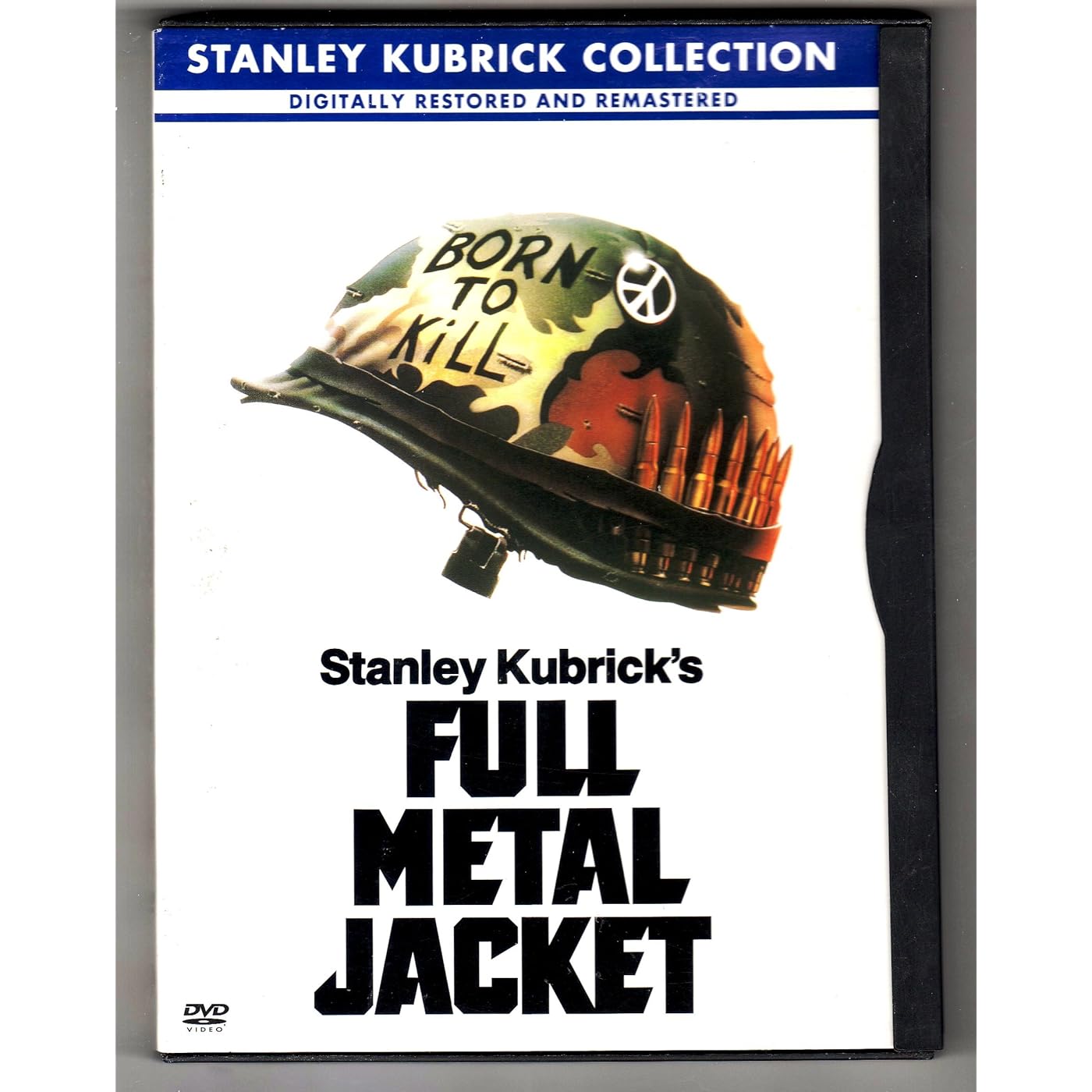
Full Metal Jacket

  • Based on 19,332 reviews
Condition: Used - Good
Checking for the best price...
$6.94 Why this price?
Save $11.05 was $17.99

Buy Now, Pay Later


As low as $1 / mo
  • – 4-month term
  • – No impact on credit to apply
  • – Instant approval decision
  • – Secure and straightforward checkout

Ready to go? Add this product to your cart and select a plan during checkout.

Payment plans are offered through our trusted finance partners Klarna, Affirm, Afterpay, Zip, Apple Pay, and Google Pay. No-credit-needed leasing options through Acima may also be available at checkout.

Learn more about financing & leasing here.

Selected Option

Free shipping on this product

This item is eligible for return within 30 days of receipt

To qualify for a full refund, items must be returned in their original, unused condition. If an item is returned in a used, damaged, or materially different state, you may be granted a partial refund.

To initiate a return, please visit our Returns Center.

View our full returns policy here.


Availability: Only 1 left in stock, order soon!
Fulfilled by ThriftBooks-Baltimore

Arrives Oct 24 – Oct 26
Order within 23 hours and 10 minutes
Available payment plans shown during checkout

Protection Plan Protect Your Purchase
Checking for protection plans...

Format: DVD January 1, 1987


Description

The story of an 18-year-old marine recruit named Private Joker - from his carnage-and-machismo boot camp to his climactic involvement in the heavy fighting in Hue during the 1968 Tet Offensive.

Format: Color, Full Screen, NTSC, Original recording remastered, Widescreen


Contributor: Adam Baldwin, Arliss Howard, Dorian Harewood, Ed O'Ross, Gustav Hasford, John Terry, Kevyn Major Howard, Kieron Jecchinis, Kirk Taylor, Matthew Modine, Michael Herr, R. Lee Ermey, Stanley Kubrick, Tim Colceri, Vincent D'Onofrio See more


Language: English


Runtime: 1 hour and 56 minutes


Studio: Warner Home Video


Aspect Ratio ‏ : ‎ 1.331


MPAA rating ‏ : ‎ R (Restricted)


Product Dimensions ‏ : ‎ 7.5 x 5.5 x 0.5 inches; 1.6 ounces


Item model number ‏ : ‎ P-48411


Director ‏ : ‎ Stanley Kubrick


Media Format ‏ : ‎ Color, Full Screen, NTSC, Original recording remastered, Widescreen


Run time ‏ : ‎ 1 hour and 56 minutes


Release date ‏ : ‎ January 1, 1987


Actors ‏ : ‎ Adam Baldwin, Dorian Harewood, Matthew Modine, R. Lee Ermey, Vincent D'Onofrio


Dubbed: ‏ ‎ French


Frequently asked questions

If you place your order now, the estimated arrival date for this product is: Oct 24 – Oct 26

Yes, absolutely! You may return this product for a full refund within 30 days of receiving it.

To initiate a return, please visit our Returns Center.

View our full returns policy here.

  • Klarna Financing
  • Affirm Pay in 4
  • Affirm Financing
  • Afterpay Financing
  • Zip Pay in 4
  • Financing through Apple Pay
  • Financing through Google Pay
Leasing options through Acima may also be available during checkout.

Learn more about financing & leasing here.

Top Amazon Reviews


  • Always worth watching
Legend!!!!!
Reviewed in the United States on July 23, 2026 by Lt. Dan 846

  • Classic!
Not the best acting in the world, but this is still a classic war movie. Love you, Longtime! 🤣
Reviewed in the United States on July 7, 2026 by Sondra E. Wagoner

  • Soft Core in a Hard Package
When I teach my film classes, I find that Kubrick (along with Hitchcock) is one of the most misunderstood filmmakers of the last century. Why is an essential component of this filmmaker (as well as others) lost in the translation? Part of it seems to be the separation between film history/criticism in the United States, where film enthusiasts seem content with the film alone, and forget that, prior to the internet, movies existed within a network of criticism that extended from the Westcoast Studios to the Eastcoast critics, and stretched overseas, where brilliant essayists like Truffaut were able to pick apart the latest offerings in the pages of the Cahiers du Cinema. These filmmakers used the theater as an extension of a critical dialogue that helped explain their core philosophies; the New york Critics and European Essayists were really cinematic linguists who helped to make sense of the "linguistic" complexity of a medium whose essential grammar seems to be more or less intuitive, both concrete and abstract. The transition to more escapist fare (at least in the late 70s studio Hollywood system) has meant a transition in the critical world as well; with the popularity of the Cinematic Essayist waning in the last 20 years, being instead replaced by schtick and the "every man" approach to film reviews, and a cruel thumbs-up, thumbs-down approach -- more or less a symptom of our collective attention deficit. While these approaches are necessary, the lack of educated "cinematic linguists" is resulting in the loss of understanding when it comes to our most important filmmakers, of which Kubrick is undoubtedly one. For instance, it surprises most people to know that one of our most important stylists considered himself to be an "objective director." Kubrick's minimalist, nuanced, distanced style is really the product of his core philosophy which was to "observe" rather than to "impart." Kubrick aligned himself with documentarians who used aesthetic restraint in crafting ethnographic narratives. In fact, if you really study the man -- his writings, his interviews -- you will find that his entire career was really a quest for cinematic truth. He constantly struggled against his own interpretation and impressions of events, to try to give a multi-faceted view of reality and drama, of which he believed that narrative itself was really an unnatural hallucination imposed on a series of random events by the mind's need to rationalize and organize. Kubrick struggled against not only studio narrative -- the classic three-act structure -- which he found predictable and as pedestrian as an overly familiar nursery rhyme; but he also resisted the narrative of the mind, its need to simplify, reduce, and impose. Even more than that, Kubrick struggled against the medium itself. In an interview, Kubrick opined about the need to import rocks onto the set of Full Metal Jacket, to acquire the realism he knew would be beyond his reach with simulation. Sounding a lot like Jorge Luis Borges speaking about the problems of a truly realistic map, he explained the natural processes that would go into the formation of those rocks, with which Hollywood verisimilitude just could not compete. Importing those rocks is proof of Kubrick's devotion to objectivity, which he felt was constantly compromised and corrupted by the cinematic medium itself (never mind that those rocks existed on a fabricated sound stage in London -- but Kubrick's philosophy on realism/formalism was always filled with contradictions). It's interesting to note that critical interpretation of Stanley Kubrick largely fails because it excludes the man's own take on his own material. Never being one to shut down another's opinion, Kubrick nevertheless had very strong and opinionated feelings about his own films, opinions that seem incredibly out-of-step with popular interpretation of his work. I would like to remind the reader (whoever has been kind enough to stay with me thus far), an obvious fact, that will seem more obvious in retrospect -- Kubrick had a lifelong fascination with the propagandistic nature of cinema as well as the theme of social brainwashing. A better word for brainwashing is "conditioning" as it's broader and encompasses what Kubrick felt was the most consistent theme running throughout the entirety of his work. Kubrick was obsessed with how man's psyche could be conditioned -- through media, through government, through aristocracy, through peer pressure, etc. And in the end, he was fascinated by the struggle between an individual's innate nature and the outside, coercive forces that threatened to eliminate his nature or suppress it once and for all. "Full Metal Jacket" has the observationalist impulse of a documentary, the lyric quality of silent cinema, the rigorous technical prowess of Max Ophuls, and the elliptical, bifurcated narrative of an art house movie. In light of these influences, "Full Metal Jacket" is less an unconventional, frustrating war movie, than a logical realization of Kubrick's core aesthetic principles as applied to the Viet Nam conflict. That being the case, what unites the two "halves" of Full Metal Jacket is the theme of "social conditioning." A soldier is like a full metal jacket -- his outer shell is formed by a rigid, brutalizing, indifferent, nearly industrial process, and yet, somewhere beneath is the soft material that can prove pliant and powerful in the wrong hands. Viewed from this perspective, the second half of "Full Metal Jacket" is not as off-putting as some have unfairly suggested. For those who are intimately familiar with the man's philosophies, the "second half" is a natural consequence of the first half, and succeeds brilliantly in emphasizing Kubrick's fascination with man's duality -- a duality that becomes more apparent in a sustained and prolonged conflict between two national dualities. (If you really want insight into the work of Kubrick or other filmmakers, do not divorce them from their influences, or their own philosophies which exist in interviews, private notes, and other secondary and third sources). ... show more
Reviewed in the United States on October 19, 2011 by Oh Boy, the Po Boy

  • Marine Corps Old School Training
Great movie along with excellent performances my Drill Sergeant & cast. Highly recommended for those who would like to see old tradition Marine Boot Camp.
Reviewed in the United States on September 19, 2026 by AnthonyMD

  • Good movie
Very good movie
Reviewed in the United States on September 15, 2026 by RC

  • I hope they're just kidding, I ain't ready for this--
Before Full Metal Jacket was released on HD DVD, I refused to watch it because for some reason Stanley Kubrick's intentions were to distribute it in Full Screen rather than the way it was filmed in Widescreen on DVD. Now that the HD DVD version is released and in Widescreen I finally got a chance to see the film, and I'll tell you my thoughts. This is one of the most realistic war movies I've ever seen. It's about 2 hours long in length but it feels like an hour. It shows how kids were broken down and built back up into killing machines. Some of the things they say can be disturbing when describing their rifle. The movie will often shock you, make you laugh, and depress you. Lee Ermey will blow you away with his role as Gunny Hartman the drill sargent. Visually, this is a so-so picture. While most of the film has a decent clarity, there is also an undeniable amount of grain during parts of the film. This isn't because it's an HD DVD, it's also the same case with the Blu-Ray version. HD DVD's have an incredible reputation with visual clarity, Blu-Ray on the other hand... well, I suppose this title fits in perfectly with other Blu-Ray movies when it comes to visual clarity. Warner Brothers could have done more than they did, perhaps in the distant future it'll be revisited. However, since the film is so good and absorbing and finally seeing it in Widescreen with some high definition at all makes it an incredible experience. Overall, if you're just getting an HD DVD player all I can say is that there's many other titles that have a groundbreaking showcase of high definition BUT if you want a movie that's truly a classic and will blow you away with the lack of real visual clarity at times, this movie is it. ... show more
Reviewed in the United States on December 29, 2006 by Hank

  • Best Vietnam era movie ever made.
Being the filmmaker genius that he was, Stanley Kubrick hired R. Lee Ermey as a technical advisor to get the Basic Training scenes correct. One day at his office Kubrick asked what a drill Instructor should look like. Ermey obliged and his performance led to a lead role. Most accurate portrayal of Basic Training life in the 60's. ... show more
Reviewed in the United States on August 2, 2026 by LGP

  • Great Movie...True Account (rumored from vets) and Oh Yes of Course R. Lee. Ermey!!!
Even though Kubrick is (was) a serious anti-Vietnam proponent and critic of U.S. intervention, from what I'm told from Vietnam Vets (I have to rely on their testimonies because I wasn't even born when Vietnam transpired---I just study the conflict), this movie is one of the most accurate depictions of the conscriptions of cadets to their actual deployment to Vietnam. R Lee Ermey, obviously gave such a truthful account of how drill instructors were during that time, that he is now a virtual immortal wet dream in the wannabes' cult imagination...and a nostalgic throwback, for today's top military brass, to the golden days when the Marines were "true killers" and the military didn't have politeness procedures so, as not to offend, "hold overs" for prima donnas and was an institution that was deadly serious. I think that as an actual Gunnery Sgt., Sgt. R Lee was prophetic enough to fortell the comming total "screw job" of lax policy, anti-american politicians, general disdain and neglect for the US Armed Forces, corruption and horrible political correctness that has infiltrated the US Miltary in general since Vietnam. I passed all of my military batteries with excellent scores but, I probably couldn't have made it through BCT with a D.I. like Ermey (Sgt. Hartman) because, I would not have been able to keep a straight face or hold my breath long enough to avoid “crackin up” at some of his expositives;( I didn't finalize my US ARMY enlistment or deploy either-- I decided to finish graduate school and move to Germany instead). Nonetheless...R Lee is really the only reason that people continue to watch and love this film but, it became truly substantive with the company's grueling and riveting entrance into the grim reality-scapes of Vietnam especially, when the sniper conflict became apparent. I still watch this movie pretty regularly for the aesthetics; even though the military is nothing like this account currently, (Sorry...but even the Marines have become P.C. and a little softer over the past decade), it is still definitely Class A work and worth the watch. If the U.S. Military and the U.S. Marines can get "born again hard" on the bottom line, they may return to a proxy like this account and any future prospective cadets should know and be prepared for the protocols and customs that they will be confronted with in B.C.T. ... show more
Reviewed in the United States on January 8, 2017 by Carluccio Viscera LeGrand

Can't find a product?

Find it on Amazon first, then paste the link below.
Checking for best price...