
Search  for anything...

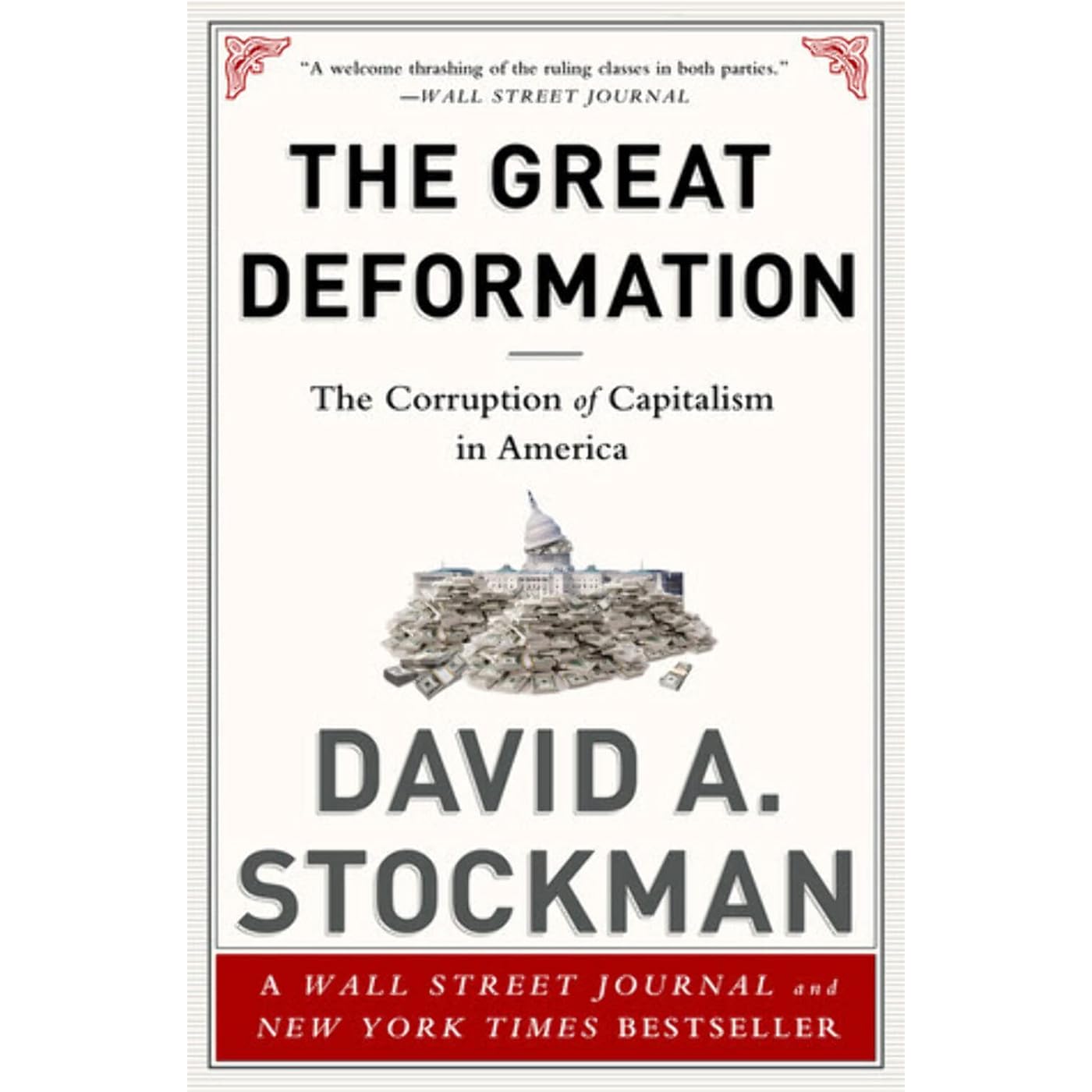
The Great Deformation: The Corruption of Capitalism in America

  • Based on 0 reviews
Condition: New
Checking for the best price...
$30.95 Why this price?
Holiday Deal · 12% off was $35.00

Buy Now, Pay Later


As low as $7 / mo
  • – 4-month term
  • – No impact on credit
  • – Instant approval decision
  • – Secure and straightforward checkout

Ready to go? Add this product to your cart and select a plan during checkout.

Payment plans are offered through our trusted finance partners Klarna, Affirm, Afterpay, Apple Pay, and PayTomorrow. No-credit-needed leasing options through Acima may also be available at checkout.

Learn more about financing & leasing here.

Free shipping on this product
This item's return window has been extended for the holiday season: FREE refund/replacement until Jan 31, 2026

To qualify for a full refund, items must be returned in their original, unused condition. If an item is returned in a used, damaged, or materially different state, you may be granted a partial refund.

To initiate a return, please visit our Returns Center.

View our full returns policy here.


Availability: Only 1 left in stock, order soon!
Fulfilled by Amazon

Arrives Friday, Jan 2
Order within 11 hours and 16 minutes
Available payment plans shown during checkout

Protection Plan Protect Your Purchase
Checking for protection plans...

Description

A New York Times bestseller The Great Deformation is a searing look at Washington's craven response to the recent myriad of financial crises and fiscal cliffs. It counters conventional wisdom with an eighty-year revisionist history of how the American state—especially the Federal Reserve—has fallen prey to the politics of crony capitalism and the ideologies of fiscal stimulus, monetary central planning, and financial bailouts. These forces have left the public sector teetering on the edge of political dysfunction and fiscal collapse and have caused America's private enterprise foundation to morph into a speculative casino that swindles the masses and enriches the few. Defying right- and left-wing boxes, David Stockman provides a catalogue of corrupters and defenders of sound money, fiscal rectitude, and free markets. The former includes Franklin Roosevelt, who fathered crony capitalism; Richard Nixon, who destroyed national financial discipline and the Bretton Woods gold- backed dollar; Fed chairmen Greenspan and Bernanke, who fostered our present scourge of bubble finance and addiction to debt and speculation; George W. Bush, who repudiated fiscal rectitude and ballooned the warfare state via senseless wars; and Barack Obama, who revived failed Keynesian “borrow and spend” policies that have driven the national debt to perilous heights. By contrast, the book also traces a parade of statesmen who championed balanced budgets and financial market discipline including Carter Glass, Harry Truman, Dwight Eisenhower, Bill Simon, Paul Volcker, Bill Clinton, and Sheila Bair. Stockman's analysis skewers Keynesian spenders and GOP tax-cutters alike, showing how they converged to bloat the welfare state, perpetuate the military-industrial complex, and deplete the revenue base—even as the Fed's massive money printing allowed politicians to enjoy “deficits without tears.” But these policies have also fueled new financial bubbles and favored Wall Street with cheap money and rigged stock and bond markets, while crushing Main Street savers and punishing family budgets with soaring food and energy costs. The Great Deformation explains how we got here and why these warped, crony capitalist policies are an epochal threat to free market prosperity and American political democracy. Read more

Publisher ‏ : ‎ PublicAffairs


Publication date ‏ : ‎ April 2, 2013


Edition ‏ : ‎ First Edition


Language ‏ : ‎ English


Print length ‏ : ‎ 768 pages


ISBN-10 ‏ : ‎ 1586489127


ISBN-13 ‏ : ‎ 20


Item Weight ‏ : ‎ 2.46 pounds


Dimensions ‏ : ‎ 6.5 x 2.25 x 9.75 inches


Best Sellers Rank: #1,097,736 in Books (See Top 100 in Books) #437 in Economic Policy #589 in Economic Policy & Development (Books) #1,151 in Economic History (Books)


Frequently asked questions

If you place your order now, the estimated arrival date for this product is: Friday, Jan 2

Yes, absolutely! You may return this product for a full refund within 30 days of receiving it.

To initiate a return, please visit our Returns Center.

View our full returns policy here.

  • Klarna Financing
  • Affirm Pay in 4
  • Affirm Financing
  • Afterpay Financing
  • PayTomorrow Financing
  • Financing through Apple Pay
Leasing options through Acima may also be available during checkout.

Learn more about financing & leasing here.

Top Amazon Reviews


  • Excellent, but only if you have an open mind and an economics background
Format: Hardcover
If you are someone with a strong political party identity or hold a strong identity with the economists Keynes or Friedman, you will hate this book! However, if you are open to hearing about how modern economic theory has failed us when put to practice in a world where real political actors exist, then this is for you. Stockman painstakingly describes the history of the Federal Reserve, the Great Depression, Nixon's end of the gold standard, and how our departure from sound money practices has over time allowed the US to have "deficits without tears" and has allowed our financial system to become a highly leveraged casino that is increasingly prone to crisis. The hubris of monetarists and Keynesians in thinking that the government could manage our economy either through monetary policy or through deficits/taxation (in other words, thanks to the government, we no longer need Adam Smith's "invisible hand" of the market!) has led to a number of consequences that neither Friedman nor Keynes anticipated - that is the hijacking of our Treasury and central bank by the lobbyists of K Street to rob the public purse and the transformation of our banks into casinos where losses are covered by the taxpayer. The government's spending and taxation policies and the central bank's monetary policies have caused large economic deformations in our economy that have sent the middle class deeply into debt while their wages have been stagnant or even declining in real terms, but letting them "feel richer" by inflating the prices of their homes and other assets while cutting their interest payments (a trend that will soon reverse). In the meantime, US corporations have not been making the investments in equipment, R&D and other productive assets because Wall Street has been strip mining companies in leveraged buyouts. Wall Street and the board rooms of large coroporations have been the major beneficiaries of these deformations as they have learned how to game the system, and Stockman explains in detail the various means they have used to benefit from these distortions. Many of us sense that the US is on an unsustainable fiscal path and that our financial system is rigged. Even if the deficits do drop down to 4% of GDP in 2013, deficits cannot and should not run indefinitely and there is no one in Washington who is seriously talking about getting the budgets balanced. Here we are five years after the financial crisis of 2008 and after the Dodd-Frank bill that was supposed to restore stability to our banking system, and the Shadow Banking System has returned to a point where even Fed Chairman Bernanke has acknowledged its renewed risk to our economy (which has the irony of a Columbian drug cartel leader warning about the dangers of drugs). This book explains the history of how we got to this strange but dangerous place. In addition to pointing out the villains in this saga (Economists Milton Friedman, J. M. Keynes, Fed Chairmen Arthur Burns, Alan Greenspan, Ben Bernanke, Presidents Franklin Roosevelt, Johnson, Nixon, Reagan, and George W. Bush and members of cabinets Casper Weinberger, George Schultz, and LBO king Mitt Romney) who did not envision where the path would lead (Friedman and Keynes) or simply sold out for short-term gain (Nixon, Johnson, Roosevelt) or to assert their power (Weinberger) or were blinded by ideology (Greenspan, Bernanke, Schultz, Reagan) he also points to the heroes. These heroes (Senator Carter Glass, Presidents Truman, Eisenhower, Kennedy, Ford, Clinton, and Fed Chairmen Paul Volker and William McChesney Martin and others) tried to keep us on a path of sound money and balanced budgets. In addition to Stockman's excellent writing skills, this is what makes this book interesting - there are real characters that he describes, and Stockman's knowledge of government and the budgetary process, as well as his experience from the financial industry along with explanations supported by data and analysis, enable him to provide insights to what really happened in a way that few can or frankly want to. This book provides the reader a historical perspective that I don't think exists anywhere else. It will also make you worry, and for good reason, how to protect yourself from the inevitable financial disaster that is waiting for us. The book, while providing a historical perspective, is not in chronological order. Chapters address themes and draw parallels or contrasts from different periods in time. As a result, some of the reviewers have mentioned that the book appears to jump around some, and this is why. If you keep in mind that the book is organized more around themes, the fact that it's not in chronological order won't surprise you. Stockman, who made a fortune in the LBO business admits to his contribution to the mess late in the book. He acknowledges that while he was in the financial bubble (that he compares to the unreal and scripted world of the Truman Show) that he really thought that stripping companies and saddling them with enormous debt as he did at Blackstone was making them more efficient. That was the thinking of everyone around him and no doubt what Mitt Romney believes about himself. But, upon reflection after some legal issues (he was charged with accounting violations that were dropped) relating to one of the companies that he led through a Blackstone LBO, Stockman recognized that, rather than making the company more efficient, he had actually gutted the company and left the company with so much debt that it could not survive even a minor economic downturn. And, in the book he identifies and details how so many companies in the US have gone down this same path, either through LBO for private companies or, in the case of publicly traded companies, management equity withdrawals where managment issues debt to purchase stock and then gives a large portion of that purchased stock to the top management. What has made all of this possible is low interest rates that are not set by free market forces, but by Fed intervention, and taxation policies that favor capital gains over dividends. And, this realization is led drove Stockman to examine how these economic distortions have affected our economy, our financial markets, and our government. Now, I don't personally agree with every conclusion that Stockman reaches, but there is too much good about this book to take a star off. The positive attributes of this book are really overwhelming. If you have an open mind you can enjoy the comprehensive history Stockman gives of how we got to where we are today and the meticulous use of supporting data without getting too hung up about differences in opinion with Stockman about where we need to go from here. In fact, I think the first chapter, which sort of captures much of what he will discuss might seem a bit off-putting at first because it sounds like he's letting off steam (he probably is). If he were to re-write the book, this is where I'd put his mea-culpa that is saved for later. But, read on. Much is explained in later chapters, and you may find yourself feeling as angry as Stockman once you get into the book. The last chapter discusses where he thinks we should go from here. Some of his recommendations are completely impractical and would require constitutional amendments. Others, like restoring sound money, bringing back a Glass-Steagall separation of investment and commercial banking) are spot on and consistent with what folks like Paul Volker (possibly the greatest Fed Chairman we have ever had) have preached. So, take the good with the bad because the good in this book far outweighs the bad. A word of caution, if you don't have a very solid background in economics and finance, this book will be a tough read. Stockman uses a lot of terminology that the average person probably isn't familiar with. The book is also pretty long as far as this genre of books is concerned, but it certainly is not boring. While long, it is a good read. ... show more
Reviewed in the United States on May 9, 2013 by JS

  • Busy professor couldn't stop reading this book
Format: Hardcover
As a political scientist, I could not stop reading this book. I now have notes in it from front to back. Of the 60 plus books I've purchased on America's evolving economic quagmire, this is clearly the most informative, insightful and expertly written. The book is a masterpiece of historical knowledge, moral reason, financial insight and sardonic wit. The author is erudite yet his book is approachable for college educated readers. He is non-partisan and equally critical of the mistakes of both parties and their leaders. While he has not written a cheery book, it is anything but downbeat, since the superb educative value of the book enlightens and empowers. The work is no rant or harangue. It is not an act of bashing government. It is an articulate, frank and powerful assessment of how ignorance and greed have combined to reduce the American prospect through the deformation of our core values and political system. Admittedly, the book sees a "sundown" era coming, with a debt crisis by the end of this decade (576, 648, 659, 671). Along that vein, Stockman offers thirteen recommendations (some involving constitutional amendments) that might reduce pending damages. STOCKMAN'S BACKGROUND Stockman is transformed since his own Waterloo (572-75). Now, he abhors the way that central bankers help financial elites plunder the world economy. Earlier, he was a political wonk, three-time Congressman, and OMB Director (appointed by President Reagan in 1981). After leaving politics, he spent most of two decades as a private equity player for big Wall Street banks and as head of his own firm. Admirably, when his CEO experience came to a calamitous end in 2005, he was man enough to admit his greed and mend his values. Now, with his extraordinary understanding of the financial and political landscape, he sets about to help his country find its financial morality anew. THE FOOTNOTE CONTROVERSY Some reviewers complain that Stockman's work--rich in statistics, case reviews, historical data and insider knowledge--does not use footnotes. Considerations of this nature are important to college professors (like myself). As Stockman explains in his endnote on sources (which he divulges), his work of interpreting and patterning economic developments does not lend itself to the footnote approach. This is reasonable. Stockman's data squares with widely disseminated information about the events he explores. His work demonstrates so much savvy interpretation and discernment that to footnote arguments would involve erroneously attributing to other writers nuanced conclusions for which they are not responsible. Thus, I have no quibble over Stockman's documentation. CONTENT OUTLINED BY BOOK SECTION PART I of the 34 chapter book introduces the 2008 financial panic with a perceptive narrative, factual gleanings, wry and sardonic anecdotes, and a scathing discussion of the nature and extent of crony capitalism that fostered the 2008 crisis and our current environment. PART II of the magnus opus explores the Reagan era as viewed by one of Reagan's best placed counselors. The endeavor is assisted by recourse to the Nixon era, the birth of the GOP's anti-tax religion, and the triumph of the welfare state in America. This section reveals an arsenal of micro-details and macro-financial facts. PART III evaluates New Deal episodes and myths, the twilight of sound money, and President Eisenhower's last stand for fiscal rectitude. People who think there is something worthwhile in a gold standard will relish much of this section. Stockman builds a case that a properly designed gold-based system can reduce the ability of central bankers to pursue asset inflation at a cost to the sustainable public interest. That said, a gold system would need a new design to work. (There are, perhaps, other ways to make central bankers toe the line.) PART IV contains 13 chapters that cover a vast landscape stretching from the rise of speculative finance through bull market cultures, roads to quick riches, serial bubbles, the Fed's subsidy of gambling manias and various other deformations of economic sanity. Along the way, Stockman shows how trillions of dollars of wealth has been transferred from America's workers to a sliver of the nation's elite. It is likely the greatest legalized robbery of all time. PART V wraps up the book with 8 chapters specific to recent political and economic events, mostly during the Obama era. One chapter in particular, "The Bernanke Bubble," has many observations that deserve airings at white tie events. Something has to awaken the consciences of those on the receiving end of an asset playing field unfairly tipped. COMPARISONS AND SUMMARY While Stockman's book stands in its own class, it resonates with themes in William Greider's 2003 book, "The Soul of Capitalism." It also shares connective tissue with Jeff Gates' work, "Democracy at Risk" and Nomi Prins' perceptive book, "It Takes a Pillage" (2010). As it regards Stockman's claim that the current recovery is "not real or sustainable" and amounts to "reverse Robin Hood redistribution" on behalf of Wall Street (653), similar arguments are found in, "America's False Recovery: The Coming Sovereign Debt Crisis and Rise of Democratic Plutocracy" (2011). In sum, only time will tell whether asset inflation, Fed-style, can heal an underlying Main Street economy. If Stockman errs in seeing a phony economic foundation, he will at least be correct in observing the brazen immorality of the wealth redistribution underway. The trouble is not that some are wealthier than others, but that the central bank has chosen to massively subsidize asset growth for Wall Street's most undeserving elites. ... show more
Reviewed in the United States on May 7, 2013 by Tim Barnett

Can't find a product?

Find it on Amazon first, then paste the link below.
Checking for best price...