
Search  for anything...

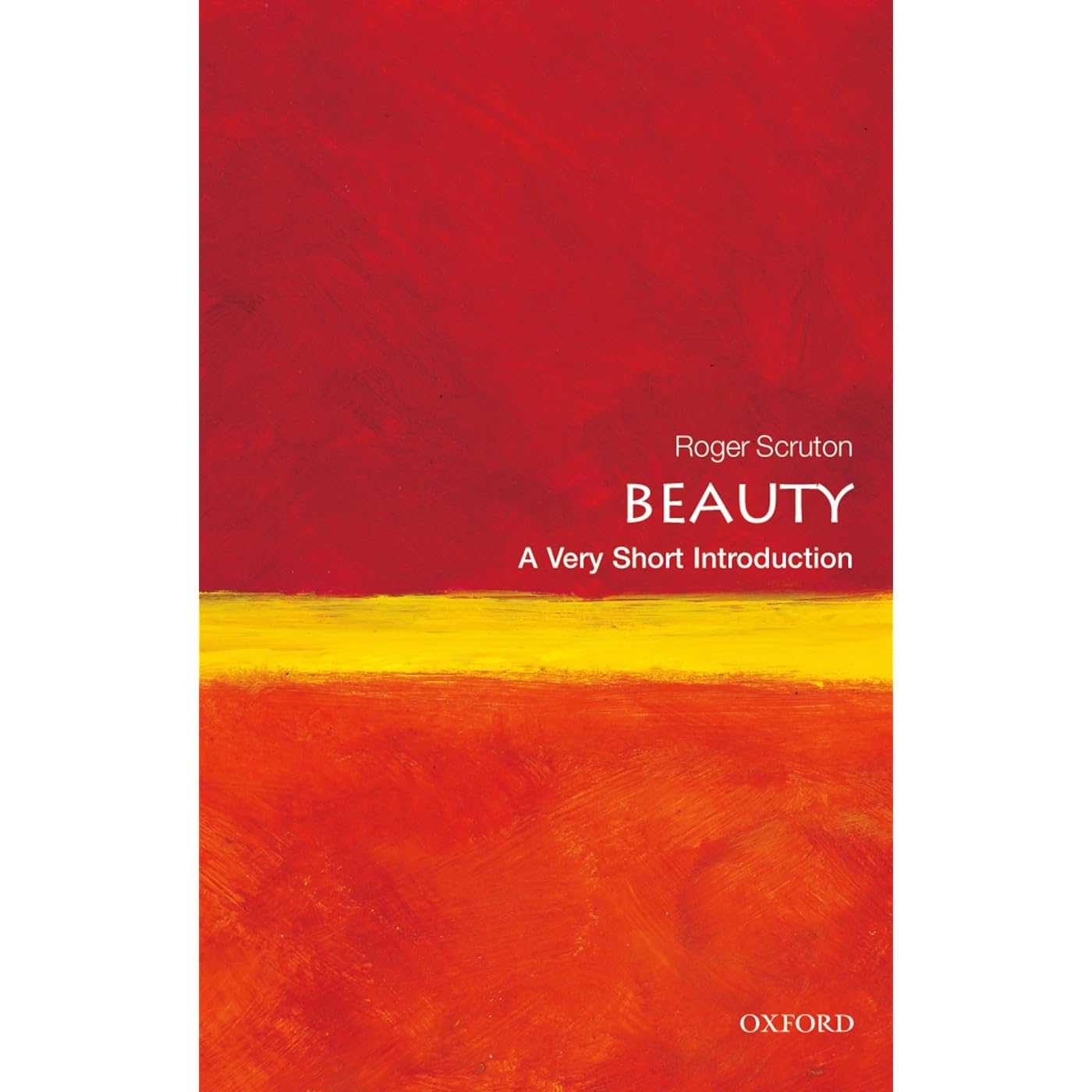
Beauty: A Very Short Introduction (Very Short Introductions)
  • Based on 640 reviews
Condition: New
Checking for the best price...
$7.99 Why this price?
Save $5.00 was $12.99

Buy Now, Pay Later


As low as $1 / mo
  • – 4-month term
  • – No impact on credit to apply
  • – Instant approval decision
  • – Secure and straightforward checkout

Ready to go? Add this product to your cart and select a plan during checkout.

Payment plans are offered through our trusted finance partners Klarna, Affirm, Afterpay, Apple Pay, and PayTomorrow. No-credit-needed leasing options through Acima may also be available at checkout.

Learn more about financing & leasing here.

Free shipping on this product

This item is eligible for return within 30 days of receipt

To qualify for a full refund, items must be returned in their original, unused condition. If an item is returned in a used, damaged, or materially different state, you may be granted a partial refund.

To initiate a return, please visit our Returns Center.

View our full returns policy here.


Availability: 20 left in stock
Fulfilled by Amazon

Arrives within 30 days
Order within 1 hour and 30 minutes
Available payment plans shown during checkout

Protection Plan Protect Your Purchase
Checking for protection plans...

Description

Beauty can be consoling, disturbing, sacred, profane; it can be exhilarating, appealing, inspiring, chilling. It can affect us in an unlimited variety of ways. Yet it is never viewed with indifference. In this Very Short Introduction the renowned philosopher Roger Scruton explores the concept of beauty, asking what makes an object - either in art, in nature, or the human form - beautiful, and examining how we can compare differing judgements of beauty when it is evident all around us that our tastes vary so widely. Is there a right judgement to be made about beauty? Is it right to say there is more beauty in a classical temple than a concrete office block, more in a Rembrandt than in last year's Turner Prize winner? Forthright and thought- provoking, and as accessible as it is intellectually rigorous, this introduction to the philosophy of beauty draws conclusions that some may find controversial, but, as Scruton shows, help us to find greater sense of meaning in the beautiful objects that fill our lives.ABOUT THE SERIES: The Very Short Introductions series from Oxford University Press contains hundreds of titles in almost every subject area. These pocket-sized books are the perfect way to get ahead in a new subject quickly. Our expert authors combine facts, analysis, perspective, new ideas, and enthusiasm to make interesting and challenging topics highly readable. Read more

Publisher ‏ : ‎ OUP Oxford


Accessibility ‏ : ‎ Learn more


Publication date ‏ : ‎ March 24, 2011


Edition ‏ : ‎ Illustrated


Language ‏ : ‎ English


File size ‏ : ‎ 3.5 MB


Screen Reader ‏ : ‎ Supported


Enhanced typesetting ‏ : ‎ Enabled


X-Ray ‏ : ‎ Not Enabled


Frequently asked questions

If you place your order now, the estimated arrival date for this product is: within 30 days

Yes, absolutely! You may return this product for a full refund within 30 days of receiving it.

To initiate a return, please visit our Returns Center.

View our full returns policy here.

  • Klarna Financing
  • Affirm Pay in 4
  • Affirm Financing
  • Afterpay Financing
  • PayTomorrow Financing
  • Financing through Apple Pay
Leasing options through Acima may also be available during checkout.

Learn more about financing & leasing here.

Top Amazon Reviews


  • Excellent introduction to thinking philosophically about beauty
Format: Kindle
Roger Scruton has written a fascinating and thought-provoking introduction to the philosophical musings surrounding beauty in this book. Rather than attempting to to exactly define what beauty is he takes a different route, striving to help the reader work through how beauty relates to man and what the significance of that relationship is. Scruton leans heavily on Kant, never quite affirming or denying Kant's ideas, but rather playing off of them, pointing out where they are helpful but also exposing their shortsightedness and/or misconceptions. In that regard, Scruton felt very balanced and mature in his approach. 

As a writer, I greatly appreciated Scruton's tactic of introducing ideas and concepts early in the book which he utilized later, early ideas and concepts being built upon and "paying off" later on in the book. The connection of desire and the exploration of sexual desire and attraction between people which he works through in the second chapter is essential to the line between erotic art and pornography he divines later on. Additionally, he introduces the idea of the sacred as early as the first chapter, though it is much more extensively explored in the second chapter and onward, which he then draws on for his climactic eighth chapter, art is contrasted with kitsch and the treasuring of the sacred with its desecration in postmodernity.

 Additionally, though it was only explored briefly, the parallel between the appreciation of jokes (and the difference between good ones and bad ones) and the beauty of art (which is judged as good and bad as well) I found quite insightful. I think a better argument might have been made for some equivalence between humor and beauty, but there are also dark corners to the reality of humor which do not fit Scruton's ultimate orientation for beauty, so that equivalence would not have lasted long at all.

 Though he never comes forward as a Christian, Scruton's religious worldview is evident in the eighth chapter, specifically with his elevation of sacrifice as that path which beauty offers to man as salvation from the mindless addiction of kitsch and desecration. To explore the ramifications of such a connection would, in my opinion, require an entirely different volume (or more) to tease out. Here, Scruton seems satisfied to point and highlight.

 Overall I found the book a quite enjoyable read, and much more accessible than I first feared. Though some of the philosophical waters he treads in are deep, he does so with ease and an nonchalant proficiency of which I am slightly envious. I would highly recommend this book to pastors and especially worship leaders or worship arts pastors who are trying to work through how the arts can fit into their church. While not proposing a theology of the arts, Scruton has laid a philosophical (and almost theological) foundation which could greatly contribute to anyone working through such things. I also think this book would be accessible to anyone interested in delving a little deeper into the philosophical waters surrounding beauty, and it would be a great starting point before diving into some much deeper waters with other philosophical writers. ... show more
Reviewed in the United States on August 7, 2017 by Zach

  • If you read one book on philosophical aesthetics…
Format: Paperback
Scruton's expertise in Kant stands him in good stead in this introduction to philosophical aesthetics. (His Oxford "very short introduction" to Kant is excellent.) Here, I would like to see more on Hume's second enquiry, but in the end it is still the finest brief introduction with which I am familiar to philosophical aesthetics. His brief treatments of kitsch and the potential sacrality of beauty are quite useful. ... show more
Reviewed in the United States on August 20, 2025 by Native Oregonian

  • Not simply in the eyes of the beholder
Format: Paperback
I wouldn't necessarily call this a *very* short introduction, as the title suggests. But it is a large topic, so perhaps any introduction would be considered 'short.' Scruton covers a lot of ground, from the Greeks and Romans through Aquinas and Dante, all the way down to the present day flight from beauty altogether. He develops a concept of four distinct types of beauty: human beauty, as an object of desire; natural beauty, as an object of contemplation; everyday beauty, as an object of practical reason; and artistic beauty, as a form of meaning and an object of taste. Each is developed in its own chapter, with prolific examples provided throughout. The book is somewhat academic and definitely not a page-turner, but still a worthwhile introduction to an important topic. Recommended. ... show more
Reviewed in the United States on September 18, 2020 by Jason Carter

  • Worth reading
Format: Kindle
A successor to. Kant on aesthetics, Scruton presents one philosopher’s carefully reasoned view. The book is insightful, thought-provoking, and in places possibly inspirational.
Reviewed in the United States on April 26, 2026 by Joe Whitmeyer

  • Intellectual equipment to determine what is beauty and why it matters
Format: Kindle
This scholarly approach to defining beauty and defending its importance has been extremely helpful to me as an artist and art teacher. I plan to use this book to launch substantive discussions regarding beauty with my art history students (11th, 12th graders). The second half of the book was more accessible to me, but I plan to reread the first half of the book as I sense that Scruton's ideas will move me closer to the truth as I pursue beauty personally in art and try to pass it on to my students. This book is worth the work to understand its content and is not without humor. I heartily recommend this book to anyone. ... show more
Reviewed in the United States on July 27, 2024 by Claire Kinyon

  • A full treatment of the topic in a readable format. Highly Recommended.
Format: Paperback
Roger Scruton does an amazing job of packing an amazing amount of information into this little book. His writing style is fluid and easy to read. He makes topics that have the potential to be quite complex, easy to understand. The book is divided into 9 chapters: 1. Judging beauty 2. Human beauty 3. Natural beauty 4. Everyday beauty 5. Artistic beauty 6. Taste and order 7. Art and eros 8. The flight from beauty 9. Concluding thoughts As you can see, Scruton covers the topic from all sides. In addition, there are a number of pictures of art works and architectural works to illustrate his points. The only thing different I would have liked to seen is color pictures, but I understand that Oxford University Press is trying to keep these little "A Very Short Introduction" books inexpensive, and for that I am glad. I have a large number of them and I will continue to purchase them as I can. Highly recommended. ... show more
Reviewed in the United States on December 2, 2017 by Where's Godot?

  • MASTERFUL
Format: Kindle
Scruton masterfully brings out the intersection of superficiality (he calls it "kitsch"), Beauty (a not just "meaningful" but truth-telling aesthetic), and culture. The clear implication - on further deep reflection - from the distinctions he pains-takingly brings forth, leads one to see the root of the "modern to post-modern" departure from beauty as valuable-in-itself, is the failure to value taking time and to make distinctions in theology. It is not "the Queen of sciences" as if one above many; Theology is very heart of science and art. There is a continuing need to re-present its symbols to avoid semantic shifts and to confront cultural iniquities (like pulling weeds before they become like trees). Scruton's insights, but also his Example in digging down to get the insight, made this book highly valuable to me. The extent to which this intersection is dismissed as something laughable or "impractical" serves to show how prophetically insightful his analysis is. ... show more
Reviewed in the United States on April 21, 2025 by John Bunyan

  • Verbose, a bit of a highbrow style and not even defining what beauty is
Format: Kindle
I agree with the opinions expressed before that the book is too verbose. I always had this itching feeling wanting to tell the author, "please, put your opinion straight, instead of going like a cat around hot milk, telling us all those things like that for for therapeutic purposes you like listening to Mozart or taking a ride on your (not "a") horse!" In the end of the book the author acknowledges that throughout the book he deliberately avoided defining what beauty is, because he found all existing definitions unacceptable. Well, after reading [half of] this book and comparing it to what is written on "Beauty" in Wikipedia and on the website called philosophyDOTaboutDOTcom, (the article is called "What is beauty?"), I found the latter material much more concrete, concise, presenting a good historical outlook for the search for the definition of the beautiful, and thus quite satisfying. Sure this current book has some interesting ideas, but for the reason sexpressed above I found it neither very enjoyable to read, nor particularly illuminating, compared to other sources. P.S. If I may put my two cents in, my takeaway after studying these and other sources is that "Beauty is in the eye of the beholder" is the only conclusion that can be objectively reached after studying individual experiences of beauty. I personally concluded so not because there never was nor is a universal consensus about any object in the world on whether it is beautiful or not - after all "the eye of the beholder" is not the same eye today as it was yesterday, and it is quite possible to imagine that every human being, with good mentoring, may be led to appreciate the beauty of what is currently judged as beauty by the majority. My primary objection for trying to objectify the beautiful is that human eye (ear, nose, etc) is _an_ eye, whith its own perspective, sensitivity to only a certain (narrow) range of radiation. But there are also eyes of bats, dogs, ants, fish and who not, and I think it is not too daring to assume that a bat may not have any feeling of beauty aroused no matter for how long it looks at the "Birth of Venus", or listens to Mozart, and no amount of human or maybe even divine counseling will make it appreciate the beauty of something that for it's sensory apparatus does not even probably exist! And likewise that bat may be absolutely convinced that a flying pattern of its mate is the flying par excellence, while to the human eye and mind it may seem chaotic and repulsive. So is there any unshakeable reason to be so sure that only humans have a feeling for beauty, or that the human perception of beauty is "more right" than others? If the answer to this is yes, then by definition we're speaking not about something objective, existing out there, but about a _subjective_ experience, which however looks to be very similar among humans. So instead of trying to segregate experiences of beauty and pleasure, as the author of this book ventured to do, why not to humbly accept that beautiful for us _is_ something that gives us certain pleasant stimulus, and that certain forms, patterns etc tend to be called beautiful by the majority of us because we all: 1) have largely the same genes, evolved in our shared ancestors while they were living in this world, 2) share the same sensory and intellectual apparatus, and 3) are blessed with the same grace of God that makes it possible for us to experience that feeling of beauty? And that the differences of whether each of us calls beautiful this or that are largely attributable to the differences in our upbringing and consequent habits, judgements, etc? ... show more
Reviewed in the United States on August 2, 2016 by Vladimir Antimonov

Can't find a product?

Find it on Amazon first, then paste the link below.
Checking for best price...