
Search  for anything...

The Circle of Fifths: visual tools for musicians

  • Based on 294 reviews
Condition: New
Checking for the best price...
$21.95 Why this price?
Holiday Deal · 37% off was $34.99

Buy Now, Pay Later


As low as $5 / mo
  • – 4-month term
  • – No impact on credit
  • – Instant approval decision
  • – Secure and straightforward checkout

Ready to go? Add this product to your cart and select a plan during checkout.

Payment plans are offered through our trusted finance partners Klarna, Affirm, Afterpay, Apple Pay, and PayTomorrow. No-credit-needed leasing options through Acima may also be available at checkout.

Learn more about financing & leasing here.

Free shipping on this product

FREE 30-day refund/replacement

To qualify for a full refund, items must be returned in their original, unused condition. If an item is returned in a used, damaged, or materially different state, you may be granted a partial refund.

To initiate a return, please visit our Returns Center.

View our full returns policy here.


Availability: In Stock.
Fulfilled by Amazon

Arrives Friday, Dec 26
Order within 2 hours and 25 minutes
Available payment plans shown during checkout

Protection Plan Protect Your Purchase
Checking for protection plans...

Description

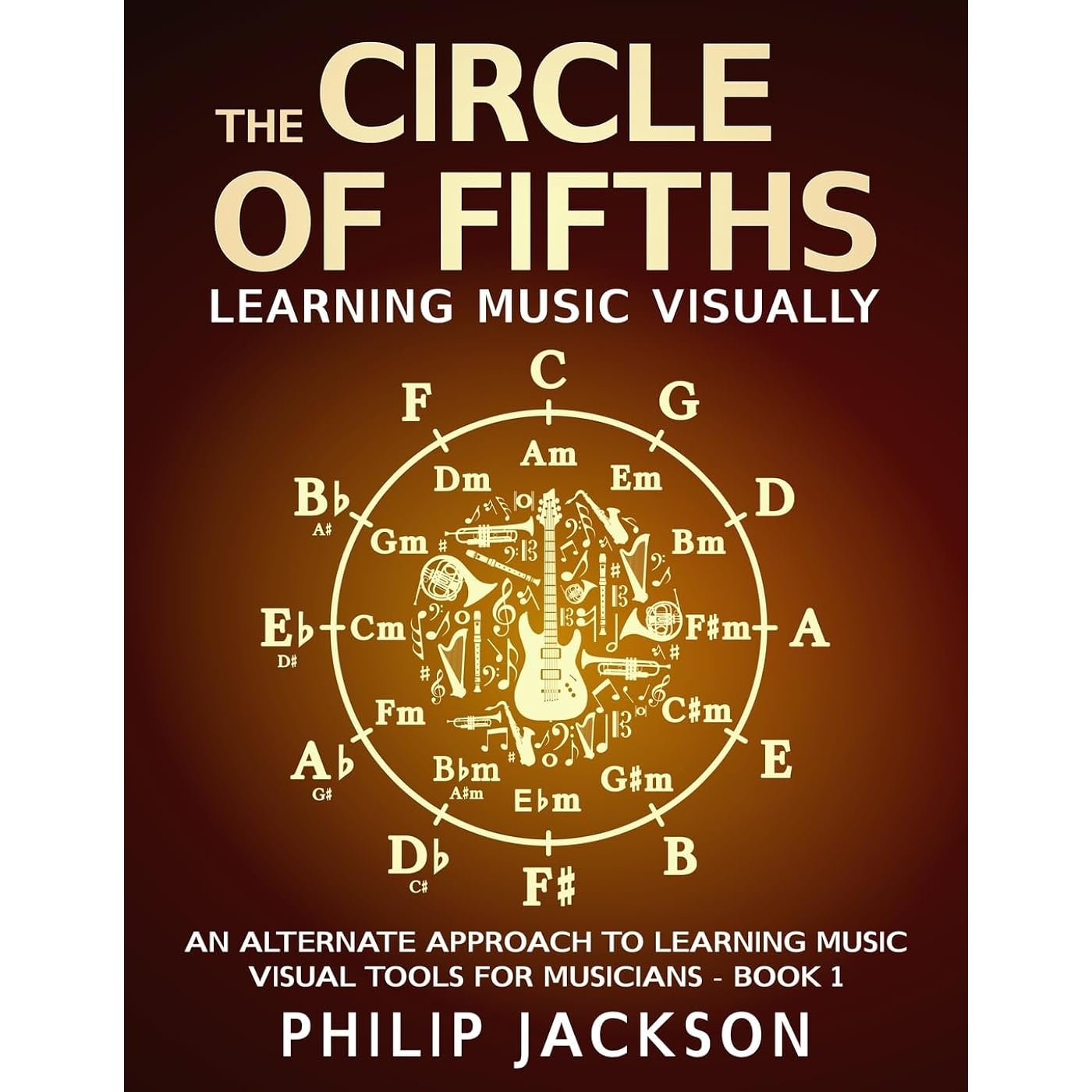
The Circle of Fifths is finally made clear, simple, and useful for real musicians.Struggling to connect music theory to your actual playing? Confused about chords, scales, or tricky intervals, and frustrated that it all feels like random facts to memorize?You’re not alone. Most musicians are taught theory in a way that’s abstract and forgettable. But when you can see the relationships between notes, keys, and scales, everything changes.Bestselling author and veteran music instructor Philip Jackson has spent over 20 years helping musicians of all levels, from beginners learning music theory for the first time to advanced players exploring jazz improvisation, turn theory into an effortless, automatic part of their music-making. Now, in The Circle of Fifths, he gives you a simple, visual system for learning music theory fast and applying it to composition, arranging, and improvisation across any instrument.Inside, you’ll discover:The Circle of Fifths explained, and how to actually use it while playing, composing, or arranging musicFast recall shortcuts for chords, scales, and key changes, even in tricky jazz progressionsGuitar improvisation techniques that work for all instruments, helping you play with freedom and confidenceHow to instantly transpose music to any key without guessworkPractical ideas to strengthen your ear, memory, and improvisation skillsAdvanced applications, from chord substitutions to harmonic layering that make your music sound pro-level Whether you’re just starting with music theory for beginners or you’re ready to expand into jazz theory and improvisation, this book will help you:Learn fasterPlay with more confidenceAnd finally feel in control of the music you make Don’t just learn theory - make it part of how you play.Grab your copy of The Circle of Fifths today and start turning knowledge into music. Read more

Publisher ‏ : ‎ Philip N. Jackson


Publication date ‏ : ‎ October 20, 2015


Language ‏ : ‎ English


Print length ‏ : ‎ 106 pages


ISBN-13 ‏ : ‎ 03


Item Weight ‏ : ‎ 9.5 ounces


Dimensions ‏ : ‎ 8.5 x 0.24 x 11 inches


Book 1 of 5 ‏ : ‎ Visual tools for musicians


Best Sellers Rank: #69,097 in Books (See Top 100 in Books) #74 in Music Theory (Books)


Frequently asked questions

If you place your order now, the estimated arrival date for this product is: Friday, Dec 26

Yes, absolutely! You may return this product for a full refund within 30 days of receiving it.

To initiate a return, please visit our Returns Center.

View our full returns policy here.

  • Klarna Financing
  • Affirm Pay in 4
  • Affirm Financing
  • Afterpay Financing
  • PayTomorrow Financing
  • Financing through Apple Pay
Leasing options through Acima may also be available during checkout.

Learn more about financing & leasing here.

Top Amazon Reviews


  • Well worth your time if you aspire to musicianship, imho.
Format: Kindle
Philip Jackson's book _The Circle of Fifths: visual tools for musicians_ is EXCELLENT. I haven't finished it yet, because it is not a book one can just beeze through, and I just got it the other day. You have to pay very close attention to what Mr. Jackson is saying. His sentences are spare and direct, and concepts build upon one another as he progresses through his explanations. I have gotten through the first four chapters and have scanned the rest. I like it so much that in addition to the Kindle version I am ordering the printed book, too. Jackson is an original thinker, and his insights are worth your time if you're a muscian or want to be one. ... show more
Reviewed in the United States on October 21, 2017 by Eric Whitney

  • Educational good material for teaching
Format: Paperback
I have not completely explored this book and resources but it seems that it will be very helpful in teaching students at almost any level. Of course the teacher may have to interpret for younger students.
Reviewed in the United States on May 23, 2024 by reevesla

  • Four Stars
Format: Paperback
I received what I expected
Reviewed in the United States on September 29, 2017 by DIEGO GOMEZ-P. LLAMBIAS

  • For Music Theorists Only!
Format: Paperback
I'm a music teacher. 5 Stars for the author's mastery and presentation of music theory as organized by the circle of 5ths, BUT!... The book is highly technical and many would say a bit obscure in its approach to organizing the way one thinks about the structure of music. If you are a person who needs visual graphics to organize information into patterns, this is the theory book for you, but only after mastering at least 3 college semesters of traditionally presented music theory. This teaches a method of organizing scale and chord structures divorced of any instrument other than the visual diagram of the circle of 5ths. My experience as a teacher ingorms me that most musicians will find it more useful to understand the same information in relation to the keyboard or the fretboard or the lines and spaces of the staff. Buy it if you love exploring the esoteric and theoretical nature of music. It will fit in nicely on your shelf of references covering the more heady methods of analyzing the form of music. ... show more
Reviewed in the United States on June 27, 2023 by Pod

  • I brought it
Format: Paperback
That I was satisfied with it
Reviewed in the United States on June 12, 2025 by Excellent

  • It’s not like the “for dummies” books, you need to know a little bit already.
Format: Paperback
I’ve been playing clarinet since 1986 and took music theory in high school in the 90’s but forgot it. Singing even longer than playing and I’m currently learning piano. I say all of that to say that I wanted to re-learn music theory. I was under the impression that this book and the others that follow would be written in “dummy” terms so that someone like me could understand it. I’ve been actively playing in a community band for years and sing in choir. I’ve taken music theory before but there is so much about these books (i have book 1 and 2) that I don’t understand. To start with, the writer tends to go off on little rabbit trails, explaining some things that are not immediately useful to the reader. From the first page, the introduction, he discusses what the circle of fifths used to be and why it was inadequate. But why it’s better now. Most of that explanation went right over my head. The writer assumes that the reader is versed in scale degrees, and their names and numbers. While there is a brief explanation in the front of the book about degrees, the writer uses degrees in the first few chapters as if the reader knows them in his/her sleep. A lot of this book is completely over my head and I seriously need to look for a “for dummies” book because this ain’t it. Again, coming from someone who has been doing music and reading music for a long time. This book is well over my head and i feel like it’s a waste of money. Maybe I’ll come back to it after I’ve read the “for dummies” books on music theory. I really wanted to like this and use it but it’s overwhelming and in some cases provides too much information, more than the reader needs at the moment. I learned some basics of music theory (as it relates to piano anyway) from the book “Alfred’s Basic Piano Library The Complete Book of Scales, Chords, Arpeggios & Cadences” Willard Palmer, Morton Mans and Amanda Vick Lethco. It’s a start. It’s mostly a scale book for new pianists but starts with about 15 pages of music theory as it relates to piano and it’s written from a “dummy” perspective. ... show more
Reviewed in the United States on January 21, 2023 by Sharon

  • Helpful? Maybe/maybe not. Depends.
Format: Hardcover
Super helpful for non-musicians but still a bit too (mathematically) complex for non-musicians who have difficulty with math.
Reviewed in the United States on April 7, 2024 by MGKAL

  • solid and academic discussion of the circle of fifths
Format: Kindle
I read this on Kindle and ordered the paper workbooks. I knew a little bit about the circle and how to write one but Philip Jackson goes into a pot of detail about how it works and why.
Reviewed in the United States on May 6, 2023 by chris Adams

Can't find a product?

Find it on Amazon first, then paste the link below.
Checking for best price...