

Search  for anything...

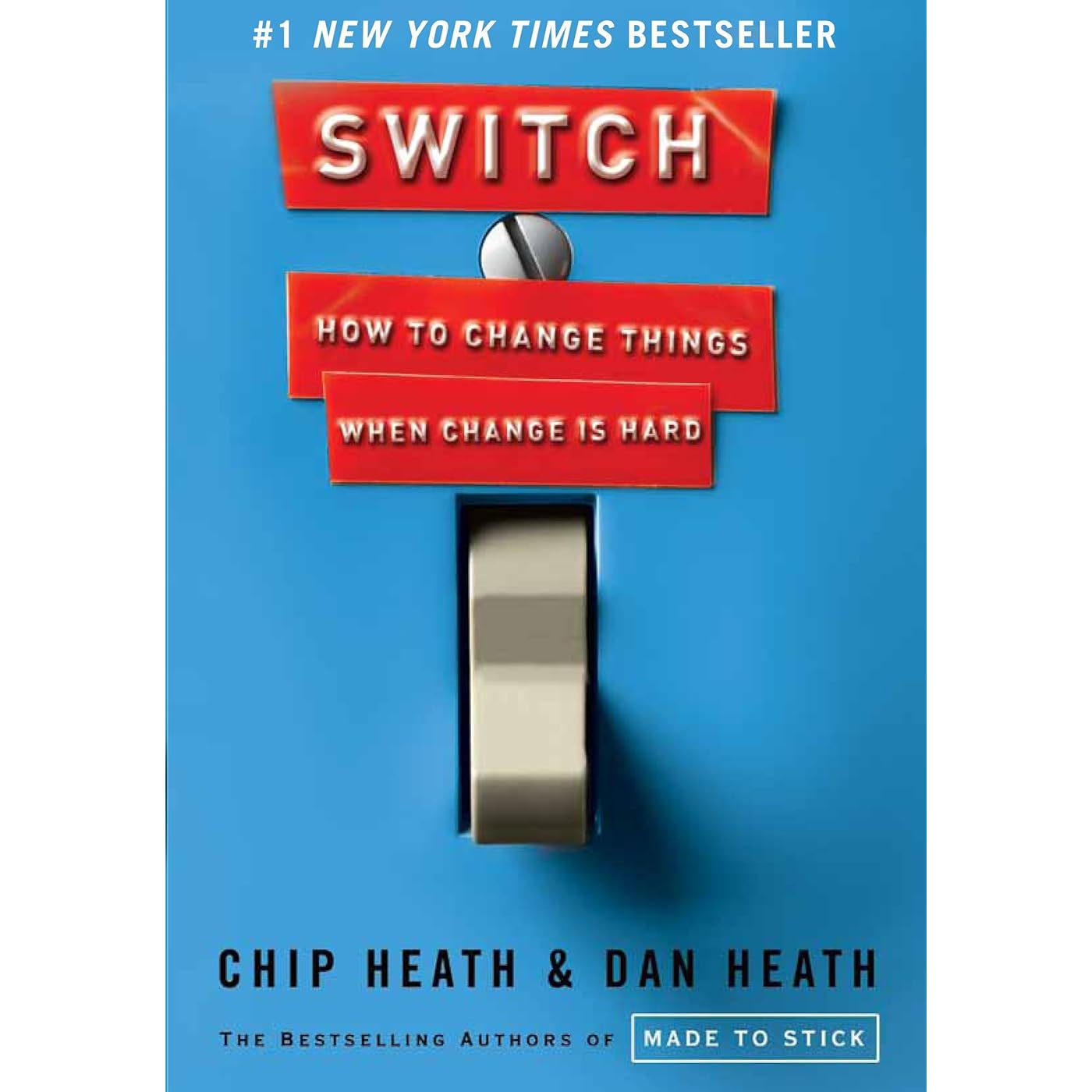
Switch: How to Change Things When Change Is Hard

  • Based on 6,051 reviews
Condition: Used - Acceptable
Checking for the best price...
$6.28 Why this price?
Save $30.71 was $36.99

Buy Now, Pay Later


As low as $1 / mo
  • – 4-month term
  • – No impact on credit to apply
  • – Instant approval decision
  • – Secure and straightforward checkout

Ready to go? Add this product to your cart and select a plan during checkout.

Payment plans are offered through our trusted finance partners Klarna, Affirm, Afterpay, Zip, Apple Pay, and Google Pay. No-credit-needed leasing options through Acima may also be available at checkout.

Learn more about financing & leasing here.

Free shipping on this product

30-day refund/replacement

To qualify for a full refund, items must be returned in their original, unused condition. If an item is returned in a used, damaged, or materially different state, you may be granted a partial refund.

To initiate a return, please visit our Returns Center.

View our full returns policy here.


Availability: Only 1 left in stock, order soon!
Fulfilled by Orion LLC

Arrives Monday, Oct 12
Order within 1 hour and 9 minutes
Available payment plans shown during checkout

Protection Plan Protect Your Purchase
Checking for protection plans...

Description

Why is it so hard to make lasting changes in our companies, in our communities, and in our own lives? The primary obstacle is a conflict that’s built into our brains, say Chip and Dan Heath, authors of the critically acclaimed bestseller Made to Stick. Psychologists have discovered that our minds are ruled by two different systems—the rational mind and the emotional mind—that compete for control. The rational mind wants a great beach body; the emotional mind wants that Oreo cookie. The rational mind wants to change something at work; the emotional mind loves the comfort of the existing routine. This tension can doom a change effort—but if it is overcome, change can come quickly. In Switch, the Heaths show how everyday people—employees and managers, parents and nurses—have united both minds and, as a result, achieved dramatic results: ● The lowly medical interns who managed to defeat an entrenched, decades-old medical practice that was endangering patients. ● The home-organizing guru who developed a simple technique for overcoming the dread of housekeeping. ● The manager who transformed a lackadaisical customer- support team into service zealots by removing a standard tool of customer service In a compelling, story-driven narrative, the Heaths bring together decades of counterintuitive research in psychology, sociology, and other fields to shed new light on how we can effect transformative change. Switch shows that successful changes follow a pattern, a pattern you can use to make the changes that matter to you, whether your interest is in changing the world or changing your waistline. Read more

Publisher ‏ : ‎ Crown Currency


Publication date ‏ : ‎ February 16, 2010


Edition ‏ : ‎ 1st


Language ‏ : ‎ English


Print length ‏ : ‎ 320 pages


ISBN-10 ‏ : ‎ 0385528752


ISBN-13 ‏ : ‎ 57


Item Weight ‏ : ‎ 2.31 pounds


Dimensions ‏ : ‎ 5.79 x 1.2 x 8.55 inches


Best Sellers Rank: #9,803 in Books (See Top 100 in Books) #21 in Popular Psychology Personality Study #31 in Business Processes & Infrastructure #50 in Decision-Making & Problem Solving


Frequently asked questions

If you place your order now, the estimated arrival date for this product is: Monday, Oct 12

Yes, absolutely! You may return this product for a full refund within 30 days of receiving it.

To initiate a return, please visit our Returns Center.

View our full returns policy here.

  • Klarna Financing
  • Affirm Pay in 4
  • Affirm Financing
  • Afterpay Financing
  • Zip Pay in 4
  • Financing through Apple Pay
  • Financing through Google Pay
Leasing options through Acima may also be available during checkout.

Learn more about financing & leasing here.

Top Amazon Reviews


  • A Must Read
Format: Hardcover
This book was the logical next step for me after reading Mistakes Were Made (But Not by Me): Why We Justify Foolish Beliefs, Bad Decisions, and Hurtful Acts and Thinking, Fast and Slow. Those both spoke about cognitive dissonance and cognitive illusion, and this one was about what to do about it. This is how the book breaks down: INTRODUCTION. Here, Chip and Dan introduce their concept of the rider and the elephant. The rider is our rational side, and the elephant is our emotional side. (You can also think of them as the ego and the id or the planner and the doer.) The rider steers the elephant, but if there's a conflict between the rider and the elephant, the elephant's going to win every time. They make it clear, however, that the elephant isn't necessarily the bad guy. The elephant gets us to try new things ("Hey, wouldn't it be cool to...") and helps to calibrate our moral compass ("That's wrong!"). DIRECT THE RIDER. The rider can get overwhelmed with too many choices or a lack of clarity. Chip and Dan lay out, very clearly, the steps you need to take to keep everyone's rational sides engaged in change. You need to focus on what's going well and replicate that and also define the goal clearly. MOTIVATE THE ELEPHANT. You can't just rely on rationality when trying to push for change. People might agree with you that you have the best course of action, but that's not going to motivate them to act. Chip and Dan talk about why it's important to make people feel the need for change and how to go about doing it. SHAPE THE PATH. Once you provide clear direction and motivate, you can also make the change easier. Eliminate all roadblocks to a specific behavior (or as many as possible), and the rider and elephant will find it much easier to do it. Chip and Dan use the Amazon one-click button as an example. All in all, this book was well-researched, invaluable to anyone who needs to lead a change, and witty. I laughed out loud multiple times. As soon as I finished, I adjusted my communication plan for a change I'm proposing at my company. The lessons learned here are immediately applicable. My only criticism (and it's a small one) is around the placebo effect. There's a very small section discussing a study about the placebo effect in which Chip and Dan state that the placebo effect only impacts how someone feels. This is categorically untrue. Placebo effects have also shown to impact ulcers, swelling, and even coughs. ----- Side note: I also had the pleasure of seeing Chip present this book, and I even got him to sign my copy (by running up to him like a crazy person as soon as he left the stage). His presentation was highly enjoyable--Chis has a dry wit that appealed tremendously to the crowd. If you get the opportunity to see him speak, I highly recommend that you take it. I rated the book beforehand, so I promise that my review and rating were not colored by the killer presentation. ... show more
Reviewed in the United States on May 14, 2012 by Kara

  • Review by J. Colannino
Format: Hardcover
Switch is a book about managing change by the Heath brothers (Chip and Dan). Chip is a professor at the Graduate School of Business at Stanford University and Dan is a Senior Fellow at Duke University' Social Entrepreneurship center. The two have teamed up before -- in 2007 they released their critically acclaimed Made to Stick: Why Some Ideas Survive and Others Die. This latest effort focuses less on the stickiness of the idea and more on the change process itself. What should a change agent do to implement lasting change in a hard-headed organization that desperately needs it? The book is organized into eleven chapters in three parts: Part 1, Direct the Rider; Part 2, Motivate the Elephant; and Part 3, Shape the Path. The titles come from a vivid metaphor by University of Virginia psychologist Jonathan Haidt. In his book, The Happiness Hypothesis, Haidt likens a person to a rider on an elephant. The rider is the rational side of a person: the part that tells him to eat better, exercise more, and stop procrastinating, for example. The elephant is the emotional side that doesn't want to work to lose weight or exercise and would rather stay put; let's say willpower vs. won't-power; but why should that be? Whatever is autonomous and ingrained by habit belongs to the elephant. The rider is theoretically in control, but it is exhausting to continually tug on the reins and direct the stubborn elephant. Eventually the rider relents and the elephant goes back to doing what he's always done. Sound familiar? Before going much farther, you should know that two things separate Switch from so many other glib books about change: first, the book has a very solid psychological basis. Despite its accessible style, scores of major psychological findings and studies are reported and undergird the book's practical formulae for change. Second, Switch is not a self-help book. I have no doubt that the book could be used in this way, but it is really a book about how to change things. It is primarily directed toward organizational change, though its principles are much broader. And there are many surprises. The first big surprise occurs in the very first chapter. "We know what you're thinking -- people resist change. But it's not quite that easy. Babies are born every day to parents who, inexplicably, welcome that change. Yet people don't resist this massive change -- they volunteer for it. In our lives we embrace lots of big changes. So there are hard changes and there are easy changes. What distinguishes one from the other?" And the surprises keep coming. Like the two researchers who dramatically and permanently got folks to reduce their saturated fat intake. Or the doctor who saved over 100,000 lives and counting in American hospitals on schedule (18 months) by getting thousands of doctors and organizations to change their practices. Or the American who went to Vietnam and changed the face of malnutrition. Or the student who saved an endangered species in a Caribbean country that didn't give two hoots about it. What do all these stories have in common? For one, none of these change agents had the sufficient budget or authority to succeed; yet, they did. How? Every one of them gave clear rational direction to the rider by finding the bright spots, scripting the critical moves, and clearly pointing to the end goal. All of them motivated the elephant by emotionally connecting with it, and they shrunk the apparent change by carefully communicating progress. They refused to underestimate their people. Instead they provided them with a newfound identity that let them to grow into the challenge. But there was more. As the authors note, many times what looks like resistance is really confusion or even the result of misaligned incentives. That's why the path needs to be shaped by making manageable changes to the environment, building sound habits, rallying the herd, and reinforcing the new habit until it becomes a way of life. Well, maybe that sounds like a lot of work. I think it is. But speaking from firsthand experience, it will be a labor of love. And if your heart is not in the change and you do not think you can derive reward from the process, perhaps you are selling yourself short -- or, maybe you're the wrong person to lead the change and you should stop kidding yourself. And perhaps that is what I like most about this book. It does not promise a panacea. It tells it like it is without the jingoism that has become the substance of many change management essays. If you are leading organizational change, the book will provide a solid prescription for achieving lasting results because Switch uses real research, reports real experiences, and provides real guidance. Here, my recommendation is enthusiastic. ... show more
Reviewed in the United States on December 3, 2012 by Joseph Colannino

  • Focus on situation and not people
This book is a summarization of the various theories of change management, be it in a business, government or NGO. Dan and Chip talk about most of the problem being with situation and not with people as most of us would jump to conclusion. So, we end up struggling about getting people to behave in a new way. The corollary they draw to most people welcoming seismic changes like marriage and babies in their lives is quite an eye opener in this regard. So, if the behavior needs to change, there has to be a change in the situation. The Elephant and Rider synonyms for the two minds in one brain was very innovative and interesting. This tells a lot and the authors uses these synonyms extensively through out the book. For instance while I knew that will power wears out after some usage and thus exhaustion becomes perceived as laziness, but with an Elephant and Rider context, it becomes very apparent. It is not that all the concepts in this book are new, at I have been exposed to some of these like shrinking the change or lowering the bar in some other books and also in practical life. But then to be fair, the authors themselves claim to have referred to tons of book on change and have also recommended a few of them for additional reading. Still, I liked this book because it gave a different context to the various approached, but kept the impact on Elephant and Rider throughout each approaches. Thus it makes it easier to identify which approach works best in which case. And the cases are quite diverse, even a case of organizing the community to save a city or a parrot for that matter!! Another innovative feature of this book was the clinics Dan and Chip give. It provides the reader an opportunity to try out the approaches and the impact of the same. I liked it a lot. I had some disagreement on the mindset concept or to be more specific the wordings of the four question used to identify the mindset. Actually, I don’t believe in mindset and always felt it as all about conditioning If you are one of those who are driving change in your place and losing steam, do read this book. It will tell you that yes, everything can look like a failure in the middle. But with if the Rider has the necessary direction (very important, ambiguity does not help to change) and the Elephant is well motivated, you will still reach the destination. After all , as Dan and Chip say, change is not an event, it a process. ... show more
Reviewed in the United States on January 15, 2015 by Harish Nair

  • Great read, great evidence and made easy!
Format: Hardcover
I would highly recommend this book to anyone looking at making changes in their lives, whether professional or personal. Switch (by same authors as Made to Stick) provides great tips and solutions presented at a user level and with a great framework. The authors first lay out the three big things: the Rider, the Elephant and the Path and describe what each of these are and provides examples so the reader can get it on his level and not some abstract thoughts. After the big introduction the authors broke the book up into parts concerning each one. The first then is about directing the Rider, the more of our conscious, self will side. To do this one should find the 'bright spots' by seeing how some things succeeded instead of what failed. Next one should script the critical moves by breaking stuff down to specific goals. Finally it's to point to the destination by giving Riders a clear view of where they're going. The second is about motivating the Elephant, more our unconscious and representative of all the inertia we have when wanting to change. Elephants are the more emotional and less logical side so the first step is finding the feeling (think those ASPCA commercials). Next one should shrink the change by making it more manageable (more on this later) and increasing the sense of accomplishment. Finally, it's about growing your people... Change will be easier if you expand the abilities and spirits of your people. The third is about shaping the Path. Within this it's about tweaking the environment (smokers know this about all the cues there are about smoking). Next it is building habits which are behaviors on autopilot and how to encourage habits. Finally one should rally the herd. Overall the book is very well written. The authors write in a very friendly style without being too personal... The couple times they do break from the books narrative to tell jokes, they work and actually made me laugh out loud. Their writing style helps the reader understand and so does the formatting, and maybe more so. While overall the book is 3 parts, there are chapters within those parts and then smaller bite sized sections. While also good for reading bit at time I have to imagine they used their own advice with it because it makes one feel more accomplished and thus wanting to read more. All their points are backed up with studies and not just opinions. Also for good measure they have independent 'Clinics' where they present a scenario and ask readers to work it out first. Therefore, overall this is a great book that I learned a lot from and have already started using both personally and in my job. ... show more
Reviewed in the United States on February 14, 2014 by Shawn C.

  • Worthwhile read but don't expect a magic bullet
Format: Hardcover
I read this book ages ago and when I start a new job or a tricky project, I pick it up again. It's useful in considering the overall factors that influence change, providing examples where you can glean insight, and opening your mind to sit down and think about your change at hand. It has helped me tremendously over the years. But let's be real, this nor any other book is a magic bullet or a detailed roadmap for your specific change or organization. You read this book, maybe some others and then you have to think about what's going on in your use case and which parallels to draw. The book gas strong action items that you can apply right away. Go into this book with realistic expectations and you'll be pleased with the outcome. ... show more
Reviewed in the United States on July 19, 2026 by Mama D

  • One of the best books on change out there
Format: Hardcover
Just read Chip and Dan Heath's book Switch: How to Change Things When Change is Hard. After reading it, if are leading change of any kind or will at any time in the future, you need to read this book. The Heath brothers look at the idea of an elephant and a rider to show how change happens, how it is reacted to and why it is reacted to that way. The rider represents our analytical side or analytical people. They are interested in data, the why behind change and how it will play out, the plan. The elephant is the emotional side, the feelings, the impulsiveness to a change. The elephant asks, "How will this change affect me?" What they pointed out that was really interesting was the idea that people often react to change and the problem is not a people problem but a situation problem, an environment problem. What they showed through a variety of studies and examples is that often to make change happen, you need to change the environment that people reside in. One of the leadership principles that often gets overlooked that they talked about was looking for bright spots. Often leaders, especially in churches, we look for what is not working and try to change that, and that is the focus of our change. What if instead, we looked for what is working, the bright spots and look at how to replicate that. As the Heath brothers said, "Anytime you have a bright spot, your mission is to clone it." In the midst of change, uncertainty will arise at some point. In those moments, that is when the people in your church or organization will retreat to what they know. That is why clarity is so important. That is why you need to appeal to the head (the rider) and the heart (the elephant) to keep them on track, to keep them on the path as the writers point out. What was probably the most helpful was the idea of scripting moves. When making a change, changing a culture, adding something to a church, tell people what is expected, what will the new world look like once the change is complete. The authors pointed out, "The details is where people get hung up and fall off track." Ambiguity is the enemy of change. Or the flip side, "Clarity dissolves resistance." Describe for people what your church will be like when the change is complete. Paint a picture. Tell them how you will get there, what it will feel like on the way. Sometimes, prepare them for failure or what will seem like failure. Often, change efforts use the sequence of analyze-think-change, which rarely works. Instead, use see-feel-change. Often what trips up leaders in making changes is the herd, the crowd. If you get the crowd, you win the change because people follow the crowd, as behavior is contagious. The authors point out "We imitate the behaviors of others, whether consciously or not." Here are a few other things that jumped out: -For anything to change, someone has to start acting differently. -What looks like resistance is often a lack of clarity. -If you want people to change, you must provide crystal clear direction. -The core of the matter is always about changing the behavior of people, and behavior change happens in highly successful situations mostly by speaking to people's feelings. -To keep the elephant motivated, people must get a sense of progress. Without progress, people will get demoralized. -The rider needs direction, the elephant needs motivation. As I said, this is a book definitely worth picking up. I was able to read it on the plane the other day, so a fast read with a ton of nuggets in it. For more book reviews, go to [...]. ... show more
Reviewed in the United States on February 28, 2011 by Joshua Reich

  • Great Framework wrapped in an unfortunate metaphor
Format: Kindle
This would be a GREAT book. The framework and essential ideas are a very helpful way to think about change. However, they use a single metaphor and then carry it through the whole book. If only they ad presented the metaphor and then left it alone. I dislike the "elephant" and "rider" metaphor a lot - so it's constant use becomes annoying. I disagree with the premise that our "logical" mind is "supposed" to be able to override our emotional selves. We aren't designed to be "ruled" by logic - we are designed to cooperate with ourselves. We have internal checks and balances that work together to keep us safe. They eventually actually make the point that logic is actually designed to SERVE emotion, not rule it. So why do they overemphasize this metaphor that doesn't even really portray their real point? And then use it ad nauseum? Why not just say that we must integrate and align our head, hearts, and bodies and work with the natural change process to get the best results. Lots of other metaphors work to describe the inner leadership and collaboration required to change ourselves intentionally. Once I got past the metaphor - I discovered several great ideas and terms that have been helpful in teaching clients how to "lead" and facilitate their own personal growth and change initiatives instead of trying to control change. Favorite ideas: - Look for the bright spots - learn from your own life. Look for small examples where you are already doing what you want to do more of. Look for what works and what doesn't, what helps and what doesn't. I find all change efforts benefit greatly from focusing more on what *is* working than on what isn't working. ALL the available feedback is helpful if is *descriptive* rather than *judged* as good or bad. Feedback from what you do when you succeed can be used to redesign your strategy to fit you and your situation in areas where you are challenged. For example, if you are often late, focus on the bright spots - the examples of where you *are* on time. How do you do that? Use that to feed your creativity and design solutions for being on time more often. (I call this agilizing change.) - Love this quote " What looks like resistance is often a lack of clarity" YES! Need to get small and specific. I would also add that resistance is also often a sign of using strategies that don't fit the situation, the person, the timing, or the resources available. In my world resistance is incredibly valuable feedback for redesigning your approach and successfully leading change. - Love the languaging of "Shape" the path. You really can't "control" or "direct" change - if you work with the natural principles of how things and people organically change you will find that shaping is a far superior and more effective strategy. Overally, the model is a simple, straightforward framework that works better than most as a primer for people new to leading change. I found that with a little tweaking and using my own metaphors (based on agile mindset, and iterative, organic, systems design thinking) I was able to enhance and simplify my own Agilizen Designing for Change model making it easier to learn. This book is definitely worth reading by anyone who helps others change or is highly motivated to facilitate their own personal growth. ... show more
Reviewed in the United States on October 2, 2013 by Alan McComas

  • A Tool I Needed
Format: Hardcover
[...] I've been thinking a lot the last few years about the uncertain times we live in. As an accidental technologist, I've frequently been asked (or pushed, even) to be a change agent within large organizations and small. I wouldn't say I've always been successful, no matter how many late nights I put in, or innovative ideas I thought up. Not even big budgets or talented folks have been a guarantee of success. I've found myself asking, often, in these transitional times, how do we get over uncertainty and "analysis paralysis" to support change? Wondering and research led me to SWITCH, How to Change Things When Change is Hard, by Chip Heath and Dan Heath. The theory Heath & Heath espose is that the brain is hard-wired to respond to uncertainty, conflict, and chaos with visceral precepts that make us our own worst enemies. They talk about the brain in metaphor, as a rider on an elephant. The elephant is the emotional, instinctual, feeling portion of our brains-while the rider is the rational analyzer. We live through the combination of both. We need both elephant and rider to move us ahead. Their script for guiding change is a combination that begins with appealing to the rational rider, removing blocks that cause panicked over-analysis and stagnation by simplifying the critical path to change and identifying the where and what of the destination. Let me say that again, simplifying. (Geez, I have sucked at that). Second, by naming the feeling that joins the elephant's animal instinct to a cause, working to make change feel manageable, and by investing in people's need to enjoy accomplishment along the way. The Heath brother's true gift is the way they've melted down stories presented in a very Malcolm Gladwell-esque sort of way to (following their own philosophy) meted steps. I found myself in moments of I-could-have-had-a-V8 head slapping, and realization that of course, a transition I was advocating didn't work. <<DUH>> I also wondered why I had not consulted friends who are psychologists and sociologists for guidance on how to be a better advocate for change. As I've thought a great deal about this book, I've also begun looking for success stories around me which mirror the wisdom in addressing rider and elephant...perhaps, more on those, another time. So, I'll leave you with this-if you're thinking about transitions in an organization, a group, your own life, or society in general, SWITCH contains some insight and armor I think we may all need in the days ahead. ... show more
Reviewed in the United States on March 19, 2013 by ellestar27

Can't find a product?

Find it on Amazon first, then paste the link below.
Checking for best price...