

Search  for anything...

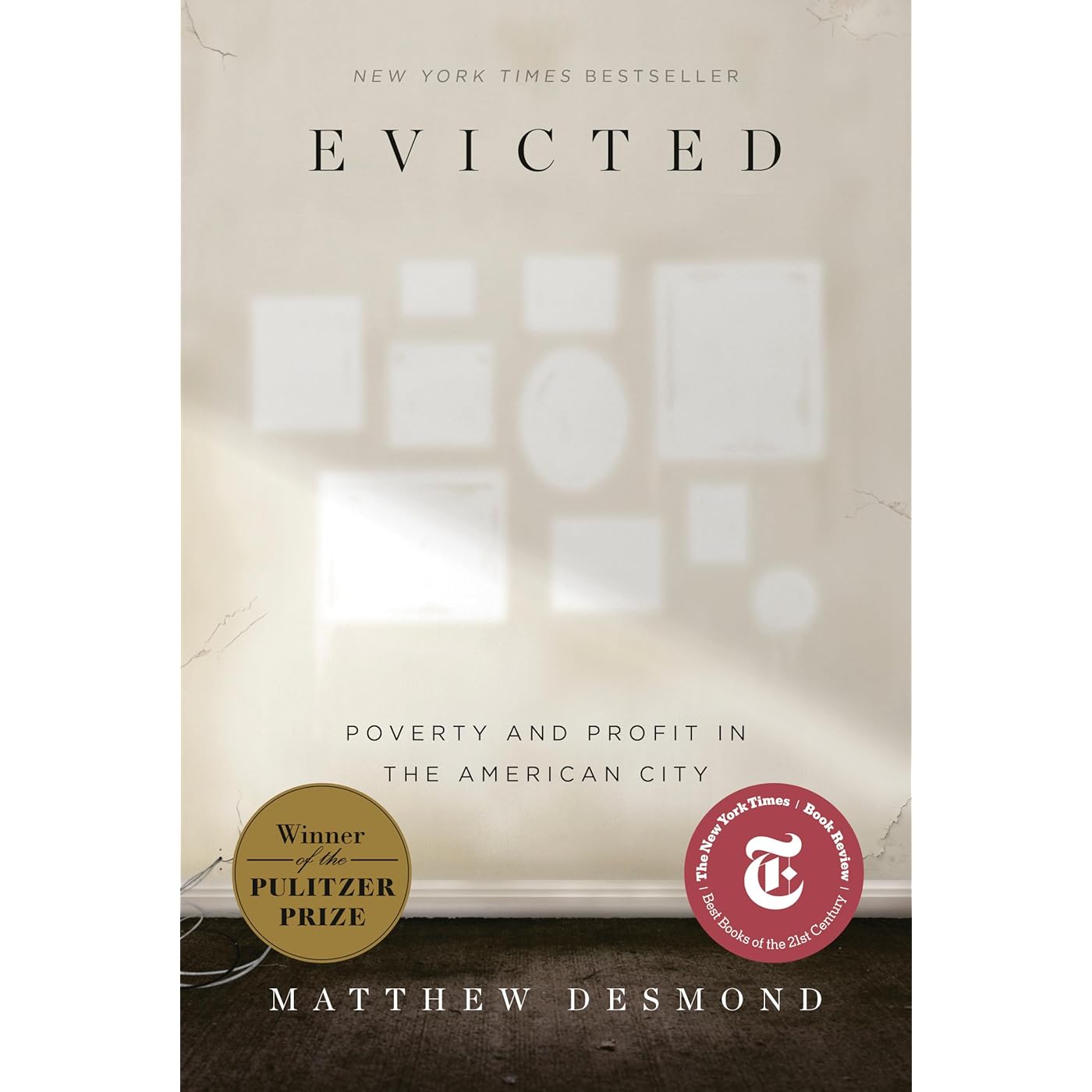
Evicted: Poverty and Profit in the American City

  • Based on 10,931 reviews
Condition: New
Checking for the best price...
$8.73 Why this price?
Save $11.27 was $20.00

Buy Now, Pay Later


As low as $2 / mo
  • – 4-month term
  • – No impact on credit to apply
  • – Instant approval decision
  • – Secure and straightforward checkout

Ready to go? Add this product to your cart and select a plan during checkout.

Payment plans are offered through our trusted finance partners Klarna, Affirm, Afterpay, Zip, Apple Pay, and Google Pay. No-credit-needed leasing options through Acima may also be available at checkout.

Learn more about financing & leasing here.

Free shipping on this product

FREE 30-day refund/replacement

To qualify for a full refund, items must be returned in their original, unused condition. If an item is returned in a used, damaged, or materially different state, you may be granted a partial refund.

To initiate a return, please visit our Returns Center.

View our full returns policy here.


Availability: Only 4 left in stock, order soon!
Fulfilled by Amazon

Arrives Monday, Oct 19
Order within 19 hours and 32 minutes
Available payment plans shown during checkout

Protection Plan Protect Your Purchase
Checking for protection plans...

Description

NEW YORK TIMES BESTSELLER • WINNER OF THE PULITZER PRIZE • ONE OF TIME’S TEN BEST NONFICTION BOOKS OF THE DECADE • ONE OF THE NEW YORK TIMES’S 100 BEST BOOKS OF THE 21ST CENTURY • A KIRKUS REVIEWS BEST NONFICTION BOOK OF THE CENTURY • AN OPRAH DAILY BEST NONFICTION BOOK OF THE PAST TWO DECADES One of the most acclaimed books of our time, this modern classic “has set a new standard for reporting on poverty” (Barbara Ehrenreich, The New York Times Book Review). In Evicted, Princeton sociologist and MacArthur “Genius” Matthew Desmond follows eight families in Milwaukee as they each struggle to keep a roof over their heads. Hailed as “wrenching and revelatory” (The Nation), “vivid and unsettling” (New York Review of Books), Evicted transforms our understanding of poverty and economic exploitation while providing fresh ideas for solving one of twenty-first-century America’s most devastating problems. Its unforgettable scenes of hope and loss remind us of the centrality of home, without which nothing else is possible. A BEST BOOK OF THE YEAR: President Barack Obama, The New York Times Book Review, The Boston Globe, The Washington Post, NPR, Entertainment Weekly, The New Yorker, Bloomberg, Esquire, BuzzFeed, Fortune, San Francisco Chronicle, Milwaukee Journal Sentinel, St. Louis Post- Dispatch, Politico, The Week, Chicago Public Library, BookPage, Kirkus Reviews, Library Journal, Publishers Weekly, Booklist, Shelf Awareness WINNER OF: The National Book Critics Circle Award for Nonfiction • The PEN/John Kenneth Galbraith Award for Nonfiction • The Andrew Carnegie Medal for Excellence in Nonfiction • The Hillman Prize for Book Journalism • The PEN/New England Award • The Chicago Tribune Heartland Prize FINALIST FOR THE LOS ANGELES TIMES BOOK PRIZE AND THE KIRKUS PRIZE “Evicted stands among the very best of the social justice books.”—Ann Patchett, author of Bel Canto and Commonwealth “Gripping and moving—tragic, too.”—Jesmyn Ward, author of Salvage the Bones “Evicted is that rare work that has something genuinely new to say about poverty.”—San Francisco Chronicle Read more

Publisher ‏ : ‎ Crown


Publication date ‏ : ‎ February 28, 2017


Edition ‏ : ‎ Reprint


Language ‏ : ‎ English


Print length ‏ : ‎ 448 pages


ISBN-10 ‏ : ‎ 0553447459


ISBN-13 ‏ : ‎ 53


Item Weight ‏ : ‎ 2.31 pounds


Dimensions ‏ : ‎ 5.13 x 0.94 x 7.98 inches


Best Sellers Rank: #7,737 in Books (See Top 100 in Books) #5 in Poverty #5 in Sociology of Urban Areas #6 in Sociology of Class


Frequently asked questions

If you place your order now, the estimated arrival date for this product is: Monday, Oct 19

Yes, absolutely! You may return this product for a full refund within 30 days of receiving it.

To initiate a return, please visit our Returns Center.

View our full returns policy here.

  • Klarna Financing
  • Affirm Pay in 4
  • Affirm Financing
  • Afterpay Financing
  • Zip Pay in 4
  • Financing through Apple Pay
  • Financing through Google Pay
Leasing options through Acima may also be available during checkout.

Learn more about financing & leasing here.

Top Amazon Reviews


  • Insightful and Thoroughly Researched Work
Format: Hardcover
In this work of non-fiction, Matthew Desmond, a Harvard sociologist, takes us to Milwaukee where we become intimately engaged in the lives of eight impoverished families. Among these, we meet Arleen- who is trying to raise her children on food stamps, Crystal – who has been in and out of the foster system since she was a young child, and Scott – who is a successful nurse-turned heroin addict who lost it all (among others). We also meet their landlords Sherrena (who owns many dilapidated inner-city units) and Tobin (the owner of a run-down trailer park). Through thorough and expansive research, Desmond walks the reader through the lives of these people — their decision making processes, the choices (and non-choices) that led them to where they are, and the laws and loopholes that work against the poorest and most vulnerable members of our society. To me, Evicted was an extremely worthwhile read, for many reasons. First, I do not read a lot of non-fiction, because the writing is often too clinical to hold my interest. This book though, reads like a novel. Desmond lived with, and visited with many of these families on a daily basis for three years. We come to know them as we would a friend, and he tells their stories in a chronological, plot-like way. I wanted to know what would happen next to each of them– I felt invested in their well-being, and frustrated when I read about their lives’ numerous drawbacks. Desmond did an excellent job of writing this book from a non-biased view. I personally believe this to be an accomplishment in and of itself; since he witnessed most of the noted events first-hand, I can only imagine how difficult it was to keep his opinion free and clear of his writing. Yet, he managed it and I appreciated that. I despise when an author tells me, either implicitly or explicitly how I am supposed to feel about about an event. In doing this, an author is not only suggesting that his/her thought and opinion is the “right” opinion, but also that I’m not intelligent enough to draw my own conclusions — which is an assumption based in condescension and inaccuracy, and is wholly insulting. Desmond left his own opinion out of his reporting – he recalled these events masterfully – completely and chock full of detail, but without any implied judgement. His writing is powerful, and allows the reader to form their own opinions. Further, Desmond provides the reader with significant background information regarding the laws around food-stamps, eviction processes, and the inaccessibility of resources for some of our cities’ most impoverished residents. Because he explained these laws and processes in layman’s terms, I was able to understand why a person might make the decisions that they did. I value logic, and when I cannot understand the logic behind one’s decisions, I become frustrated and impatient. For example, one of the women spent much of her food-stamp allocation for the month on lobster tails and lemon meringue pie. For one meal. Normally, I would think, “Now see — this, this here is the problem.” The author understood that his reader would feel this way, and went on to explain just how difficult it is to drive oneself out of grinding poverty. “People lived with so many compounded limitations that it was difficult to imagine the amount of good behavior or self-control that would allow them to lift themselves out of poverty….those at the bottom had little hope of climbing out even if they pinched every penny. So they chose not to. Instead, they tried to survive in color, to season the suffering with pleasure.” This actually made sense to me. I cannot even begin to imagine feeling so low, and with the author’s careful and logical explanation, I realized that until I live it, I shouldn’t judge it. This brings me to my final point. I admittedly understand little about our nation’s housing laws and the difficulties that are faced by those who live within the throes of urban decay. I know how expensive apartments are (the Boston area has some of the highest rents and mortgages in the country), and how exhausting the housing search can be. However, even at my poorest moments, when my bank account was completely in the red, I was not without my soft resources (successful parents who’d rather not watch their child become homeless or starve, friends with the ability and willingness to help, a graduate level education and the ability to procure a job that would pay me a steady salary). In short – I can’t fathom the struggle. The people highlighted in this book do not have these soft resources — they are completely on their own. The author surely knew that most of his readers, (with the ability to spend $13.99 on his book for their reading pleasure), might not be able to comprehend the lives and struggles that these people are living — but he made me want to try. I wasn’t left with any anger over the spending or perceived wasting of tax dollars; rather, I finished the book with a confused feeling – a “in what universe does that law make sense?” type of sentiment. I’m sure this was Desmond’s hope for his book, to provide his reader with an eye-opening experience which, at least in my case, was successful. To read more of my reviews, go to my blog at [...] ... show more
Reviewed in the United States on March 20, 2016 by Maggie L

  • Crushing, sobering, and extremely important that it be read.
Format: Kindle
Evicted is, simply, a heartbreaking work of staggering genius (to borrow from Eggers.) Desmond embeds himself into the very fabric of the modern poor, taking in and reporting on the experience of poverty from two different but similarly compelling perspectives. He weaves a frustrating tapestry that reveals what it means to be truly, unstably poor, but also provides interesting insights in the shape of in-depth stories from the perspective of the landlords involved. Every page reveals just how much effort went into telling these people's stories, and each story will make you gasp, shake your head, furrow your brow, and feel upset and helpless, while also granting you a sliver of enlightenment. Poverty isn't how it's portrayed on TV. It isn't a simple matter of being unwilling to work hard enough to pull yourself out of its grasp. Instead, it's a vicious circle, a complex, paradoxically expensive labyrinth that makes every day immeasurably harder—a systemic, societal failure that feeds back on itself over and over again, and a problem of compounding interest on simple mistakes made repeatedly, and then multiplied to devastation. This is a tale of people who don't typically have their story heard. It's an important exploration into what factors and events happen in a person's life that could cause things to get this bad. It's not a strictly apologetic piece, either: frequently those featured in the book explain that they know the mistakes they've made, and even sometimes continue to make, but that's what makes the circle so vicious. It's also a book with ideas, perspective, and context. It's crucial to know and see things from the landlord's point of view, for instance, and Evicted really delivers on this front. It's important to acknowledge that a class of people profit off of another class, ad infinitum, and that rules, processes, and systems conspire to make things even harder for the poor than they need to be. Further, it's important to acknowledge that while landlords make money, they're not strictly painted as the enemy here. Almost every one evicted in the course of the stories told admit that they effectively have it coming, and don't blame the landlord for doing what's necessary. You may have it in your head what it means to be poor, and you may have some opinions about what sort of people end up in these circumstances—what sort of people get evicted. But I guarantee you that Evicted will completely transform your way of thinking about these things moving forward. It's masterfully done, and the commitment to getting the details right and to reporting from the literal front lines of poverty should be applauded. These are stories that were difficult, backbreaking work to collect; that required a level of sacrifice and fearlessness that most wouldn't be willing to put forth. I can't recommend this book highly enough. It's crushing, sobering, and extremely important that it be read. ... show more
Reviewed in the United States on July 17, 2016 by Chris Cardinal

  • Slumlord's mantra: "It's All Good In the Hood."
Format: Hardcover
There are few books that have hit as close to home for me like Evicted has: I've been put out with everything I owned on the lawn. I've had to bring my son home to a rathole, with all of my 437.00 a month welfare benefit going towards rent. I've had friends and family offer to help, only to have them put me out at the same time they took my rent. When you've lived through eviction, hunger, extreme poverty, and inhumane housing you have a tendency not to forget it, as it's never far behind. Matthew Desmond's "Evicted" profiles several families, both black and white, who live in blighted communities in Milwaukee. He is granted unprecedented access into the lives of those being evicted, and shows how poverty, race, fragmented communities, and dysfunctional decisions contributes to being evicted. Invariably, the individuals featured in Evicted are the losers in a rigged system designed just for them. And where there are losers, there are winners profiting the aftermath. Quentin and Shareena Tarver are living the American Dream by renting subpar units to those unable to rent elsewhere. Shareena believes that the inner city ghetto is an untapped community asset, and that all is "good in the hood." Heck, a roach-infested apartment backed up with sewage is better than the streets. On the other side of Milwaukee is a white trailer park runned by Tobin, an older man who vacations in Florida while his tenants have no heat in the dead of winter. The trailer park's residents consider themselves lucky to live there, as anything is better than the Northside. If for nothing else in their bleak existence, they have their whiteness to hold on to. Other characters profiting on human suffering are Belinda the Expedition-driving rep payee, The movers who clear out homes of those evicted, the courts...poverty is profitable and offers job security. Then there are the many maddening, dysfunction decisions that result in the evictions. Spending your rent money on Luminare makeup. Spending the rent on your sister's funeral. Keeping friends around who ask all your neighbors for a joint. Its easy to lay blame the Evicted for their predicament, but when there is no hope for tomorrow and what matters is today, it becomes easier to understand why people take their rent money to help Katrina victims or use their food stamps on lobster. Desmond writes Evicted as part gritty nonfiction and part intricate ethnographic study. He does exceedingly well at this, while still retaining the elements of an engrossing story. The only qualm I had with Evicted is a lack of follow-up with the characters, as it would have been great to have that in the epilogue. Overall, this is a terrific read for anyone concerned about social justice issues. ... show more
Reviewed in the United States on May 9, 2017 by Paisley Princess

  • An Interesting yet heartbreaking read
Format: Paperback
I've served the poor community with a lot of my own personal time. I've seen firsthand what poverty can do to the lives of people. I've helped moved evicted substance addicted individuals out of homes and seen what a disastrous living condition looks like. So for me, the book wasn't necessarily an eye-opener for me in that regards. But I thought it did a good job illustrating how hard it is for people to break the cycle of poverty and eviction plays a big role in it. I thought it was a good raw, heartfelt documentation of the lives of a handful of poor and their landlords. I see people who have this book low ratings missing the point of the book. The author is not excusing the individuals in this book culpability in their struggles (i.e. buying lobster and crab on food stamps as Larraine did is asinine), but how one eviction can lead to another etc. He illustrates the problem with unaffordable housing the people in Milwaukee are experiencing. If you're familiar with the topic, it's not unique to Milwaukee. The author took 20 pages at the end to explain why he wrote the book, that his aim wasn't to offer all the solutions, but to encourage more research to be done on how to solve the problem. I think he did a great job tackling this from a different perspective. People who rate this low because they thing he's blaming the landlords, excusing the poor, or that he expects the government to solve all of these problems totally and completely miss the point of the book. He reported on what he saw in these specific individuals lives. He illustrated how not having enough money to buy basic necessities leads you down this path of desolation and its difficult to pull yourself out of it. My takeaway is that there is a broken housing problem in this country. In such a rich nation, we have millions living the way people are in this book, and as you can ascertain from even some of the reviewers, we don't care. His overall point is housing should be affordable. We should figure out a way to make it such by not eliminating landlords' right to make profit. He floated some solutions in the last 10 pages or so, but that wasn't his focus with this project. It's unfair to be critical about him brainstorming a few solutions when that was .03% of the book's content. All in all, it is a worthwhile read. And the author does a good job in furthering the on-going conversion in the housing crisis in this country. ... show more
Reviewed in the United States on May 15, 2021 by clifton pickard

  • Excellent and engaging book
Format: Kindle
This book is a must read for all Americans. We need to do better and we can… we just have it make it a priority to assist our most vulnerable citizens.
Reviewed in the United States on August 20, 2026 by Naomi

  • A Brilliant, Devastating, Dispiriting and Timely Ethnographic Study of our Affordable Housing Crisis
Format: Hardcover
Matthew Desmond's "Evicted" is a brilliant ethnography of poverty in America and its impact on one of humanity's most basic needs, shelter. "Evicted" calls to mind seminal ethnographic works like Jacob Riis's "How the Other Half Lives" and Michael Harrington's "The Other America". It is certain that "Evicted" will be at the top of virtually all 2016 best lists and is probably an odds on favorite to win top book awards for non-fiction. Desmond does his primary research (through first hand reporting that calls to mind Katherine Boo's remarkable "Behind the Beautiful Forevers") in Milwaukee by living among those he is “studying”. Milwaukee is a microcosm of broader trends happening throughout the rest of the country. Desmond does a brilliant job gaining proximity and trust among a wide range of people struggling through many hardships, some self-inflicted, others not. In spite of this proximity to his subjects, he is able to maintain role of impartial observer and never does one question any bias to about those he is writing about. The most harrowing aspect of "Evicted" is the vicious cycle the characters in the book (and others like them) find themselves confronting daily. There is virtually no margin for error in their lives -- any unforeseen event or small mistake has tragic and lasting consequences. Despite this, many display a fortitude to continue pressing on after multiple evictions, dead end housing searches, job losses, health tragedies, etc. The ability most show to take things day-to-day and continue marching on is remarkable. Their adversity would test others living in far better circumstances facing similar adversity. At the same time, Desmond doesn't try to portray any of the individuals as faultless in decisions that might have caused their problems. "Evicted" calls to mind another seminal work of the last few years, "The New Jim Crow". Where "The New Jim Crow" focused on mass incarceration of young African-American males, "Evicted", while not solely focused on African-Americans, underscores the significant impact eviction is having on African-American females. While the impact on African-American is tragic enough, the situation is even more devastating for African-American women with children. The long term implications of this are obvious --- children in formative years constantly moving schools, having to make new friends, etc. It was even striking even among most of the individuals Desmond follows, very few were struggling because of catastrophic medical situations which has been another factor leading to housing issues and homelessness. While much of the book covers those who've been evicted, Desmond does tackle the housing issue from the vantage point of the landlord. While there are challenges landlords face, I do find it hard to have as much sympathy for them as for tenants. Most of these landlords own multiple properties, particularly in these poorer neighborhoods. They make quite a bit of money off the less fortunate while minimizing investments in keeping their properties above the barely livable level. Since the “power” in the landlord/tenant relationship is often with the landlord, most have little incentive to address issues under legal order to do so. As a result, there is little incentive (and the constituent who would benefit has little political power) to have a more equitable system (like a broader national voucher program) even though it would likely alleviate evictions of tenants as well as force landlords to invest in their properties to upgrade the living conditions. At the same time, there would be benefits for landlords including less expense in the legal system and lost money due to unpaid rent. "Evicted" is an important, albeit dispiriting look at the widening gulf between rich and poor and the consequences the lack of affordable housing is creating on the poorest individuals in our society. A growing number of people are barely able to find shelter and even when they do, it is likely to be transient in conditions we'd barely tolerate for animals. Our shelters are bursting at the seams and many cities are facing homeless epidemics. Hopefully, "Evicted" can spur a broader public policy debate where we can find innovative solutions and programs that tackle this vast and growing problem. ... show more
Reviewed in the United States on March 29, 2016 by William Capodanno

  • Powerful look into the rental and eviction industry
Format: Kindle
I picked up Evicted: Poverty and Profit in the American City recently, and, given the eviction moratorium during the pandemic, I was curious to learn more. It’s been a long time since I’ve rented my home. Still, it’s impossible to get online without seeing articles and comments about homeownership being out of reach of upcoming generations. I wondered if Evicted might help illuminate more for me. The book is entirely based in Milwaukee but could easily be in any mid-size American city like Cincinnati, Raleigh, or Kansas City. Matthew Desmond, the author, spend years in Milwaukee living the poverty life and shadowing both tenants and landlords, white, black, male, and female. Evicted is mostly real human stories about life below the poverty line and the all-too-common lack of due process for evictions. This book has many heart-wrenching stories, and there isn’t always a happy ending. On the one hand, I found myself frustrated by peoples’ inability to better their circumstances. On the other hand, I was FURIOUS with the systemic issues and inequalities keeping people from even having a shot at improving their circumstances. It’s a vicious cycle meant to keep people down. The most crucial information in this book lives at the end in the epilogue and the “About This Project” sections. In these sections, you learn the toll this research took on Desmond. His interviews and shadowing took place in 2007-2008, but this book wasn’t published until 2017. Desmond explains that between his constant audio recording and written observations, he ended up with over 5000 pages of single-spaced notes. That would take anyone ten years to go through and pare down to create a story. Since this took place during the Great Recession, it makes you wonder how much worse things have gotten around the country since 2008, especially during the last two years in a pandemic. The same types of people Desmond interviewed in Milwaukee live throughout this country and are often in hourly-service jobs or essential jobs without adequate benefits. These people are often caregivers; some caring for adults, some caring for children, and some caring for both. What struck me in reading this book is the argument Desmond makes for the home being central to breaking negative generational trauma cycles. If you don’t have a stable home as a child (meaning physical location – psychological is a whole separate discussion), it’s nearly impossible to be able to focus on schoolwork. When a child is in survival mode all the time, there’s little space for learning and development, so these children fall behind, drop out of school, and often become parents – and thus, the cycle begins again. These systems and cycles disproportionately affect people of color, highlighting racial inequalities in other systems. I hope Evicted shines a light on the need for stable housing for all and shapes the political debate. As populations rise and the gap between the extremely wealthy and the rest of us grows, more and more people will experience unstable housing in America. There are some happy moments in Evicted, but not all stories have happy endings – or even resolutions. That said, it’s definitely a book you should read. ... show more
Reviewed in the United States on July 21, 2023 by Beguiled By Books

  • Extensive Scholarship About the Housing Crisis
Format: Paperback
Intellectually, I understood that there are problems in both directions (for landlords and for renters) in our housing market, ESPECIALLY after COVID. "Evicted: ..." was written in 2016, before the FIRST Trump occupancy of the White House. From the news, I understand that the problems have worsened exponentially since that time. In "Evicted: ... " we meet a slumlord (I'm straight out calling her that), Shereena, and many of her tenants, almost 100% Black. We also meet the manager and occupants of a trailer court, almost completely white, as Milwaukee was still highly-segregated in housing in 2016. At that time, there was little incentive for landlords to respond to tenant complaints about housing conditions, b/c if one group moved out or had to be evicted, there were basically folks lined up to take the place. And I had never understood the toll that eviction takes on the evicted individual, or that nearly 75% of evicted individuals were single mothers with families, and that folks with families found it next to impossible to find housing at all that they could afford, even in the ghetto. I have to warn you, this is a bummer of a read. However, the time invested by the author (years) in actually living in the areas he described, and the scholarship involved in then writing the book (the notes and citations are EXTENSIVE) make this a worthwhile read for anyone interested in the acute housing CRISIS in this country. Not only did Mr. Desmond delineate the problem so well, he also offered a possible solution for ameliorating the problem. 5 stars. ... show more
Reviewed in the United States on April 14, 2026 by Sherry Sharpnack

Can't find a product?

Find it on Amazon first, then paste the link below.
Checking for best price...