


Search  for anything...
NA

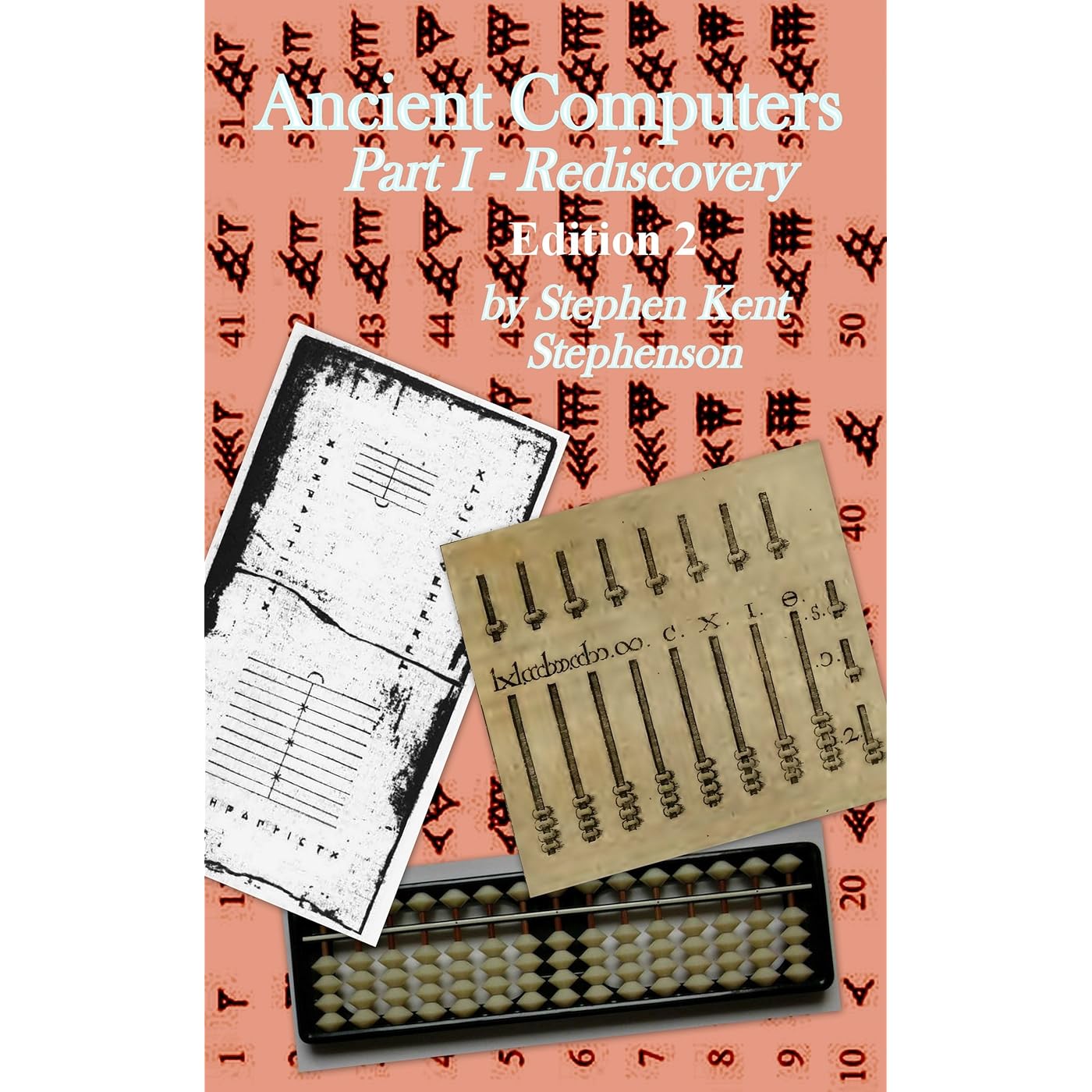
Ancient Computers, Part I - Rediscovery, Edition 2

  • Based on 5 reviews
Condition: New
Checking for the best price...
$4.38 Why this price?
Holiday Deal · 69% off was $13.98

Buy Now, Pay Later


As low as $1 / mo
  • – 4-month term
  • – No impact on credit
  • – Instant approval decision
  • – Secure and straightforward checkout

Ready to go? Add this product to your cart and select a plan during checkout.

Payment plans are offered through our trusted finance partners Klarna, Affirm, Afterpay, Apple Pay, and PayTomorrow. No-credit-needed leasing options through Acima may also be available at checkout.

Learn more about financing & leasing here.

Free shipping on this product

This item is eligible for return within 30 days of receipt

To qualify for a full refund, items must be returned in their original, unused condition. If an item is returned in a used, damaged, or materially different state, you may be granted a partial refund.

To initiate a return, please visit our Returns Center.

View our full returns policy here.


Availability: In Stock.
Fulfilled by Amazon

Arrives Wednesday, Dec 17
Order within 17 hours and 11 minutes
Available payment plans shown during checkout

Protection Plan Protect Your Purchase
Checking for protection plans...

Description

Ancient Computers is an excellent introduction to the calculating methods of diverse cultures across time. A mixture of history and practical techniques for understanding and using these ancient devices brings the tools of these long-forgotten civilizations to a wide audience. Stephenson writes in an easy- to-understand and accessible manner and the use of diagrams is extensive. Want know how to use an abacus or where it came from? This is the book for you! The book is appropriate for high school audiences and above. Dag Spicer Senior Curator Computer History Museum Mountain View, CA ===== The author ... makes two points that deserve wider dissemination. The first is that he sees the central dividing line of the Salamis Tablet as allowing an additive side and a subtractive side ... and notes that this approach, ‘reduces the number of pebbles needed tremendously’. It also makes many calculations easier. One cannot argue with his claims of increased efficiency and this point deserves further investigation. The author’s second substantive point is that in attempting to understand ancient mathematics, historians need to pay more attention to the available tools, technology, notation, and terminology to see how particular algorithms may have been performed. The author has a video of himself computing the square root of 2 using a set of Salamis Tablets following Heron's method. It takes him 25 minutes [to achieve the four sexagesimal digit precision of Yale tablet YBC 7289]. His argument is that [making and] using only [mathematical reference] tables and writing intermediate [cuneiform] results on clay would take a lot longer. From review by Prof. Duncan Melville, in Aestimatio, ===== People, especially historians, have long struggled to appreciate and understand how Ancient Romans, Greeks, Egyptians, and Babylonians, et al, were able to do their arithmetic calculations. Many say the Ancients "probably" used line abacuses or abaci, a.k.a. counting boards. But most then trivialize the possible impact that use would have on the Ancient cultures because they really don't think those abaci would be very powerful and that they would be extremely hard to use. The (re-)discovery this book documents and explores materialized from the author's experiences in engineering, with a knowledge that design compromises often have to be made; computer programming, especially the different number bases used; the hobby use of a Japanese abacus called the Soroban; and study of the Ancients' numbers and culture. The bottom line is that the Ancients had a powerful and lightning fast computer; powerful and fast compared to any other calculation method available to them in their time. Features included: - multi-base number modes: e.g., sexagesimal, decimal, duodecimal, or nonary; - operating on those numbers in two parts: a signed fraction of the base and a signed exponent of the base, equivalent to scientific notation; - easy and low-cost expandability; and - built-in error checking! On the "standard" Ancient line abacus doing base-10 calculations, the fraction could have 10 significant digits and the exponent 4. Certainly enough for most modern engineering or scientific problems. If you need more, though, just scribe a few more lines on the abacus and add a few more pebbles to your pouch! By the way, 170 small pebbles will suffice for any problem on the "standard" line abacus. They fit in a pouch that can be easily and comfortably carried in a man's trouser pocket. I hope you find Ancient Computers interesting and useful, -Steve Stephenson, July 15, 2010 ===== Edition 2 corrects some formatting issues and adds two appendices: N: Nonary Abacus as Candidate for Modern Electronic Implementation; and V: Visualizing the Basis of Abacus Arithmetic using Colored Chip Models. -Steve Stephenson, July 15, 2013 Read more

Publisher ‏ : ‎ Stephen Kent Stephenson


Accessibility ‏ : ‎ Learn more


Publication date ‏ : ‎ November 19, 2013


Edition ‏ : ‎ 2nd


Language ‏ : ‎ English


File size ‏ : ‎ 1.9 MB


Simultaneous device usage ‏ : ‎ Unlimited


Screen Reader ‏ : ‎ Supported


Enhanced typesetting ‏ : ‎ Enabled


Frequently asked questions

If you place your order now, the estimated arrival date for this product is: Wednesday, Dec 17

Yes, absolutely! You may return this product for a full refund within 30 days of receiving it.

To initiate a return, please visit our Returns Center.

View our full returns policy here.

  • Klarna Financing
  • Affirm Pay in 4
  • Affirm Financing
  • Afterpay Financing
  • PayTomorrow Financing
  • Financing through Apple Pay
Leasing options through Acima may also be available during checkout.

Learn more about financing & leasing here.

Top Amazon Reviews


  • Sympathetic and plausible speculation about the tools/techniques of ancient human calculators
Steve Stephenson, a retired engineer (and later retired schoolteacher) spent several years researching historical abacuses / counting boards, and thinking about how they might be used for complicated computations, taking the design of the Salamis Tablet (https://en.wikipedia.org/wiki/Salamis_Tablet) as inspiration. This book – also available as a webpage http://ethw.org/Ancient_Computers with associated Youtube video playlist https://www.youtube.com/view_play_list?p=545ABCC6BA8D6F44 – presents his findings. His ideas are somewhat speculative about the details, but what I like about it is that (a) he takes ancient technologies seriously instead of brushing them aside as obsolete relics [nearly every modern description of Roman numerals aimed at a popular audience talks about how terribly cumbersome they are, without bothering to explain their context or purpose, and mostly use them as a straw-man foil for Hindu–Arabic numerals which are presented as clearly superior], (b) he tries to reconstruct/invent working solutions to problems that would come up when attempting to do real concrete computations, approaching it as an engineer rather than a historian. In the context of primary/secondary schools, I think it would be great to teach this kind of arithmetic (as a supplement to standard Hindu–Arabic arithmetic, the Japanese Abacus, a slide rule, etc.) for a few reasons: 0) It requires almost nothing in the way of supplies. Just a pile of pebbles and some lines drawn on paper (or lines drawn in the dirt with a stick). 1) There is practically no rote memorization involved, but lots of pattern matching, discovery, and thinking about the concrete meaning of numbers. 2) Unlike a fixed-frame abacus, the counting board allows for unreduced numbers to sit on the board, and shows very clearly and explicitly the relation between reduced and unreduced numbers. The method of reducing a number to a standard form can be handled using tiny obvious steps in many possible orders. Other arithmetic operations can also be done in a variety of possible paths, as long as each step is valid. This is the core of algebraic thinking. 2a) The counting board can make use of “balanced” positional numeration, i.e. the use of negative numbers within a particular place value instead of only complete integers being positive/negative, and there is obvious symmetry between positive/negative versions – just flip everything across the divider line; I think the loss of this idea in Hindu–Arabic arithmetic as usually practiced and on fixed-frame abacuses is a real step back for conceptual understanding of more sophisticated later mathematics. 3) The counting board is a fabulous piece of our cultural history as humans, and it’s a shame that a mere 4–5 centuries of disuse (after millennia of use) have been enough to almost completely wipe it out of mainstream awareness (except as backgammon boards, and in the etymology of various words/phrases). Moreover, understanding the counting board makes it easy to understand what Roman numerals are for and how they function. Namely, they are the written record of finished computations, not a tool for actively performing arithmetic. 4) In Steve’s version, there is an explicit treatment of an exponent as an integer, instead of as just a movable position of a decimal point. This is a good stepping stone to scientific notation, the floating point arithmetic used by computers, and logarithms. 5) The counting board can be fluidly/easily adopted to many different number bases for different purposes, unlike Hindu–Arabic numerals. Students figuring out how to properly change the “rules” of the board to deal with new number bases will have to think deeply about the relationships involved and the fundamental nature of positional numeration. 6) In a modern era when electronic calculators can handle the rote performance of computation, it’s more important than ever to focus thinking on the *meaning* of numerical relationships, and the *design* of algorithms. The counting board does this very well. Pen-and-paper arithmetic might turn out to be more efficient if you need to multiply 1000 pairs of 4-digit numbers, but these days nobody needs to do that. Readers should treat this book as a speculative but plausible description of counting board methods and a practical guide for using a counting board in an effective manner, *not* as a work of precisely factual scholarship. Even if some of the proposals here turned out to be entirely different than Babylonians’ and Romans’ actual historical methods, they would still be worthy of consideration by primary and secondary school mathematics students. ... show more
Reviewed in the United States on November 15, 2016 by Jacob Rus

Can't find a product?

Find it on Amazon first, then paste the link below.
Checking for best price...