
Search  for anything...

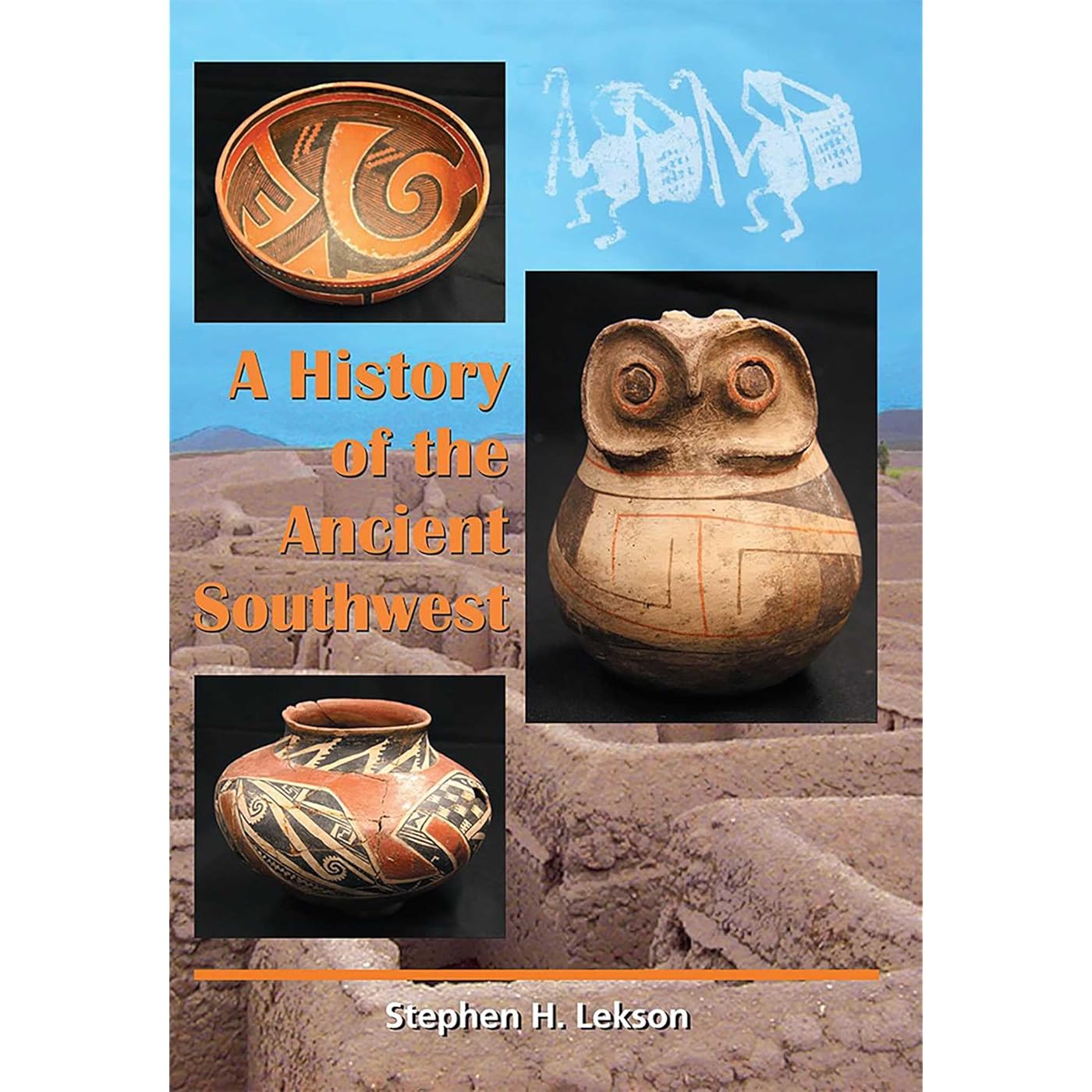
A History of the Ancient Southwest

  • Based on 50 reviews
Condition: New
Checking for the best price...
$33.00 Why this price?
New Year Deal · 17% off was $39.95

Buy Now, Pay Later


As low as $8 / mo
  • – 4-month term
  • – No impact on credit
  • – Instant approval decision
  • – Secure and straightforward checkout

Ready to go? Add this product to your cart and select a plan during checkout.

Payment plans are offered through our trusted finance partners Klarna, Affirm, Afterpay, Apple Pay, and PayTomorrow. No-credit-needed leasing options through Acima may also be available at checkout.

Learn more about financing & leasing here.

Free shipping on this product

FREE 30-day refund/replacement

To qualify for a full refund, items must be returned in their original, unused condition. If an item is returned in a used, damaged, or materially different state, you may be granted a partial refund.

To initiate a return, please visit our Returns Center.

View our full returns policy here.


Availability: 13 left in stock
Fulfilled by Amazon

Arrives Sunday, Feb 1
Order within 19 hours and 38 minutes
Available payment plans shown during checkout

Protection Plan Protect Your Purchase
Checking for protection plans...

Description

According to archaeologist Stephen H. Lekson, much of what we think we know about the Southwest has been compressed into conventions and classifications and orthodoxies. This book challenges and reconfigures these accepted notions by telling two parallel stories, one about the development, personalities, and institutions of Southwestern archaeology and the other about interpretations of what actually happened in the ancient past. Read more

Publisher ‏ : ‎ SAR Press


Publication date ‏ : ‎ June 22, 2009


Edition ‏ : ‎ First Edition


Language ‏ : ‎ English


Print length ‏ : ‎ 452 pages


ISBN-10 ‏ : ‎ 1934691100


ISBN-13 ‏ : ‎ 06


Item Weight ‏ : ‎ 2.1 pounds


Dimensions ‏ : ‎ 6.5 x 1 x 10.25 inches


Best Sellers Rank: #275,114 in Books (See Top 100 in Books) #593 in Native American History (Books) #2,962 in U.S. State & Local History


Frequently asked questions

If you place your order now, the estimated arrival date for this product is: Sunday, Feb 1

Yes, absolutely! You may return this product for a full refund within 30 days of receiving it.

To initiate a return, please visit our Returns Center.

View our full returns policy here.

  • Klarna Financing
  • Affirm Pay in 4
  • Affirm Financing
  • Afterpay Financing
  • PayTomorrow Financing
  • Financing through Apple Pay
Leasing options through Acima may also be available during checkout.

Learn more about financing & leasing here.

Top Amazon Reviews


  • A tremendous and highly readable account of the history and archaeology of the ancient Southwest
Format: Paperback
Like many American gringos, I am fascinated by the Native Americans of the Southwest -- both those living there today and those who lived there in pre-Columbian times and left thousands of ruins (including an impressive one less than two miles from my house). But I have long had a vague uneasiness about two things. First, I sensed that my perception of Indians of the Southwest might be "reverentially idealized". Second, I was somewhat bewildered by the profusion of "ancients" of the Southwest, scattered over the landscape like so many potsherds. Stephen Lekson's A HISTORY OF THE ANCIENT SOUTHWEST addresses those two personal concerns and much, much more. Lekson has spent his professional career as an archaeologist in the Southwest, and A HISTORY is a summation or synthesis of what he learned. He is intelligent and an independent thinker; he challenges orthodoxies ("Orthodoxies are comfortable, but they are not necessarily correct"); he is chary of faddish academic theories; he has a predisposition towards doing "history", using the plenitude of archaeological data (and working around the numerous gaps) to hypothesize what actually happened; and he tackles big picture issues rather than the quotidian minutia that is the staple of so many archaeology books. Moreover, he writes extremely well, with panache and nada academic pretentiousness, a generous measure of humor, and a refreshing dose of self-deprecation. A HISTORY covers a lot of ground -- far too much to communicate adequately in the space of an Amazon review. Lekson begins his survey in "Time Immemorial" and carries it through about 1600 and the Spanish conquest of the Southwest. He concentrates on the three major regions of prehistoric peoples -- Anasazi, Hohokam, and Mimbres -- and, surprise!, he discusses their interconnections and reciprocal relationships. He covers major settlements -- "capitals" even -- such as Chaco, the Phoenix Basin, and Casas Grande (or Paquimé). Believing that the Anasazi, Hohokam, and Mimbres were not hermetically isolated in the Southwest, Lekson even explores the influences of Mesoamerica and the Mississippi Valley (especially, Cahokia, which was coeval with Chaco). Parallel to his history of the Southwest, Lekson also writes about the history of archaeology of the Southwest -- the evolution of academic theories . . . and biases. He also covers major "external" drivers of the way archaeology has been practiced in the Southwest, such as CRM (cultural resource management) and NAGPRA (Native American Graves Protection and Repatriation Act). One of his themes is that the Indians of the ancient Southwest were not anything like current Native residents, such as the modern Puebloans, Navajo, Hopi, and O'odham. (How could they be the same, Lekson asks, after everything Europeans did to them?) He has a predisposition to examine matters "political" (how the Indians must have organized themselves) and an aversion to matters of ritual and religion. On the issue of religion, here is an excerpt that also serves as an example of Lekson's style: "Please don't ask me about the content of Hohokam religion. It's remarkably difficult to get a handle on the core doctrines of major modern religions, even with popes and ayatollahs laying down the law. Attempting to determine the principles of an ancient religion--gone for almost a thousand years--is probably a waste of time. We might ferret out hints and details, but think how easy it would be to misunderstand major modern religions from only hints and details." If you are wedded to a reverential, touchy-feely, New Age conception of the Indians of the Southwest, Lekson's book is not for you. If you have been trained as an archaeologist specializing in the Southwest, or if otherwise you are a serious student of Southwestern matters, Lekson's book will run counter to much that you have learned and possibly hold dear. But for an interested, intelligent (and, dare I say, "open-minded") layperson, A HISTORY OF THE ANCIENT SOUTHWEST is immensely informative and an exhilarating treat to read. It merits my highest recommendation. P.S.: Don't ignore the endnotes. There are nearly 100 pages of them (as opposed to 250 pages of text), and many of the textual endnotes are as interesting and informative as the principal text -- and even more witty or provocative. The book also contains about seventy illustrations, a lengthy bibliography, and an index. ... show more
Reviewed in the United States on July 12, 2015 by R. M. Peterson

  • A Radical History of the Ancient Southwest
Format: Paperback
The title of this book is best understood in the context of Lekson's reputation as a radical archaeological thinker - that is the only way to properly prepare oneself for the content to be found between these covers. In one sense, this book is a critical history of southwestern archaeology from 1500 to 2005. Lekson presents the evolution of the methods and the theoretical approaches to southwestern archaeology over time. Each punctuation in this evolution seeks to amend the perceived weaknesses of the previous generation. Lekson is no exception, presenting his own systems-thinking theoretical approach to southwestern archaeology as a remedy to the sui generis thinking borne of (among other things) outdated attitudes toward the Pueblos (but carried forward as a theoretical apparatus through inertia even as these attitudes have changed). In another sense, this book is a reinterpretation of the southwestern archaeological body of evidence dating from before 1500 BC to 1600 AD from Lekson's systems-thinking theoretical perspective. His mantra for this reinterpretation is "Everyone knew everything! No coincidences! Distances can be dealt with!" The result is a reinterpretation that ascribes realistic social attributes to the populations of the southwest throughout time. It is a reinterpretation that incorporates not just the Hohokam, the Anasazi, the Mimbres, the Pueblos - but also the Aztecs and Cahokia and so on as the interconnected elements of a continental social system of systems with ebbs and flows of people and ideas across all regions. In a third sense, this book is a hypothetical reconstruction of the history of the ancient southwest based upon the reinterpretation that precedes it. It is a history of the peoples of a region of great climatic adversity, and their response to this adversity in the form of near continuous experimentation with political forms. It is a whirlwind tale of political change, ranging from the Hohokam who achieved large scale public works while rejecting elites, to the Anasazi who achieved monumental architecture by embracing elites, to the Mimbres who picked and chose what was appealing from both, to the Pueblos whose cautionary oral histories are a clear rejection of all that went before. Humankind is creatively at its best in the face of adversity, and so there is a ring of truth to Lekson's working hypothesis. In a fourth sense, this book is an engaging popularization of southwestern archaeology, with the main body of the work oriented toward "those with more than a casual interest". In a fifth sense, this book is for budding and professional archaeologists, with nearly half of the volume devoted to technical notes and references. In being a Jack of all of these things, this book is in effect a masterwork of none of them - and trying to judge it in terms of one of these genres would miss the point. The only way to judge this book is on its own terms. With this book, Lekson's goal is to challenge the reader to reconsider the mainstream theoretical approaches to southwestern archaeology and look at the archaeological body of evidence from a new theoretical perspective. And, for me at least, this book ultimately succeeds in that respect. ... show more
Reviewed in the United States on September 15, 2011 by Ideophile

  • Not for the conservative southwest archaeologist.
Format: Paperback
Steve Lekson makes you think. And he’s funny, too. This book is an updated version of his first book on Chaco culture, The Chaco Meridian, and it’s very I tersting reading. He’s a big picture archeology, and makes the argument for a relationship between the Chaco culture of the San Jusn Basin, Aztec Ruin snd Salmon Ruin to the north, and the Paquime site in northern Mexico, and how these puebloan cultures may relate to the more southern mesoamericsn cultures as well. It reads like a narrative, and he’s often funny, knowing that some of his ideas Area a bit off kilter. The extensive notes backing up his clsims are at the end of the book, for those who want to get into in more detail. He recommends reading one of the more conventional books on ancient southwest culture before tackling this one, if you aren’t familiar with The ancient native cultures of the southwest. This is a good suggestion, which I followed before reading Leksons book. But it’s very readable, and it does make you think. Chaco is a strange puzzle to this day, and the experts are still all over the map on just what it was all about. I quite enjoyed it, and it will definitely make me think when I visit Chaco Canyon this fall. ... show more
Reviewed in the United States on June 7, 2018 by Sue M.

Can't find a product?

Find it on Amazon first, then paste the link below.
Checking for best price...