
Search  for anything...

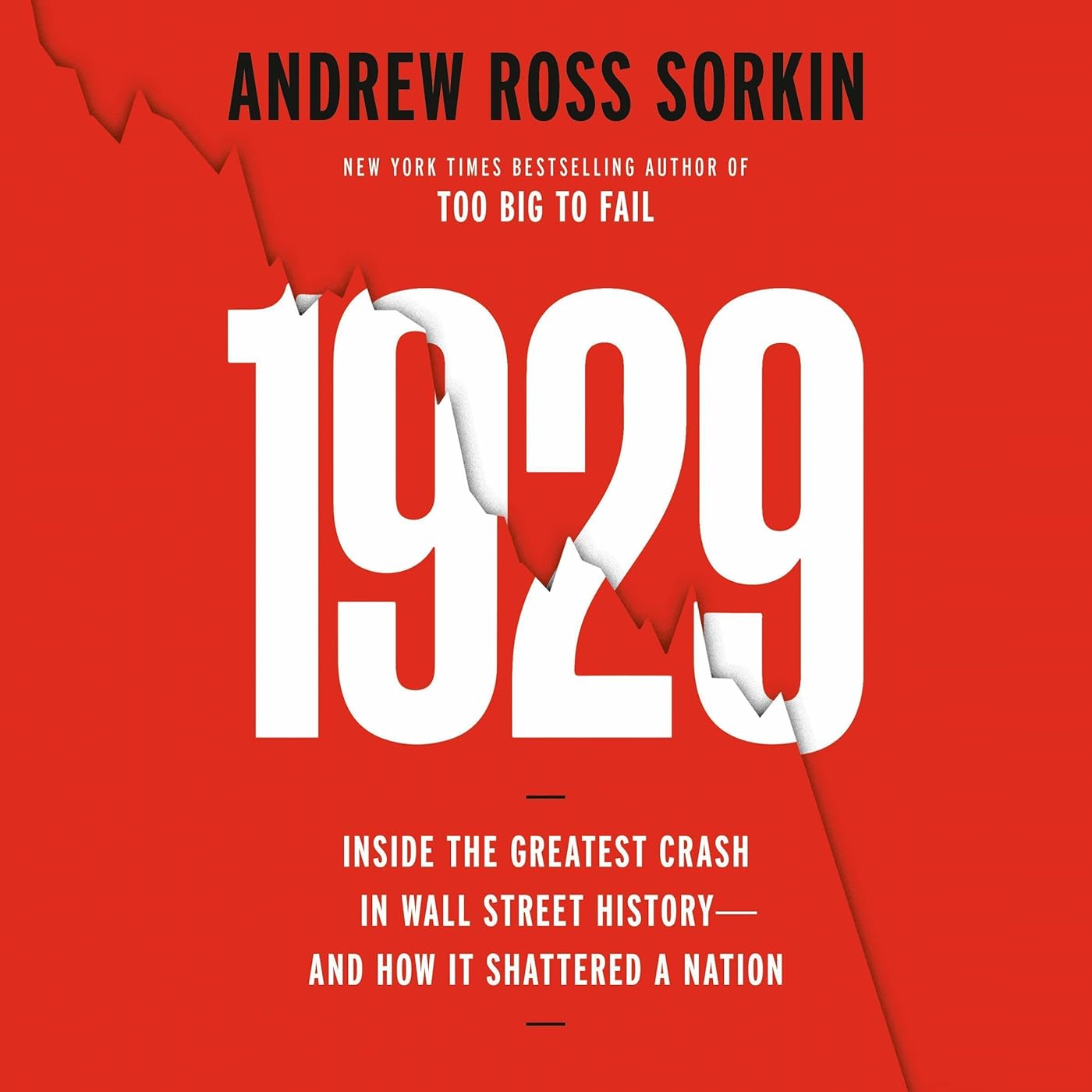
1929: Inside the Greatest Crash in Wall Street History--and How It Shattered a Nation
  • Based on 10,481 reviews
Condition: New
Checking for the best price...

Buy Now, Pay Later


As low as $6 / mo
  • – 4-month term
  • – No impact on credit to apply
  • – Instant approval decision
  • – Secure and straightforward checkout

Ready to go? Add this product to your cart and select a plan during checkout.

Payment plans are offered through our trusted finance partners Klarna, Affirm, Afterpay, Apple Pay, and PayTomorrow. No-credit-needed leasing options through Acima may also be available at checkout.

Learn more about financing & leasing here.

Free shipping on this product

This item is eligible for return within 30 days of receipt

To qualify for a full refund, items must be returned in their original, unused condition. If an item is returned in a used, damaged, or materially different state, you may be granted a partial refund.

To initiate a return, please visit our Returns Center.

View our full returns policy here.


Availability: 20 left in stock
Fulfilled by Audible,

Arrives Jul 17 – Jul 21
Order within 1 hour and 29 minutes
Available payment plans shown during checkout

Protection Plan Protect Your Purchase
Checking for protection plans...

Description

1 NEW YORK TIMES BESTSELLER “It is one of the best narrative histories I’ve read.” —The Wall Street Journal A New York Times Notable Book of 2025 One of Barack Obama's Favorite Books of 2025 Named a BEST BOOK OF 2025 by The Washington Post, TIME, The Economist, Air Mail, Bloomberg, Fast Company, Katie Couric Media, and History From the bestselling author of Too Big to Fail, “the definitive history of the 2008 banking crisis,” (The Atlantic) comes a riveting narrative of the most infamous stock market crash in history—one with ripple effects that still shape our society today. In 1929, the world watched in shock as the unstoppable Wall Street bull market went into a freefall, wiping out fortunes and igniting a depression that would reshape a generation. But behind the flashing ticker tapes and panicked traders, another drama unfolded—one of visionaries and fraudsters, titans and dreamers, euphoria and ruin. With unparalleled access to historical records and newly uncovered documents, New York Times bestselling author Andrew Ross Sorkin takes readers inside the chaos of the crash, behind the scenes of a raging battle between Wall Street and Washington and the larger-than-life characters whose ambition and naïveté in an endless boom led to disaster. The dizzying highs and brutal lows of this era eerily mirror today’s world—where markets soar, political tensions mount, and the fight over financial influence plays out once again. This is not just a story about money. 1929 is a tale of power, psychology, and the seductive illusion that this time is different. It’s about disregarded alarm bells, financiers who fell from grace, and skeptics who saw the crash coming—only to be dismissed until it was too late. Hailed as a landmark book, Too Big to Fail reimagined how financial crises are told. Now, with 1929, Sorkin delivers an immersive, electrifying account of the most pivotal market collapse of all time—with lessons that remain as urgent as ever. More than just a history, 1929 is a crucial blueprint for understanding the cycles of speculation, the forces that drive financial upheaval, and the warning signs we ignore at our peril. Read more

Listening Length: 13 hours and 30 minutes


Author: Andrew Ross Sorkin


Narrator: Andrew Ross Sorkin


Whispersync for Voice: Ready


Audible.com Release Date: October 14, 2025


Publisher: Penguin Audio


Program Type: Audiobook


Version: Unabridged


Language: English


ASIN: B0DXQFKTBN


Best Sellers Rank: #310 in Audible Books & Originals (See Top 100 in Audible Books & Originals) #1 in Banks & Banking (Audible Books & Originals) #1 in Economic History (Books) #1 in Economic History (Audible Books & Originals)


Frequently asked questions

If you place your order now, the estimated arrival date for this product is: Jul 17 – Jul 21

Yes, absolutely! You may return this product for a full refund within 30 days of receiving it.

To initiate a return, please visit our Returns Center.

View our full returns policy here.

  • Klarna Financing
  • Affirm Pay in 4
  • Affirm Financing
  • Afterpay Financing
  • PayTomorrow Financing
  • Financing through Apple Pay
Leasing options through Acima may also be available during checkout.

Learn more about financing & leasing here.

Top Amazon Reviews


  • Enjoyable, Extremely Well-Written, Not Afraid of Uncertainty or Nuance
Format: Hardcover
This was a terrific read! 1929 is the type of non-fiction we all long for – interesting, factual, balanced, and avoiding minutia that can render too much of works in this genre a dry slog. Sorkin takes a broad cast of characters and intertwines their actions during the pivotal year leading up to the Great Crash. Enough background on the players is given to separate them from the large cast without drowning reader attention in an avalanche of extraneous biography. (Would that the great author Ron Chernow have embraced this in his too long recent bio of Mark Twain) The book pacing is excellent. Characters act and interact over relatively short pages in the many chapters, with important occurrences given a bit longer treatment. As the play navigates among bankers, Wall Street manipulators, Federal Reserve officials and politicians, their actions and non-actions weave a connected story that sets the stage for the great calamity we know to be ahead in late October. While Sorkin does what a lot of nonfiction authors do and ascribes thoughts and descriptions that I am sure he in some cases invented, they ring very true and plausible due to great sourcing and believability due to what we know about his cast. Finance and banking can be a dry morass to those unfamiliar with the field. One of the great accomplishments of this book is Sorkin's ability to skillfully, simply, and effectively convey financial structures and strategies for lay readers. Anyone not familiar with stock pools and bear raids, partnerships like JP Morgan, short selling, margin accounts and a host of other financial practices that figure in the story need not worry. This book brilliantly reveals them without making them seem like future exam questions in a finance course. Credit to the author for his confidence with the unknown and his ability to see two sides of a situation. I think many want an answer to why the 1929 crashed happened and who was to blame. Beyond the obvious "irrational exuberance" that flooded the market with the emergence of unknowledgeable retail investors using high margin accounts as a buying source, there were a lot of practices that were questionable and risky. However, it is still all these decades later unclear as to what was the specific trigger or major factor that may have loomed above others in precipitating the great decline. As Sorkin's information and telling shows, the entire system needed transparency and safeguards. It is not altogether clear even today what worked and what didn't in terms of all the reforms made in the 1930's. Clearly audited financial statements and limits on margin accounts have added a lot of informational confidence and reduced a lot of risk in the market. But, the Glass-Steagall separation of commercial and investment banking (touted as a major necessity to right our financial markets) has been greatly relaxed (in the 1990s) to no apparent ill effect. Still unclear is how much deposit insurance (the Steagall part of Glass-Steagall) is appropriate without eliminating depositor attention to the risks of their local bank. Sorkin describes well this moral hazard issue – a real issue in many federal financial changes made and contemplated to this day). I like the fact that Sorkin is confident to present as uncertain what is uncertain and acknowledge that we just don't and won't be able to unwind causation from all the many strands making the 1920's market, except at a broad level. The cast of characters are terrific as well. Dumont, Mitchell, Lamont, Glass, Roosevelt and others are colorful and fascinating. I particularly liked his focus on John Jacob Raskob (being a Delawarean and familiar with him because of the huge impact he had here). Raskob was a significant and brilliant financial and corporate innovator who went on to run the DNC as Al Smith's chief enabler and build the Empire State Building (as an aside, there is a terrific bio of Raskob worth picking up called "Everybody Ought to Be Rich.") Particular attention is worthy to pages 443 and 444 where the author sums up his grand takeaway from this exercise. I believe he is absolutely correct in highlighting human nature as the real story here. In about a page he succinctly and memorably casts the whole drama and what came after as a display of human nature. I think he is correct in this summation. The author's humility at not claiming a bright sparkling new "discovery" with his work (a tiresome and unnecessary coda for too much non-fiction) is impressive. I rather like it and really think highly of this book. ... show more
Reviewed in the United States on January 16, 2026 by Wayne A. Smith

  • Not In Our Stars, but in Ourselves
Format: Hardcover
Andrew Sorkin's book on the Crash of 1929 is a delight to read. The praise that has been showered upon it is well deserved. It is well researched and so well organized and so well written that it reads more easily than the morning paper. Sorkin's interest is not so much in the details of stock trading and margin calls but in gaining some purchase on the dark heart of human greed that drives all market bubbles. For Sorkin the Crash is not something that is best understood through the application of macroeconomic analysis-- thank goodness-- but through the story of human ambition darkened by human avarice. This story is necessarily one of tragedy. The Crash is not so much to be explained as to be narrated. This narrative requires our sympathy more than our judgement. We cannot understand market bubbles, he implies, unless we understand human nature and how we are all susceptible to enticements that make little sense as well as the need to assign blame and identify virtue. We know we are reading a very different approach to the Crash when the story opens with "Sunshine" Charlie Mitchell bounding up the "steps of 55 Wall Street" where he will exert his usual "confidence and certitude" on what was the "crushing afternoon" of October 28, 1929. Apparently, the key to understanding that fateful afternoon lies not in complications of stock trading but in understanding the temperaments of the men who made the trades, launched the schemes, and reaped the benefits. Sorkin is careful, however, to keep his story from becoming a morality play. He shows us the characters and asks us to find a connection with them, an affinity, so that when the tragic moment comes, we do not so much as judge them as identify with them. This is no small achievement. In this book Sorkin becomes Eric Larson and the Crash of 1929 becomes our story as well as the story of Sunshine Charlie, Tom Lamont, Will Durant, George Whitney and all the others. This is high praise. When George Whitney comes to beg a personal loan from fellow Morgan Partner Tom Lamont after discovering that his brother Richard Whitney had been stealing money from clients in his bond trading firm, we feel deep sadness for how people can fail, pity for one brother trying to help another brother, admiration for a partner bailing out a colleague, and a sense of head shaking disgust for how we all lie to ourselves in such moments. It is here we realize again that Sorkin is giving us a history more akin to Greek tragedy rather than an analysis of how markets fail or of how banks and investment firms need to be regulated. Sorkin does this at every moment in his story of the history of the Crash. And he does it masterfully. The story of the Crash becomes something of a Vanity Fair. Sorkin does not lecture the reader, he simply invites our sympathies to understand, or better, he implies that understanding requires our sympathies. Before reviewing the final tragic act in the life of stock shorting master Jesse Livermore, Sorkin poses a rhetorical question for the reader: "What did it feel like to move through the world of money and power with complete confidence, only to see it all vanish, as if you were no less expendable that those living in Hoovervilles?" This is another masterful move-- he asks us in the end to see Livermore, the avaricious short-seller who made a hundred million dollars shorting stocks in the Crash, who sits at a table in the Stork Club bereft of his fortune, as one of the inhabitants sitting in the shanty of a Hooverville. Then he adds one of the best lines in the entire book: "The male ego certainly took a beating in the aftermath of the crash." What?! Was it aggressive male greed that brought this all about? Yes, he implies, and in fact he is certain of it. Then just a few short lines later he offhandedly notes that Livermore is his wife Harriet's fifth husband. Masterful. Sorkin has given us something new. A new way of understanding financial markets, bubbles, crashes, government reactions to such things, and why they happen. He has given us nothing less than a new set of questions to ask about these moments of economic disaster. Why, he asks, is the project of constructing the Empire State Building launched in the midst of the market run up to the Crash? Is it just coincidence that the phallus of American commerce was erected when it was, or is there some portent here? Mercifully Sorkin does not explore this question more than simply imply it. He lets us do the work, draw the connection (or not), and wonder about the role of male ego in all of this. Even President Hoover gets a softer, gentler review. Long the punch line and scapegoat for what went wrong, Sorkin cautions us to slow down and look again. Hoover is portrayed as trying his best. Isn't that all any of us can ever do? Roosevelt, long celebrated as the savior in our darkest hour, is presented as woefully cheery and optimistic and lacking in knowledge of banking and economics. Somehow Sorkin makes this portrayal refreshing. Sorkin knows that the explanation he works to reveal does not lie within the kind of analysis published in academic economics journals, but within the mystery of dark hearts and pitiable human foibles. To this end John Maynard Keynes is hardly mentioned, nor is Friedrich Hayek. Irving Fisher and Roger Babson are granted entry into the drama but only to show that one of them got it right (Babson) and the other, the most famous economist in America at the time, Fisher, got it wrong. Perhaps wisely, Sorkin refrains from drawing easy parallels to the overvalued markets of today. Again, he leaves that to the reader and to his comments on television as he promotes this fine book. That is as it should be, but make no mistake, this story of the Great Crash of 1929 and the Great Depression that followed, is completely relevant to today. This is a great book. ... show more
Reviewed in the United States on November 22, 2025 by Gil Greggs

  • Like a great character driven horror story. Some gaps as a history but still worth reading!
Format: Kindle
Andrew Ross Sorkin does a great job of making this a riveting story about human foibles and sometimes human virtues. I agree with a couple of reviewers who say this is the strongest part of the book. By vividly and objectively illustrating how the main characters acted before and after the crash he teaches valuable and fascinating lessons worthy of a great comedy or tragedy. I especially agree with the way he closes the loop on Jessie Livermore, the famous subject of “Reminiscences of a Stock Operator.” I won’t spoil it here, but there are valuable life lessons to learn from that. I also really appreciated that the crash is actually the middle and not the end of the book. He does a great job of following through to explain what happened afterward, and takes a 360 degree view of politics, economics, and individuals. That is another real strength of the story, and maybe the aftermath is even better than the run up itself. His description of the “black” days of panic in October is worthy of any great horror writer. I actually felt real fear in reading them. While I admire his attempt to bring some balance to the blame Hoover got for the depression, I did scratch my head at one dubious claim he makes, based on a poll of metropolitan residents, claiming that in 1932 Americans really believed the Depression was over and instead elected Roosevelt based on ending Prohibition. This is the first time I’ve ever heard that and I found the claim so non-credible that I laughed out loud. That poll is almost for sure bogus and I was surprised Sorkin cites it so credulously. The other place where I would have liked a little more depth was his explanations for the weaknesses in the financial system prior to the crash, and his explanation for its causes. What were “bucket shops” and “investor pools”, how did they function, how much of the market were they really, and were they as important as trading on margin as contributors to the crash? Were there enough Americans actually trading on margin to have brought down the banking system? Or was something else behind the banking panic? While the character studies were excellent I found the analysis a little scattered and underwhelming. You wonder if Michael Lewis would have helped here. All in all I gave it four stars because the strengths of the book - his narration, character descriptions, and pacing - well overcome the weaknesses, especially if this is an introduction for the reader. ... show more
Reviewed in the United States on March 21, 2026 by Eric Samuels

  • "1929" by Andrew Ross Sorkin
Format: Hardcover
"1929" as you could guess centers on the events that resulted in The Great Depression, especially the Stock Market Crash of October 1929. The strength of this telling is that it humanizes many of the actors whose actions helped shape the event and its causes and consequences. Additionally, Mr Sorkin gives you a flavor of the times by helping to show why these individuals acted as they did and how it wound up affecting the nation. The Great Depression in the USA lasted from October of 1929 until about 1939. That was over twice as long as the US involvement in WW2. My parents were born in 1929 and 1932 - children who grew up in the Great Depression and their parents were faced with the task of raising a family in those uncertain times. This strongly affected my grandparents and to some degree my parents. Whole generations were shaped by these events. I read the hardback version, and it is nicely illustrated and printed. The book is obviously well researched (there are 100 pages of reference notes in the back). Mr Sorkin did his homework. The main story is ~450 pages long. It is a relatively easy read, mercifully the author has mostly used plain English to tell the story with a minimum of specialized vocabulary. Be prepared to at least come away from the book with a different perspective on these events. I grew up with a simplified story of what happened and why a Wall Street Panic was part of what resulted in an economic depression. Mr Sorkin gives a more nuanced version that helps you to understand that it was the culmination of trends - like more liberal consume credit to increase sales of everything, the attitudes and values of the bankers, the speculators, and the theory of government at the time. I came away with a better understanding of some of the key individuals and their values and motives. I also came away with the impression that under the rules and values of the times, it was likely only a matter of time until the boom of the 1920's turned into the depression of the 1930's. It wasn't a magical date when the panic came, there had been some close calls before October 29, 1929. It was like a pot simmering and beginning to boil and then suddenly boiling over. Stock speculators and stock pools (secret groups of investors who are intentionally rigging the market for what we now call a "pump and dump") intentionally acted to jack up the price of a stock they secretly bought cheaply and then with news, rumors, and trading within the pool they pumped up the price. And then they sell out leaving the uninitiated later to be stuck with overpriced stocks while the pool profits handsomely. And these things were quite legal at the time. On the opposite side, the "bears" sensing a potential weakness in a stock, shorted the stock (sold shares they didn't own yet with the intention of buying later to make good on their initial sale) and did everything they could to drive the stock's price down to make money on the decline. The sale of stocks on margin made the system unstable in the event of a decline in value. Margin was loaned money from the brokerage with the stock as collateral in which the buyer put up as little as 10% (the margin) of the stock cost but was ultimately liable for up to the whole purchase price if the stock declined below the margin. It wasn't just the investment class who used this - It was middle class America who got their savings wiped out by the crash. When the crash came there was panic selling and not even the investment bankers collectively could pump in enough cash to limit the financial carnage without many of them being wiped out financially. When the market was rising, margin buying multiplied the gain of the investor, but when it was falling it multiplied the financial disaster. After close to a decade of mostly a rising market, people were lulled into acting as if the market only went up. Overall, the book is well written and quite readable. My Sorkin has done a very good job of helping you to understand the character, values, and motives of some of the key people who unwittingly created the most severe and prolonged depression the USA has seen so far. Some were not much better than pirates with nice manners and the trappings of wealth. Some were motivated by loyalty to their group, firm, colleagues, and friends above the greater good. And some were seemingly hapless victims In the wrong place at the wrong time with good intentions but not the nature or skill to accomplish what was needed to save the day - Like President Herbert Hoover. The frightening thing is not the tragedy that took a decade to completely play out, but the parallels you notice with the risks of today. Crypto is one of the the new risks plus the hint of war in the background. A few people are warning us, but as long as people are making money like in the "roaring 20's" nobody is listening. Just as the collapsing rural economy of farm workers displaced by farm machinery made many rural banks already at risk of failing, AI risks putting at least some workers out of a job in the future - and that will have consequences. I finished the book up last night to this morning between 2 AM and 7 AM - It really is a good read, and I recommend it if you have an interest in the history of the 20th century or in understanding how economic systems and human psychology interact. ... show more
Reviewed in the United States on January 1, 2026 by Charles W.

  • This is a Compelling, Informative Read
Format: Hardcover
If you’ve ever wanted to know what went on behind the scenes during the epic stock market boom and bust of the 1920’s, this book’s for you. It’s all about bankers and banks, especially New York City’s big investment banks. But don’t just yawn and push it away. The author meticulously researched the topic, from private letters, public and private collections, government files, personal interviews, and newspaper and press files. His story exposes an intimate view of the lives and families of the principal players. At the front, he gives a cast of characters in the story, along with their professional affiliations—very useful for keeping the reader on track. The book is over 400 pages, but its page design and typeface allow for easy reading, even late at night. The author builds the tension with each chapter, and you will want to start the next. The author explains how excessive borrowing of money for speculation on the New York stock exchange led to a meteoric run up of the Dow-Jones average. He describes the quasi-legal, but immoral schemes the banking executives used to manipulate the market and create profits for themselves—to the disadvantage of smaller investors. Deep-pocketed investors pooled massive amounts of money to buy or sell huge blocks of stock to force the stock price up or down, as needed. The over-rich banking executives formed an aristocracy in New York and around the world, living luxurious lives in multiple palatial homes. The bankers placed big, leveraged bets on the markets, making or losing outrageous sums of money on a single trade. Small investors across the country borrowed money to join in the speculative orgy, hoping to get rich quick. When the bubble popped, banks throughout the country did not have the money—all loaned out—to pay frantic depositors clamoring to get their life savings back. Thousands of banks failed. The resulting Great Depression led to massive, long-term unemployment and breadlines. The Dow-Jones did not recover its pre-crash high until 25 years later. President Herbert Hoover—a believer in keeping the government out of the financial markets—started a widely publicized Senate hearing on the cause of the crisis, which struck a favorable chord with the public. Franklin Roosevelt, the incoming president, temporarily closed the nation’s banks, took the dollar off the gold standard, and increased the money supply. He sensed the public’s mood for banking reform and instituted banking protections we enjoy today: separation of investment and commercial banking, federal deposit insurance (FDIC), and securities and exchange commission (SEC). I believe the author was a little soft on Hoover, often cast as the villain, and pressed a bit hard on Roosevelt. Will it happen again? Probably. Will it be as bad? Not likely, unless our current government continues to chip away at banking regulations. In the concluding words of the author: “… the forces that drove the market to such stratospheric levels—optimism, ambition, and the belief that the future could be endlessly brighter—did not disappear forever. They never do. … we need to remember how easily we forget … The greater the heights of our certainty, the longer and harder we fall.” As they might say in New Orleans, “Laissez les bons temps roulez!” ... show more
Reviewed in the United States on November 15, 2025 by ZumDum

  • “Déjà vu all over again.” (Yogi Berra)
Format: Kindle
The great stock market crash of 1929 was one of the defining moments of the twentieth century. The market ultimately lost 80% of its value, more than 1,000 banks were wiped out, and, more importantly, Americans’ trust in the financial system was greatly undermined, with lasting consequences. This is not a financial primer. It is the story of the people involved, in all their humanity. As Sorkin explains, he sought “to restore the texture and detail of the human lives at the center of an epic historical event.” And he does that masterfully, without judgement. To his credit, the reader is not told how to react. As Walter Cronkite might have said, ‘That’s the way it is…’ There is no consensus as to whether the great crash caused the great recession. There is more than a coincidence in timing, but both were the result of common themes as well. The biggest culprit was debt. Institutions and individuals alike were drowning in it, much of it used to buy stock on speculation, without taking the time to understand the mechanics of leverage and, ultimately, deleverage. (Mathematically, deleverage is far more powerful when it comes to financial matters.) Investors deluded themselves in an addictive cocktail of excessive exuberance and borrowed funds. Some good did come out of the crash, such as the Glass-Steagall Act, which formally separated investment and commercial banking, as well as government deposit insurance for consumers. More than anything else, however, it was a grim reminder that government guardrails, properly applied, are essential to countering the behavioral excesses that inevitably flow from self-interest. The underlying message, for me, although Sorkin never explicitly states it, is that all of life is personal and we, as humans, are essentially selfish. The saga, at its core, is the saga of individuals exuberantly pushing a perspective that is in their best interests. While not evil, or even corrupt, necessarily, there is little selfless heroism. The writing is crisp and clean. You do not have to be a financial analyst to understand it. He assiduously avoids the technical jargon of the industry. This is a narrative about people, not the stuff of an MBA classroom. Beyond just being an enjoyable and informative read, perhaps the best reason to read this book are the parallels between 1929 and today. The similarities, particularly the crushing debt currently suffocating most consumers and the federal government. Consumers are using the debt to get by instead of buying stocks, but the effect is the same. It is a house of cards. So, even if you aren’t a fan of history, I highly recommend you read it. It will give you great insight into what is happening around us today. ... show more
Reviewed in the United States on January 12, 2026 by Gary Moreau, Author

  • Missed the boat
Format: Hardcover
Good book regarding tracking down the dates, timetable, and players involved in the 1929 stock market crash. Also, a timely read as the country and the world are approaching another potential market crash. Explains how big bankers and other insiders controlled the markets and took advantage of the unknowledgeable public individual investor. Falls short on the big picture of what else was going on during this time period that would have added perspective. Doesn't fully explain the creation of the Federal Reserve, doesn't mention income taxes, doesn't put into perspective the impact of the second industrial revolution, and doesn't fully explain prohibition to name a few. ... show more
Reviewed in the United States on February 26, 2026 by steve

  • "1929" Through the Lens of Two Great Books on Human Behavior
Format: Hardcover
I am going to frame Andrew Ross Sorkin’s 1929 through the lens of two books I’ve really liked for years: Sway by Ori and Rom Brafman*, and The Black Swan by Nassim Nicholas Taleb. Reading Sorkin’s book with those ideas in mind made the whole story of the crash feel less like distant history and more like a real-world example of how people think, react, and get things wrong. What jumped out at me is how much 1929 lines up with the ideas in Sway. The Brafmans explain how people fall into predictable traps, like sticking with bad decisions because they’re already invested, or following the crowd because it feels safer than standing alone. Sorkin brings those ideas to life through the financial people of the time. You can feel the loss aversion, the overconfidence, and the groupthink happening; the blindness (whether by choice or not) by many. It’s not theory, it's human nature playing out on a massive scale. Then, the Taleb angle. The Black Swan is all about how we underestimate rare, high-impact events and convince ourselves that the world is more predictable than it really is. Sorkin doesn’t call the 1929 crash a Black Swan per se, but he shows exactly the kind of thinking Taleb warns about: people just know the good times would keep rolling, leaders believing they had everything under control, and a system built on the idea that nothing too dramatic could happen. When the crash hit, it wasn’t just a market failure; it was a failure of imagination, a failure of examining all facets of a situation. (I am convinced, based on these books and being a history enthusiast, that is a big lift for anyone.) What I appreciated most about 1929 is how human it feels. Sorkin doesn’t just list facts; he shows the emotions behind them. Normal people, making normal decisions, helped create a crisis that spiraled, way more than anything they could conceive (or tried to conceive). It’s a reminder that markets aren’t machines; they’re reflections of us. Taken together, these three books make a powerful trio. Sway explains why people make the choices they do. The Black Swan explains why we’re so bad at seeing big risks coming. And 1929 shows what happens when those two forces collide in the real world. If you like history or psychology, or just want a deeper understanding of how financial disasters actually happen, 1929 is absolutely worth reading. If you simply enjoy reading the work of a superb reporter, this works. Sorkin is a terrific blend of reporter, researcher, and analyst. ---- * Note: I developed a year‑long curriculum to help emerging young leaders in the Carolinas’ energy industry build real personal leadership skills. A pillar of the program was the book Sway. It pushed them to think analytically for themselves rather than simply following trends, or, more importantly, defaulting to whatever their boss thought. Every year, that book landed. It opened their eyes, challenged their assumptions, and became one of the most consistently valuable parts of the entire program. ... show more
Reviewed in the United States on March 15, 2026 by Scott

Can't find a product?

Find it on Amazon first, then paste the link below.
Checking for best price...