


Search  for anything...

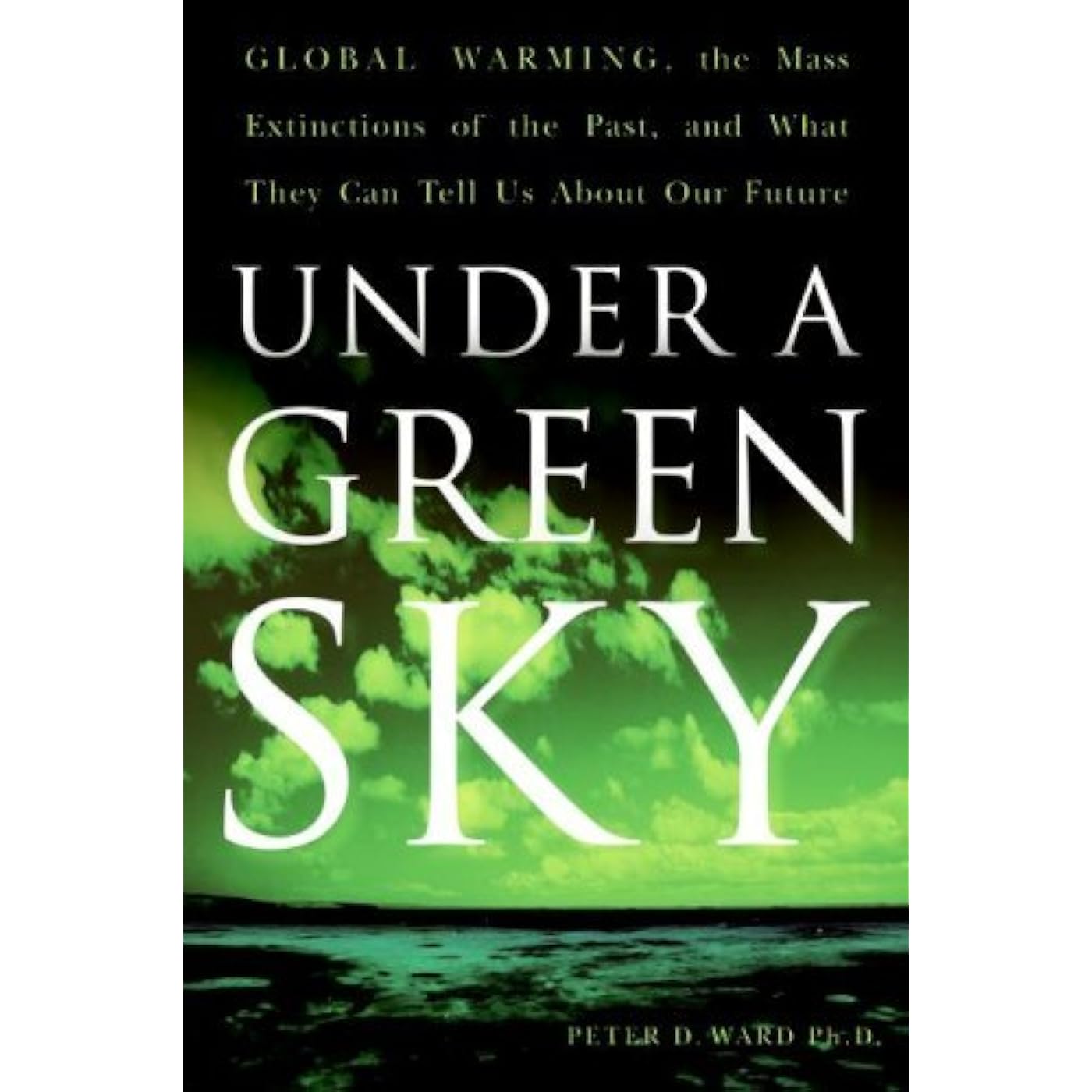
Under a Green Sky: Global Warming, the Mass Extinctions of the Past, and What They Can Tell Us About Our Future – How Rising Carbon Dioxide Led to the Permian Catastrophe
  • Based on 152 reviews
Condition: New
Checking for the best price...
$12.49 Why this price?
Save $5.49 was $17.98

Buy Now, Pay Later


As low as $3 / mo
  • – 4-month term
  • – No impact on credit to apply
  • – Instant approval decision
  • – Secure and straightforward checkout

Ready to go? Add this product to your cart and select a plan during checkout.

Payment plans are offered through our trusted finance partners Klarna, Affirm, Afterpay, Apple Pay, and PayTomorrow. No-credit-needed leasing options through Acima may also be available at checkout.

Learn more about financing & leasing here.

Free shipping on this product

This item is eligible for return within 30 days of receipt

To qualify for a full refund, items must be returned in their original, unused condition. If an item is returned in a used, damaged, or materially different state, you may be granted a partial refund.

To initiate a return, please visit our Returns Center.

View our full returns policy here.


Availability: 20 left in stock
Fulfilled by HarperCollins Publishers

Arrives within 30 days
Order within 15 hours and 20 minutes
Available payment plans shown during checkout

Protection Plan Protect Your Purchase
Checking for protection plans...

Description

More than 200 million years ago, a cataclysmic event known as the Permian extinction destroyed more than 90% of all species and nearly 97% of all living things. Its origins have long been a puzzle for paleontologists, and during the 1990s and the early part of this century a great battle was fought between those who thought that death had come from above and those who thought something more complicated was at work. Paleontologist Peter D. Ward, fresh from helping prove that an asteroid had killed the dinosaurs, turned to the Permian problem, and he has come to a stunning conclusion. In his investigations of the fates of several groups of mollusks during those extinctions and others, he discovered that the near-total devastation at the end of the Permian was caused by rising levels of carbon dioxide leading to climate change. But it's not the heat (nor the humidity) that's directly responsible for the extinctions, and the story of the discovery of what is responsible makes for an fascinating, globe-spanning adventure. Read more

Publisher ‏ : ‎ Harper


Accessibility ‏ : ‎ Learn more


Publication date ‏ : ‎ October 13, 2009


Edition ‏ : ‎ Illustrated


Language ‏ : ‎ English


File size ‏ : ‎ 883 KB


Screen Reader ‏ : ‎ Supported


Enhanced typesetting ‏ : ‎ Enabled


X-Ray ‏ : ‎ Not Enabled


Frequently asked questions

If you place your order now, the estimated arrival date for this product is: within 30 days

Yes, absolutely! You may return this product for a full refund within 30 days of receiving it.

To initiate a return, please visit our Returns Center.

View our full returns policy here.

  • Klarna Financing
  • Affirm Pay in 4
  • Affirm Financing
  • Afterpay Financing
  • PayTomorrow Financing
  • Financing through Apple Pay
Leasing options through Acima may also be available during checkout.

Learn more about financing & leasing here.

Top Amazon Reviews


  • Best analysis of CO2 so far but raises important questions
Format: Paperback
This book is THE most important thing for anyone to read before forming an opinion on how important it really is to reduce CO2 emissions. It is also the most complete big picture review I have seen to date (though others have gone into more depth on the issue of sea level effects). (NONE OF THE VIEWS HERE REFLECT THE VIEWS OF ANY OF THE ORGANIZATIONS I AM CONNECTED TO. I hope to learn more from them later.) The book tries really hard to be folksy and appealing to the layman. That gets to be a bit annoying in the first few pages, but after awhile it is useful, as it gives you a concrete feeling for the empirical data which underlies his analysis. He has many pages of solid scientific citations in the back, which he explains in commonsense terms. What's important for the policy-maker: he claims that if CO2 gets to 1000 ppm in the atmosphere (which will probably happen if we do not take more competent and effective action very soon), we will probably set off an inexorable chain of events which leads to H2S poisoning of the atmosphere and high radiation, which within a certain number of centuries would be enough to kill off all humans and all mammals as soft as us. What's important for the scientist: he provides a unique and credible depth of analysis in explaining the major mass extinctions which have happened in the past, with a special focus on the biggest ones -- for which the empirical data he has collected himself are important evidence. He gets deeper into the chain of logic than anything else I have seen. He also shows links to the global climate models. It's an essential starting point for real understanding of what's going on. But there are major holes in the analysis, even so. For example -- at one point he seems to say that 1000 ppm CO2 in the atmosphere leads to melting of the icecaps, which then changes the oceanic "conveyer belts" so that there is very little oxygen in the deep ocean, which then causes a huge production of H2S in the deep ocean, which gets to the atmosphere, poisoning us all and destroying the stratospheric ozone layer as well. But he also shows that CO2 has been WELL over 1000 ppm for very large chunks of earth's history without this happening, and he suggests that the poles were ice-free for a large part of that times as well. In a more detailed discussion, he says that all of this was crucial -- but it also required upwelling of deep ocean water (to get the H2S into the atmosphere)and a "volcanic trigger" as well, to get to extinction. So why is a volcanic trigger needed? Just what new does it do? Are we home free today if we don't get that trigger (which is unlikely)? He doesn't say. Lots of folks in this field are interested in the role of volcanoes. Could volcanoes BY THEMSELVES explain the mass extinctions? I didn't see so much discussion of that here. At a later part of the book, he compares CO2 levels with mass extinctions, across time. That's a very impressive graph. The peaks and the extinctions line up very well. We shouldn't ignore something like that. He then argues that the RATE OF INCREASE OF CO2 is the number which really drives extinctions, not the actual level, a story which seems to fit his graph. If it is the RATE of CO2 increase which matters, then we are indeed at great risk today. But the problem is that his story about ice caps and conveyer belts seems to depend on the LEVEL of CO2; he doesn't explain WHY the rate of increase of CO2 should be the driving variable, instead of the level. He does offer one possible clue as to why the rate should be important. In the oceans, he says that a SLOW but LARGE increase in dissolved CO2 is largely buffered by very slow chemical processes, so that the acidity of the ocean does not change much. But a RAPID increase is not buffered, and leads to large regions of acidity. This leads to some important questions: is it the ppm of CO2 dissolved in the ocean that we should be worried about, rather than the CO2 in the air? Could it be that the ACIDITY kills the benevolent purple bacteria he talks about (the ones which eat the H2S before it gets to the atmosphere), or that it stimulates the growth of archaea which produce H2S and methane? If so, we may be in trouble just as serious as he claims, but we may need to use totally different metrics (and new types of sensor systems) in order to know just how far away we really are from possible disaster. And the detailed dynamics remain unproven. Also... the role of green bacteria, and the importance of purple bacteria versus upwelling, are rather unclear in this discussion. There is a lot we would need to nail down, to know how far off (and in what direction) is the nearest point of no return we need to avoid. In practical terms... it is sometimes said that the "damage payment" for CO2 emission based only on sea level effects would not be enough to justify really draconian caps on CO2 emission under present technology. The issues raised in this book are a crucial starting point to evaluating whether more than such a moderate "damage payment" or carbon tax is really called for. In summary, this is an essential starting point which we need to follow up on... but we don't yet know what it really adds up to. And perhaps I need to look at the volcano story more closely. ... show more
Reviewed in the United States on January 20, 2009 by Paul J. Werbos

  • The Ultimate Horror Story
Format: Hardcover
For true terror Under a Green Sky has no equivalent. A year or so ago I came across this interview with Peter Ward:[...] After reading the interview I ordered Under a Green Sky. Granted Ward's clunky, often opaque prose style takes a bit of getting used to, but the effort is rewarded many times over. As well as explaining why the activities of our species will result in the extinction of the majority of species present today, probably including our own, the book covers some major brawls within the paleontology research community and Ward's personal accounts of doing paleontology research. The 6th great extinction is well underway. The mechanisms Ward sets forth and explains will provide an unstoppable killer punch to the process. Science provides the facts that allow us to make rational judgements. Unfortunately most of our species is not rational and ignores science. The general public thinks of scientists as nerds in white coats, but we're paid up members of our demonic species. (I'm a life scientist. If the general public only knew, life in the life sciences makes James Bond look dull.) This book will give you a glimpse of what is it like to be a scientist. Scientists, being human, sometimes allow their personal interests and preconceived views to overcome their objectivity. Brawls among scientists are often bitterly fought and highly entertaining if you aren't directly involved. The uproar over whether asteroids or volcanoes account for previous extinctions is just such a brawl. This is an excellent account of a very important scientific debate. Read the book and form your own conclusions on the asteroids vs volcanoes debate. The implications..... Though it doesn't mention Ward, the excellent documentary Crude: the Incredible Journey of Oil [...] is in accord with what Ward is saying. You can see the documentary over the web, but I bought a copy of the DVD as it is more convenient to watch. It's one of the best documentaries I've ever seen. Here is a link to a Scientific American article by Peter Ward that gives a well-written synopsis of the recent paleontology research Ward covers in more detail in Under a Green Sky [...]The editors of Scientific American have cleaned up Ward's prose considerably:) The recent discoveries of the paleontologists show us the mechanisms whereby the CO2 we'll continue to pour into the atmosphere will cause the oceans to become anoxic; releasing hydrogen sulfide, turning the sky green and completing the 6th great extinction which is already underway thanks to us. We are the ultimate plague species. I wish every person on the face of the earth could understand these mechanisms, their implications and the damage we're doing to the great systems that drive the earth's climate and the ocean currents, though I know that will never happen. When you think of the huge portion of humanity that isn't even literate you can see what an uphill battle it is to get people to understand the dangers to the planet's homeostatic systems due to the devastating activities of our species. It's even worse that so many people who are literate and supposedly educated and thus should be capable of understanding refuse to. It's just incredible how many climate change deniers are still out there. ... show more
Reviewed in the United States on September 28, 2009 by Jean Harris

Can't find a product?

Find it on Amazon first, then paste the link below.
Checking for best price...