
Search  for anything...

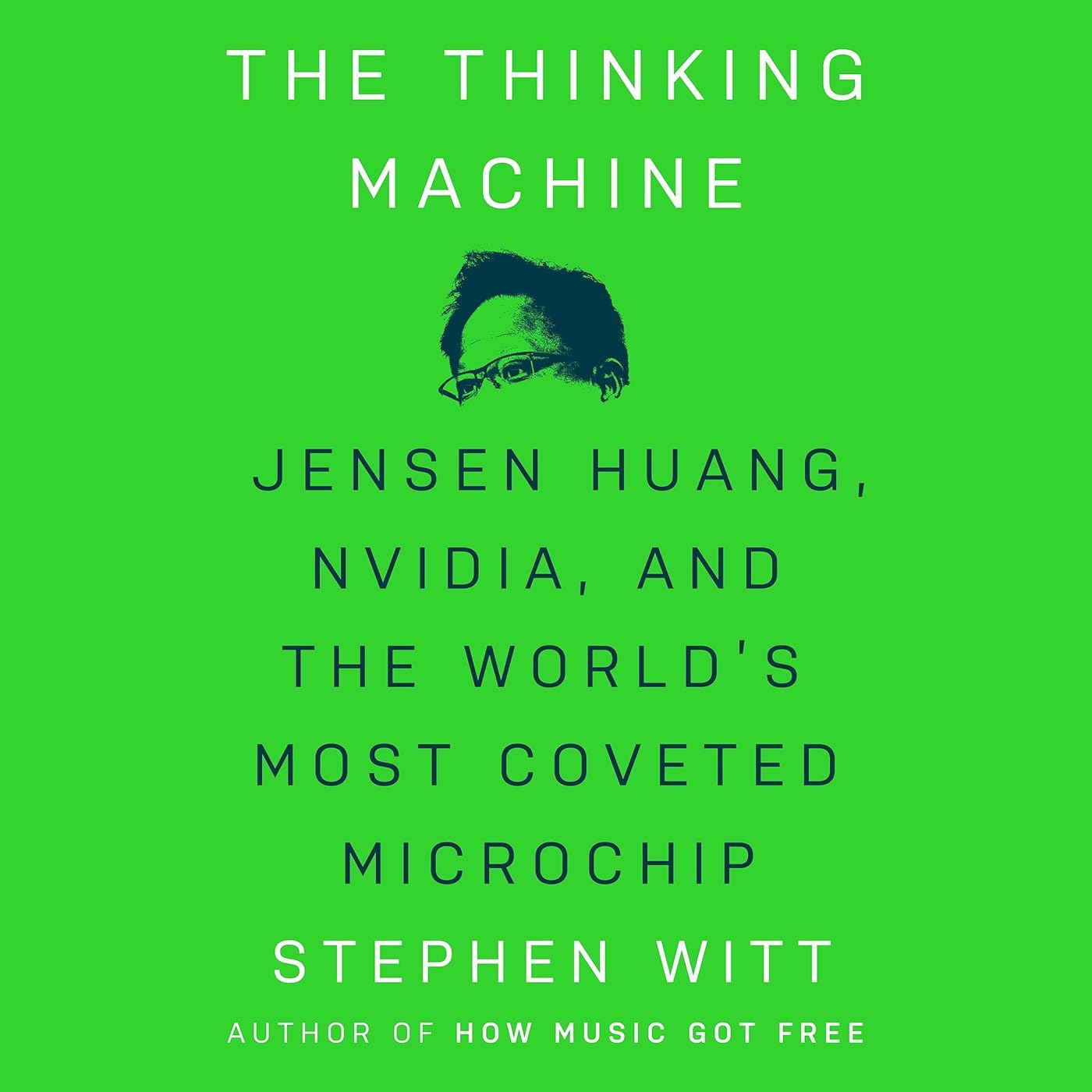
The Thinking Machine: Jensen Huang, Nvidia, and the World's Most Coveted Microchip
  • Based on 0 reviews
Condition: New
Checking for the best price...

Buy Now, Pay Later


As low as $5 / mo
  • – 4-month term
  • – No impact on credit
  • – Instant approval decision
  • – Secure and straightforward checkout

Ready to go? Add this product to your cart and select a plan during checkout.

Payment plans are offered through our trusted finance partners Klarna, Affirm, Afterpay, Apple Pay, and PayTomorrow. No-credit-needed leasing options through Acima may also be available at checkout.

Learn more about financing & leasing here.

Free shipping on this product

This item is eligible for return within 30 days of receipt

To qualify for a full refund, items must be returned in their original, unused condition. If an item is returned in a used, damaged, or materially different state, you may be granted a partial refund.

To initiate a return, please visit our Returns Center.

View our full returns policy here.


Availability: 20 left in stock
Fulfilled by Audible,

Arrives Feb 12 – Feb 17
Order within 4 hours and 34 minutes
Available payment plans shown during checkout

Protection Plan Protect Your Purchase
Checking for protection plans...

Description

Winner of the FT and Schroders Business Book of the Year Award Named a Best Book of 2025 by The Economist “Framed as a biography of Jensen Huang, the only CEO Nvidia has ever had, the book is also something more interesting and revealing: a window onto the intellectual, cultural, and economic ecosystem that has led to the emergence of superpowerful AI.” —James Surowiecki, The Atlantic “A lively biography. . . . The story of how Nvidia became the hottest investment on Wall Street and a household name is fascinating.” —Katie Notopoulos, The New York Times Book Review Nvidia is as valuable as Apple and Microsoft. It has shaped the world as we know it. But its story is little known. This is the definitive story of the greatest technology company of our times. In June of 2024, thirty-one years after its founding in a Denny’s restaurant, Nvidia became the most valuable corporation on Earth. The Thinking Machine is the astonishing story of how a designer of video game equipment conquered the market for AI hardware, and in the process re-invented the computer. Essential to Nvidia’s meteoric success is its visionary CEO Jensen Huang, who more than a decade ago, on the basis of a few promising scientific results, bet his entire company on AI. Through unprecedented access to Huang, his friends, his investors, and his employees, Witt documents for the first time the company’s epic rise and its single-minded and ferocious leader, now one of Silicon Valley’s most influential figures. The Thinking Machine is the story of how Nvidia evolved to supplying hundred-million-dollar supercomputers. It is the story of a determined entrepreneur who defied Wall Street to push his radical vision for computing, becoming one of the wealthiest men alive. It is the story of a revolution in computer architecture, and the small group of renegade engineers who made it happen. And it’s the story of our awesome and terrifying AI future, which Huang has billed as the ‘next industrial revolution,’ as a new kind of microchip unlocks hyper-realistic avatars, autonomous robots, self-driving cars, and new movies, art, and books, generated on command. This is the story of the company that is inventing the future. Read more

Frequently asked questions

If you place your order now, the estimated arrival date for this product is: Feb 12 – Feb 17

Yes, absolutely! You may return this product for a full refund within 30 days of receiving it.

To initiate a return, please visit our Returns Center.

View our full returns policy here.

  • Klarna Financing
  • Affirm Pay in 4
  • Affirm Financing
  • Afterpay Financing
  • PayTomorrow Financing
  • Financing through Apple Pay
Leasing options through Acima may also be available during checkout.

Learn more about financing & leasing here.

Top Amazon Reviews


  • An Enthralling Journey into the World of Artificial Intelligence
Format: Hardcover
Stephen Witt's "The Thinking Machine" is an exploration of the captivating and often enigmatic world of artificial intelligence. Witt's ability to weave intricate narratives with meticulous research makes this book not only a fascinating read but also an invaluable resource for anyone intrigued by the advancements and implications of AI. Despite the complexity of the subject matter, Witt's use of accessible language makes "The Thinking Machine" a suitable read for a wide audience. He avoids jargon and explains technical terms in a straightforward manner, allowing readers from various backgrounds to grasp the concepts with ease. I wrote an AI overview for a broad audience and understand its difficulty from experience. A crucial aspect that Witt addresses in "The Thinking Machine" is the environmental impact of AI, particularly the power consumption of data centers that support AI technologies. Witt sheds light on how the growing demand for AI applications contributes to increased energy usage, raising important questions about sustainability. The intricate nature of AI systems, characterized by continuous operation and complex computational demands, necessitates a strategic approach to energy efficiency. Data centers must prioritize optimization of resource usage, reduction of energy consumption, and facilitation of renewable energy transitions. The recently published book "Making IT Sustainable: Techniques and Applications" by Academic Press provides further insights into these critical developments, offering a comprehensive exploration of sustainable IT strategies and challenges of AI development. ... show more
Reviewed in the United States on May 30, 2025 by Flying Wombat

  • Deep, exciting, useful, interesting, fun business and technology read
I found this book to very useful on several levels. It informs my decisions in buying NVIDIA shares (I did). It gave a deep background about the recent history of AI - and the technology was very clearly explained. It gave a case study of a Silicon Valley success and the multiple factors governing that success. It finally, like Musk (The Musk Way, recommended) reminds us of the power of a single CEO/Founder and persistence in search of excellence. It would not be waste of time for students and managers and startup founders to read this book. Much better than the glib theory of the strategic planning professors. ... show more
Reviewed in the United States on January 9, 2026 by Tom Gilb

  • Neural Networks on Silicon
Format: Hardcover
The Thinking Machine: Jensen Huang, Nvidia, and the World’s Most Coveted Microchip By Stephen Witt The Thinking Machine: Jensen Huang, Nvidia, and the World’s Most Coveted Microchip by Stephen Witt describes the evolution of Nvidia (pronounced IN-vidia) under the leadership of founder and CEO Jensen Huang (“Jensen”) as well as parallel developments in computer technology and Artificial Intelligence in the 21st century. After graduation from Oregon State, Jensen worked at LSI Logic where despite his youth, he quickly rose to a leadership position. In the early 1990s together with two colleagues from Sun Microsystems, Nvidia was formed to provide chips for PC video games. With the support of Will Corrigan, founder and CEO of LSI Logic, Nvidia secured an initial round of venture funding. Like many entrepreneurial startups, Nvidia had its ups and downs. In 1997 with funding about exhausted its Riva 128 (Real-Time Interactive Video and Animation accelerator) took off selling over 1 million cards in four months. Gamers and game designers constantly want more features: pixel shaders, multiplayer combat, increased screens per second, these demands were straining traditional chip capabilities. At that time most chips processed one instruction at a time sequentially. Jensen began to explore a chip that would process multiple instructions at once, referred to as “parallel computing.” This technology was at the heart of Nvidia’s GeForce, referred to as a Graphics Processing Unit (“GPU”) that ushered in a golden age of gaming in the early 2000’s. Jensen believed that parallel processing could also be more effective with certain scientific applications: weather simulation, Black Hole modeling or breast imaging. Nvidia invested heavily in Computer Unified Domain Architecture (“CUDA”), but the demand for this technology was limited. CUDA launched in 2006 was a drag on earnings and by 2013, with Nvidia stock stagnant, investors were losing patience. The human brain (and other animals) recognize objects through a neural network. At the lowest level neurons in the brain recognize points of light, at the next level, neurons combine these points to make a line; then a shape; ultimately a cat that the brain recognizes. Professor Geoffrey Hinton at the University of Toronto believed that a neural network could be created with transistors on silicon serving as neurons. With error correction technology, back propagation, a computer neural network could self-correct, learn to identify objects. In 2012 he tasked Alex Krizhevsky and Ilya Sutskever, two students with recent PhDs in computer science to create a neural network with CUDA. The two graduates pooled their savings, $1,000, to purchase 2 GeForce GPU’s from Nvidia and in Krizhevsky’s bedroom tried to create a neural computer network about equivalent to the brain of a honeybee. At first the results were awful, but then the network began to learn: correct identification “moving to 1 percent, then 10 percent, then 40 percent, then 60 percent ….” (page 124). They entered their network in a 2012 Artificial Intelligence contest recording a stunning 80% correct identification, 10 points above the nearest competitor. Shortly thereafter, Krizhevsky presented these results at an Artificial Intelligence conference in Florence and, overnight, a discipline was transformed. Let me pause to reflect, in an age with one-hundred million dollar + research budgets and huge science teams it is heartwarming that two recent graduates with a $1,000 capital budget working in a bedroom develop a Nobel Prize winning technology that transforms a discipline. Google, Microsoft, Facebook and numerous other companies and research institutions immediately recognized the potential of this technology. Nvidia has the chip design and has worked closely with Taiwan Semiconductor who manufactures these very complex devices; Nvidia has the software support. The billions of dollars invested to develop Artificial Intelligence has led to dramatic revenues and earnings gains for Nvidia as well as staggering investment returns (this is not an investment recommendation). For many years parallel computing and neural networks were backwater technologies. Jensen with imagination, hard work and persistence, as well as the assembly of a very capable team, and Hinton, Krizhevsky and Sutskeyer with the development of neural networks on silicon drove the revolution in artificial intelligence. This book is the history of that evolution. Julian Schroeder ... show more
Reviewed in the United States on July 22, 2025 by Julian Schroeder

Can't find a product?

Find it on Amazon first, then paste the link below.
Checking for best price...