
Search  for anything...
NA

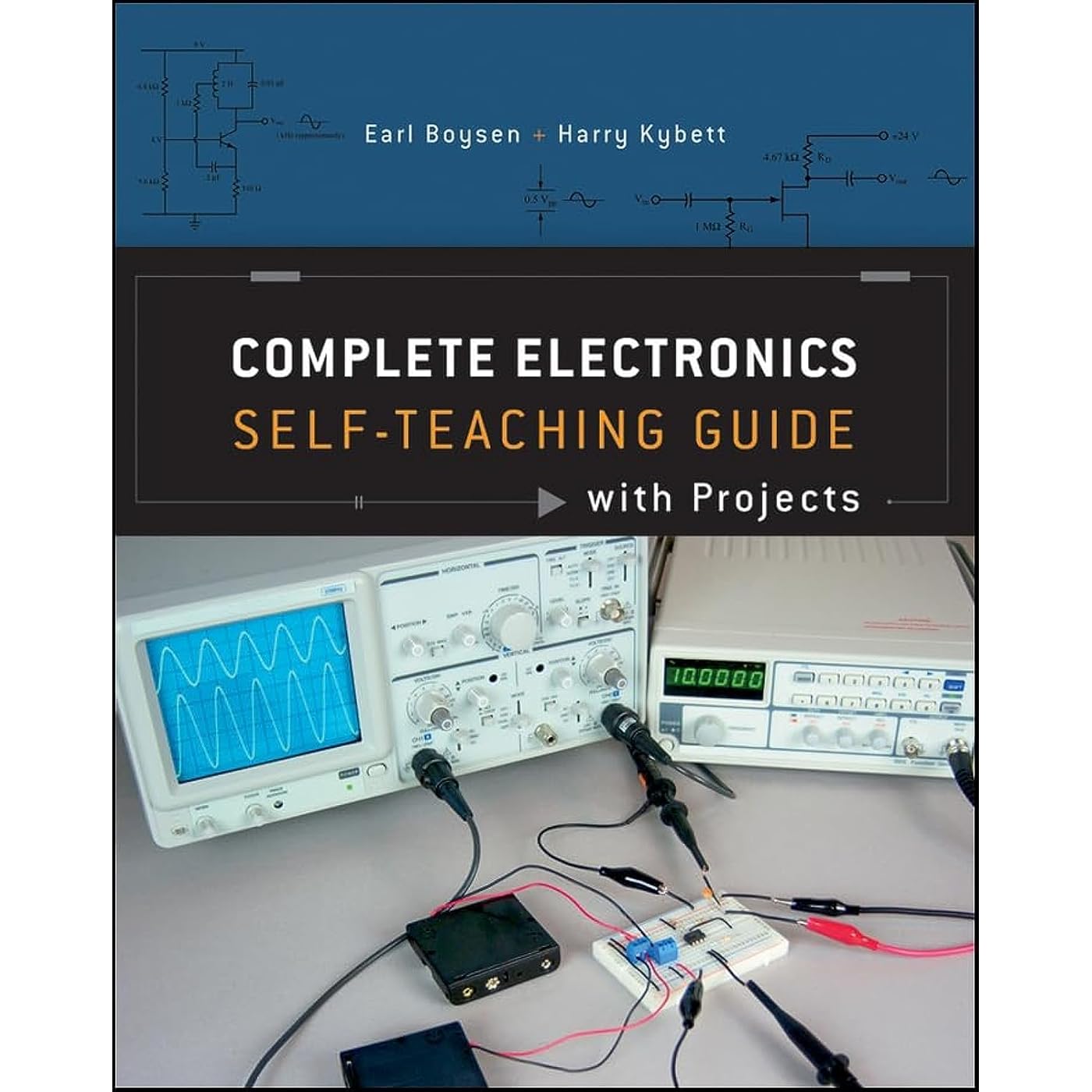
Complete Electronics Self-Teaching Guide with Projects

Based on 542 reviews
Condition: New
Checking for the best price...
$28.03
Holiday Deal · 24% off was $37.00

Buy Now, Pay Later


As low as $7 / mo
  • – 4-month term
  • – No impact on credit to apply
  • – Instant approval decision
  • – Secure and straightforward checkout

Ready to go? Add this product to your cart and select a plan during checkout.

Payment plans are offered through our trusted finance partners Klarna, Affirm, Afterpay, Zip, Apple Pay, and Google Pay. No-credit-needed leasing options through Acima may also be available at checkout.

Learn more about financing & leasing here.

Free shipping on this product

FREE 30-day refund/replacement

To qualify for a full refund, items must be returned in their original, unused condition. If an item is returned in a used, damaged, or materially different state, you may be granted a partial refund.

To initiate a return, please visit our Returns Center.

View our full returns policy here.


Availability: In Stock.
Fulfilled by Amazon

Arrives Wednesday, Nov 11
Order within 19 hours and 45 minutes

Available payment plans shown during checkout

Protect Your Purchase

Easy claims online, fast replacements, no fees

Checking for protection plans...

At a glance

Condition
New
Dimensions
7.4 x 1.3 x 9.2 in
Weight
2.64 lb
Publisher
Wiley
Publication date
July 31, 2012
Edition
4th
Language
English

Description

An all-in-one resource on everything electronics-related!For almost 30 years, this book has been a classic text for electronics enthusiasts. Now completely updated for today's technology, this latest version combines concepts, self- tests, and hands-on projects to offer you a completely repackaged and revised resource. This unique self-teaching guide features easy-to-understand explanations that are presented in a user-friendly format to help you learn the essentials you need to work with electronic circuits.All you need is a general understanding of electronics concepts such as Ohm's law and current flow, and an acquaintance with first-year algebra. The question-and-answer format, illustrative experiments, and self-tests at the end of each chapter make it easy for you to learn at your own speed.Boasts a companion website that includes more than twenty full-color, step-by-step projectsShares hands- on practice opportunities and conceptual background information to enhance your learning processTargets electronics enthusiasts who already have a basic knowledge of electronics but are interested in learning more about this fascinating topic on their ownFeatures projects that work with the multimeter, breadboard, function generator, oscilloscope, bandpass filter, transistor amplifier, oscillator, rectifier, and moreYou're sure to get a charge out of the vast coverage included in Complete Electronics Self-Teaching Guide with Projects! Read more

Specs 9

Publisher Wiley
Publication date July 31, 2012
Edition 4th
Language English
Print length 608 pages
ISBN-10 1118217322
ISBN-13 20
Item Weight 2.64 pounds

Frequently asked questions

If you place your order now, the estimated arrival date for this product is: Wednesday, Nov 11

Yes, absolutely! You may return this product for a full refund within 30 days of receiving it.

To initiate a return, please visit our Returns Center.

View our full returns policy here.

  • Klarna Financing
  • Affirm Pay in 4
  • Affirm Financing
  • Afterpay Financing
  • Zip Pay in 4
  • Financing through Apple Pay
  • Financing through Google Pay
Leasing options through Acima may also be available during checkout.

Learn more about financing & leasing here.

Top Amazon Reviews


A great book to learn electronics!
Format: Paperback
This is one of the best electronics books I have seen to date, especially for the price. The material is presented in an easy to read and understand manner. Some sections may sometimes come across a bit brief, or incomplete, but sometimes that is all that is needed to learn a certain topic. Sometimes, too much, is too much... There are many lab exercises, and most of us will find that we do not have the equipment/test equipment needed to complete them. I do feel they shouldn't have included these in the book, but sometimes doing it is easier to understand than reading about it. Also, throughout the book, there are questions and answers about what you had just read, which is great, but sometimes they put the answers just below the questions on the same page. I feel that the answers should have been placed at the end of the chapter or somewhere else in the book instead. This is a all-in-one book, an overview of electronics that a person can understand without further instruction. But, if there is something you find that you want to know more about after reading through this book, then I would suggest purchasing a more expensive textbook or a more specialized book afterwards. As I am sure you will see from reading other reviews, there is a bit of complaints about errors. As with any book, especially technical books, there will be some mistakes no matter how hard the authors and editors try to avoid them. Yes, as stated, there are a few errors, but with a little patience and research, and if you are astute enough to notice the error, than it will be easy enough to correct it by writing over what is incorrect. Overall, "Complete Electronics" is a great read. ... show more
Reviewed in the United States on March 5, 2016 by KL

Books about electronics
Format: Paperback
It is a good book to read and learn about electronics.
Reviewed in the United States on January 12, 2026 by Christopher W Nemecek

Fairly Complete, Fairly Essential
Format: Paperback
A very good introduction to the fundamental concepts and (discrete) devices used in modern electronic practice. If you want a "hands-on" experience, and are willing to put in the time, this book (structured in modules that walk you through practical examples of how devices and basic circuits work) could be a good choice. I note the criticisms by other reviewers, and don't disagree with them. I've been less than completely satisfied by the format (as noted elsewhere, "backwards" Q-&-A ordering), and sometimes the explanations are skimpy. Just one example: the section on diodes, particularly the functioning of zener diodes, just wasn't adequate for me--I had to consult other books in my library (which had more detail and informative graphs) to feel that I had really grasped the material. I'm still "in progress" with this one, so will reserve further judgment for later. Despite those shortcomings, this self-paced, self-teaching program really does have a lot to offer the beginner. NOTE that if you do all the exercises in this book, it could be costly, depending on how well-supplied your workshop is right now. (And one of the very few missing ingredients of this book is an introductory section with a complete list of devices and supplies that are needed to complete each section). At a minimum, you'll need a breadboard with jumpers, alligator clips, and appropriate devices (transistors, resistors, diodes, coils, and so forth); a power supply; at least one multimeter (and several of the exercises show THREE DMM's in play for simultaneous measurement of circuit parameters like voltage, resistance, and/or current), an oscilloscope, and a function generator. Obviously, if you don't have a particular item, you can forego the exercise, but for maximum return, it's clearly best to have all of these gadgets on hand, either through purchase or borrowing. The arrangement of this book is sequential and logical, the writing is generally clear and readable, and the examples are practical and informative. ... show more
Reviewed in the United States on February 15, 2013 by Malamati

More of a fórmula manual than a teaching guide
Format: Paperback
I got this book to brush up on my electronics knowledge for a new job (haven’t used my electrical engineering degree in some time, but that’s another story)…however this book gives a brief explanation of each component and then follows up with the formulas and examples of using these formulas…I wanted more of a book that reminded me of what each component does and it’s schematic symbol…but I still gave this book 5 stars because it is well-written, provides proper instruction and doesn’t miss any important info…it’s more of a serious read than other “for beginners” books but it is still a worthwhile investment. ... show more
Reviewed in the United States on July 30, 2024 by Albert

Requires some prior knowledge of electrical theory
Format: Paperback
Just a heads-up that this is not for the complete novice. The book begins with a review of DC theory which may be enough to get you caught up, but you'll realistically need at least some basic understanding of electrical theory. I'd recommend pairing this with a beginner's book, or just finding a decent YouTube channel to get you up to speed. That said, it is a fantastic book. It's organized much like a normal class with information, followed by questions to repeat and thus help retain what was taught, then end of chapter tests. This is a great book to accompany your first breadboard starter kit, and will quickly get you browsing around for a meter, then more components, and eventually you'll be drooling over oscilloscopes. Excellent resource, no doubt a 5-star presentation and 5-star quality! ... show more
Reviewed in the United States on December 26, 2021 by jf84

Great refresher course in electronics
Format: Paperback
This book is written in simple language that makes it easy to understand the concept. There are no derivations therefore no higher math than simple algebra is needed. Equations needed are supplied. The book also includes experiments to visually illustrate electronic concepts. It's well written for the novice or the more advance student that desires a refresher course. ... show more
Reviewed in the United States on March 24, 2024 by S.M. Del-Gado

Leaves you in the dark on several occasions
Format: Paperback
The book is very good for understanding the basic principles of things and inculcates those in the reader with useful examples. That part is very good. Now for the bad: 1. No mentioning of where or how to choose an oscilloscope 2. Certain concepts are stated and followed by "this is too complicated to explain/calculate, so here's the formula". In the section on "stable amplifier", I didn't see any explanation why adding a couple of resistors made the amplifier stable. Sure I can follow a formula and plug in numbers, but is that why I bought the book? No, I want to know the details. Give me the math and say "understanding this is optional". I don't like doing things in the blind. Before this book I followed "Make Electronics", which also suffers from the same flow, but at a bigger scale. I want to know the inside and out of electricity. Otherwise I can just get a schematic off the net. Bottom line: not a bad intro, but won't answer all of your questions about subjects that the book itself introduces. ... show more
Reviewed in the United States on December 20, 2012 by Sergei G.

Electronics book
Format: Paperback
Good book
Reviewed in the United States on November 9, 2025 by Richard V.
Checking for best price...