


Search  for anything...
Couldn't find selected product

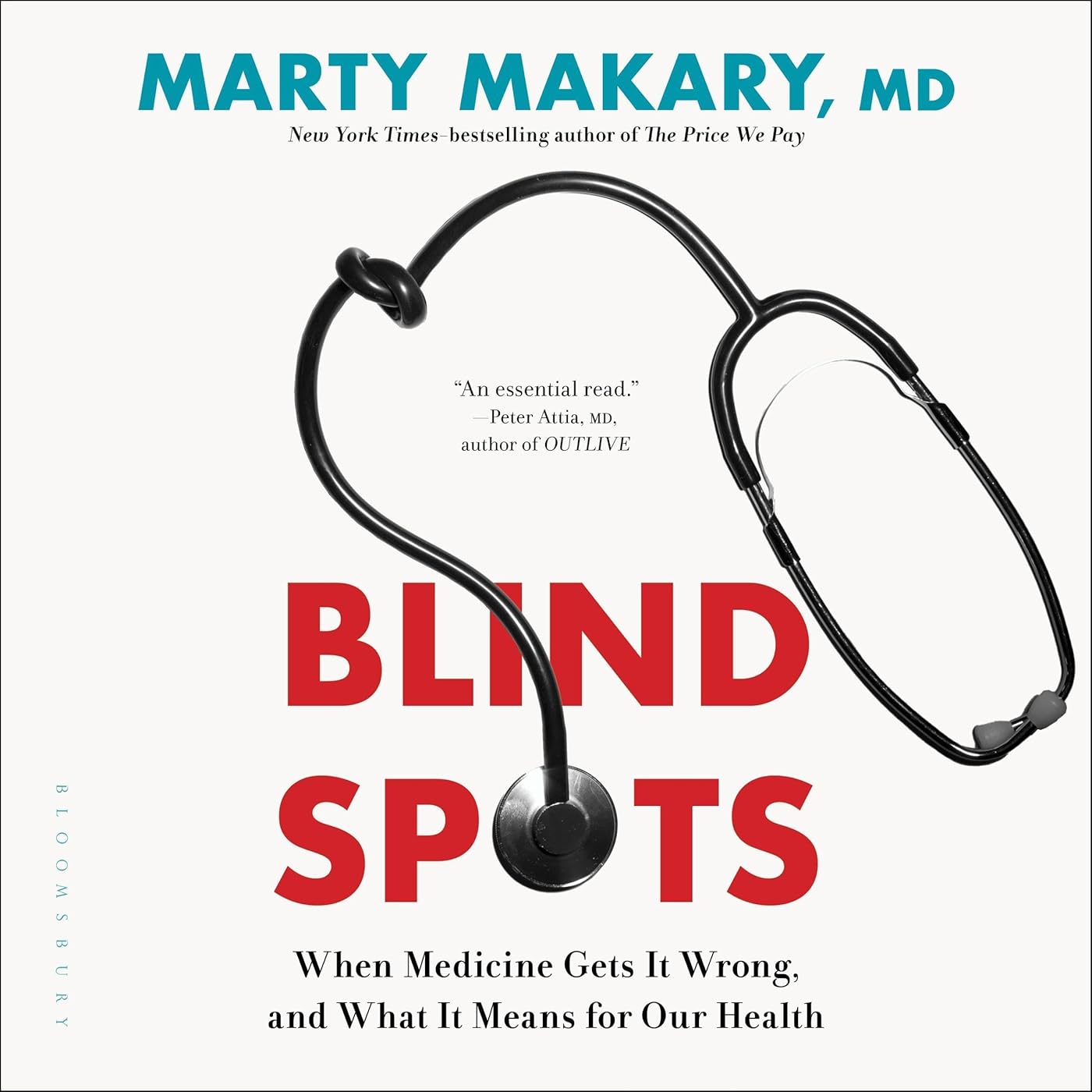
Blind Spots: When Medicine Gets It Wrong, and What It Means for Our Health

  • Based on 0 reviews
Condition: New
Checking for the best price...

Buy Now, Pay Later


As low as $5 / mo
  • – 4-month term
  • – No impact on credit to apply
  • – Instant approval decision
  • – Secure and straightforward checkout

Ready to go? Add this product to your cart and select a plan during checkout.

Payment plans are offered through our trusted finance partners Klarna, Affirm, Afterpay, Apple Pay, and PayTomorrow. No-credit-needed leasing options through Acima may also be available at checkout.

Learn more about financing & leasing here.

Free shipping on this product

This item is eligible for return within 30 days of receipt

To qualify for a full refund, items must be returned in their original, unused condition. If an item is returned in a used, damaged, or materially different state, you may be granted a partial refund.

To initiate a return, please visit our Returns Center.

View our full returns policy here.


Availability: 20 left in stock
Fulfilled by Audible,

Arrives Jun 6 – Jun 10
Order within 7 hours and 23 minutes
Available payment plans shown during checkout

Protection Plan Protect Your Purchase
Checking for protection plans...

Description

Bloomsbury presents Blind Spots written and read by Dr Marty Makary From Johns Hopkins medical expert Dr. Marty Makary, the New York Times-bestselling author of The Price We Pay—an eye-opening look at the medical groupthink that has led to public harm, and what you need to know about your health. More Americans have peanut allergies today than at any point in history. Why? In 2000, the American Academy of Pediatrics issued a strict recommendation that parents avoid giving their children peanut products until they’re three years old. Getting the science perfectly backward, triggering intolerance with lack of early exposure, the US now leads the world in peanut allergies—and this misinformation is still rearing its head today. How could the experts have gotten it so wrong? Dr. Marty Makary asks, Could it be that many modern-day health crises have been caused by the hubris of the medical establishment? Experts said for decades that opioids were not addictive, igniting the opioid crisis. They refused menopausal women hormone replacement therapy, causing unnecessary suffering. They demonized natural fat in foods, driving Americans to processed carbohydrates as obesity rates soared. They told citizens that there are no downsides to antibiotics and prescribed them liberally, causing a drug-resistant bacteria crisis. When modern medicine issues recommendations based on good scientific studies, it shines. Conversely, when modern medicine is interpreted through the harsh lens of opinion and edict, it can mold beliefs that harm patients and stunt research for decades. In Blind Spots, Dr. Makary explores the latest research on critical topics ranging from the microbiome to childbirth to nutrition and longevity and more, revealing the biggest blind spots of modern medicine and tackling the most urgent yet unsung issues in our $4.5 trillion health care ecosystem. The path to medical mishaps can be absurd, entertaining, and jaw-dropping—but the truth is essential to our health. Read more

Frequently asked questions

If you place your order now, the estimated arrival date for this product is: Jun 6 – Jun 10

Yes, absolutely! You may return this product for a full refund within 30 days of receiving it.

To initiate a return, please visit our Returns Center.

View our full returns policy here.

  • Klarna Financing
  • Affirm Pay in 4
  • Affirm Financing
  • Afterpay Financing
  • PayTomorrow Financing
  • Financing through Apple Pay
Leasing options through Acima may also be available during checkout.

Learn more about financing & leasing here.

Top Amazon Reviews


  • Well Done, Disturbing, and Thought Provoking
Format: Hardcover
Peanut allergies were rare before health policy makers decided that children should abstain from eating any peanut products the first years of their lives to address those very infrequent occurrences. The result: peanut allergies exploded among children who never had any contact with peanuts during their early years. Silicone breast implants were satisfying many patients who needed reconstructive surgery or who wanted augmentation until some medical researchers (who it appears did not approve of cosmetic surgery) used very weak study linkages to proclaim them dangerous. Lawsuits exploded and millions of women had their implants removed. Later scienced proved that wrongheaded. The FDA reversed itself and today labels Silicone breast implants safe. Dr. Makary (at this writing, the nominee to run the FDA), has written an important book that is eye opening to the public and I imagine also many physicians. His book illustrates several medical policy positions beyond peanut abstention and breast implants taken by the medical establishment (AMA, AHA, FDA, leading medical journals) which have stood upon weak evidence, evidence that contradicts the policy position, or even the strongly held beliefs of medical policy gatekeepers who rely on their wisdom that certain causations “just make sense.” Almost all of these have been reversed or superseded - but usually only after years or even decades of existence guiding standards of care and medical interventions. Some of these did great harm to patients and people and some like over reliance on antibiotics reverberate today. This book is very well written and accessible to non-physicians and the public. He explains medical topics for the layperson. It is very much worth reading. In addition to those standards of care named above, Makary tells the stories of over prescribing of antibiotics and the effect on the gut biome, the lack of understanding that dietary cholesterol has little to no effect on body cholesterol levels, and how wrong thinking around many aspects of medical care related to childbirth led to premature babies having worse outcomes and children born of c-sections having altered gut biomes (due to lack of maternal germs gained through passage down the birth canal) which negatively influences other aspects of their development. Perhaps the most interesting to me is that science has recently concluded that ovarian cancer actually starts from cancerous fallopian tube cells that migrate to the ovaries. It appears generations of women who had ovaries removed as a preventive measure were removing the wrong organ to no benefit (and even to their detriment as ovaries provide important hormones for the body). Today due to studies that appear sound, many physicians recommend a fifteen-minute procedure to remove fallopian tubes for women who are either not having more children or past child baring age in some cases. What gives credence to Dr. Makary's examples is that in each case he goes back to the initial study that resulted in new and mistaken medical standards of care and explains poor data, lack of causation or just incorrect data assessments, or poor study structure that changed lives for millions because of physician adherence to promulgations by our medical standards gatekeepers. His arguments are greatly enhanced because he tracked down either the initial study authors or the AMA committee members or medical journal editors that blessed the care changes and talked to them about the data and study problems that underpinned these changed standards. These people either admitted they were wrong, or the studies were not conclusive, or defensively fall back on arguments of "needed to not upset the public," or "keeping consistent with our positions" as reasons for why they made or supported positions that turned out to be wrong. None of the original protagonists with whom he discussed these wrong turns did or were able to defend their original positions. Some of the conclusions the author makes which are important if we are going to get new standards of care right: 1. The data underpinning studies must be made available for review (shockingly to me they were not available in most cases) 2. Authors of studies should be blinded so reviewers / journal editors cannot play favorites among their colleagues or support studies done by their own institutions 3. The AMA, FDA and other gate keepers must become comfortable with saying “we don’t know” instead of perceiving a need to quickly solve frustrating and high visibility issues for public satisfaction 4. Leadership positions at medical societies and journals need to be rotated so fresh thinking can be injected into assessment processes and defensiveness minimized 5. Journals and associations and the government need to embrace studies related to care delivery more than they historically have. 6. Topic myopia – where grants go in large part to the same narrow topic areas and fresh ideas are shunted aside needs to be reduced so that new thinking can be tested and studied 7. Politics and extraneous considerations need to be removed from grant making, publication, and committee work. This is a captivating book that seems to show difficult to refute case studies (usually because in most cases the offending incorrect standard of care has been reversed or significantly altered). His prescriptions to improve the environment in which medical knowledge is advanced and standards of care embraced make a lot of sense and are worthy of open debate. ... show more
Reviewed in the United States on February 13, 2025 by Wayne A. Smith

  • Must read
Format: Audiobook
Great book, as a healthcare provider, I really appreciated this author’s honesty, and the education he offered. I have recommended this book to other healthcare providers. I work with.
Reviewed in the United States on May 8, 2026 by Amazon Customer

  • Most important is how ignorant almost all doctors are of these blind spots.
Format: Kindle
Dr. Makary does a terrific job describing very important blind spots in our medical community. Reading the book as a PhD medical research scientist, I relished the details of the blind spots Dr. Makary describes. The details are important to appreciate their reality. My own experience follows in step his subject matter. I've been studying vitamin D full time for ten years. I've put in somewhere between 10,000 and 15,000 hours, including reviewing more than 15,000 medical journal articles related to vitamin D. What I have found is quite astonishing, although I doubt Dr. Makary will be astonished, although somewhat surprised. One of my findings is that there has been massive corruption amounting to tens of billions of dollars over a few decades that has led to the suppression of vitamin D dosing. The machinations of that are too lengthy to describe here. One of the dogmas I found is that vitamin D is very toxic. The scientific literature on this is mainly from the 1930s and 40s, when scientists were allowed to poison their subjects in studies to see how much they could take before having a toxic reaction. The results showed that extremely high doses were benign. The real culprit is calcium which can be controlled for high doses of vitamin D to be used. Such doses can put hundreds of diseases into complete remission. I have interviewed many hundreds of patients who have achieved full remission. It works in 90% of patients. With more than 10,000 such patients, no adverse effects have been seen. Another blind spot is how vitamin D is processed in the body. It is very different from how it is described in the scientific literature. In an upcoming book, I go to great lengths to describe this. Yet another blind spot is what is considered the active form of vitamin D doing the work and can be measured in the blood. It can't do the work because it cannot pass through cell membranes. So, what is doing the work is easily explainable, but it remains in a blind corner. In a very active trauma center, over a dozen years, high-dose vitamin D, administered to every patient daily, brought the mortality rate down from 11-13% to 3%, among many other benefits. I could tell you so much more. The health of every American can benefit greatly from taking higher doses of vitamin D. Many people will read this and dismiss it as fabrication. I suspect Dr. Makary will read it with approval and appreciation as it fits so well with his blind spots. ... show more
Reviewed in the United States on December 28, 2024 by Alan Roth

  • Missing blind spots
Format: Kindle
Great read of evidence based medicine and the many treatments or discontinued practices which were branded medical dogma. Very educational for those who like to advocate for their own health. The only reason I deducted a star is (my opinion/blindspot) that the author has completely missed the point on Covid vaccine injuries. Whether that may make the content of a future book it is to be seen. He is highly complimentary of Dr Kariko the inventor of mrna vaccines yet misses the harm this invention caused to many people. ... show more
Reviewed in the United States on November 5, 2024 by Carrie

  • Finally some facts!
Format: Kindle
A well-written, appropriately researched and life-enhancing book. As a research scientist and someone who has seen the ins and outs of groupthink both in my professional career and as a patient, I encourage everyone to read this book. It will open your eyes and guide you to advocate better for yourself and your loved ones. Doctors are sadly very narrow in their knowledge and don’t always have the patient’s best interest at heart. Some just want to follow protocol vs heal. Most patients lack the knowledge to do their own research about their health and healthcare recommendations by these so-called experts. This easy to read book will give you some great discussion points and the courage to demand the best solutions for your health. Gift this book to those you love! Bravo Dr. Makary and thank you for leading with data vs opinion. ... show more
Reviewed in the United States on January 10, 2025 by HomeEase2019

  • An Eye-Opener. Don't believe everything they tell you! Consider a second opinion.
Format: Kindle
The Blind Spot by Dr. Marty Makary is an uplifting, reassuring book. At least, somebody is looking out for our wellbeing, alerting us to questionable medical practices based on groupthink or on opinion rather than good science. Some such unproven treatments may be motivated by financial gain, narcissism, a natural resistance to change, or bias (against silicone breast implants). By promoting low fat over sugar free products, the food industry has contributed to the obesity epidemic today. Makary highlights treatments that save lives but were withdrawn on a whim or shabby evidence, such as the ban on hormone replacement therapy in postmenopausal women. Many people stopped taking the hormones, increasing their risk for heart disease and other age-related conditions. Such stoppage reminds me of Propulsid that worked wonders for heart burn or acid reflux. The drug was one of many that could trigger a fatal heart rhythm abnormality. Susceptibility to the abnormality could also be congenital. In my medical practice, when I found out that Propulsid had been voluntarily withdrawn by the manufacturer in 2000 because it could trigger the heart condition, and other medications that could also do so only carried a warning, I was taken aback. I had not seen any studies showing that Propulsid put more patients in danger than the other medications did. I still feel for the patients today. I would also like to see evidence of the adverse effects artificial sweeteners can have on the body. I rank Dr. Makary among those dedicated to improving the health of the public through evidence-based medicine and adamantly stick to their guns to inform us regardless of the risk for ostracization. But the truth has a tendency to come out, sooner or later. Makary has been nominated to be the next head of the FDA. I’m looking forward to his leadership, as I’m sure that his decisions will be based on good science. The Blind Spot contains a lot of information with examples written in a readable story-telling-style. It deserves 5 stars. https://a.co/d/fAQNZi2 ... show more
Reviewed in the United States on March 9, 2025 by Henry Kakembo

  • Eye Opening
Format: Kindle
I was very impressed with the quality of the evidence described in this book. This author is clearly at home with current “evidence based” medicinal care. He is not afraid to go against the groupthink ideas of Western medicine. As a retired medical doctor, I have been through the pressures applied by Big Pharma, to promote their new drugs. The “drug reps” visit your office, often carrying copies of “ papers, recently published in peer reviewed medical journals “. They use them as a means of promoting their new drug. I learned over time to be skeptical about these results. Medications such as statins, calcium channel blockers, and anti- inflammatory agents were, in many cases not effective or found when used by large numbers of patients to have serious and potentially lethal side effects. Medicine has turned into robotic encounter in which providers try to find a diagnosis/ disease and then gleefully prescribe the “right drug”- often times the drug just promoted by Pharmaceutical Company X. There is no attempt to sort out other issues going on in the patient’s life and therefore put the current stress in their life in the proper context. One disease and one drug is the magical solution, all done in under 10 minutes, and your out the door. I trained at McGill University and McMaster University, in Family Medicine in the early 1970s. I was trained during my residency by Dr. Dave Sackett who as you described was always pushing “evidence based” medicine but who still very seriously felt the need to have a relationship with the patient. I felt then, as I do now, that a lot of the positive outcomes in my specialty were as result of the relationship with the doctor- a placebo like effect. The patient felt better, long before the “pill” had a chance to work. Remember, we are basically “energy fields “ these fields can be modified in an instant. Thank you to Dr. Makary for your time and effort in writing this book. I will be reading your other books in the future. Dr. J. Bell. ... show more
Reviewed in the United States on November 10, 2024 by James Bell

  • Eye opening!!! Definitely recommend this, especially healthcare workers.
Format: Kindle
Let me start with I am a nurse in labor and delivery. My husband never wants to listen to my work stories, but one day, I came home and he had all kinds of work related questions for me, I was floored. He had heard the author speaking on a radio show promoting this book. He had me listen and asked me about some of things discussed related to the babies being born section. I listened and then I ordered the book! I have seen first hand some of things he talked about. Others were before my time, but shocking none the less to read how long things took to change because the "establishment" didn't want to believe. I used to be that person that went by the "literature." I didnt realize how much literature was being suppressed. There have been many things I have seen in my career that I at one time didn't believe in until I saw it firsthand. So I am aware the dogma exists to not believe, but after seeing it for myself, I now keep an open mind to new ideas. The section on skin to skin contact with mom is a perfect example. What sealed it for me was when I was caring for a mom whose baby had a congenital condition and birth defects that were incompatible with life, meaning the baby was going to die no matter what. Mom wanted to try to carry the baby to term, hopefully deliver a living baby, and hold him until he died in her arms. He was born and in doctors' hands, not doing well. I put him skin to skin with mom, and he immediately started improving. He was breathing and pink and like any otherwise healthy baby. He did so well that mom decided to let other family members hold him. In their arms he would stop breathing and turn purple, they would panic and ask me what to do, i would take baby and put him skin to skin with mom, reminding them, mom wanted to hold him while he died. However, every time he went skin to skin, he started breathing again and turned pink without any medical intervention at all. This went back and forth for hours as the various family members took their turns. In the end, the baby lived for 12 hours and eventually died in mom's arms as planned, but mom got 12 hours with her precious baby that she wouldn't have had without skin to skin contact. I had seen doctors recommend certain treatments or procedures that parents have refused, and everything turns out fine, to the point of me thinking, "miracles do happen." I now have changed my practice to side with patients and support whatever decisions they make. I stand up to doctors and routinely question the "why" when I dont agree. I share with them and my patients my experiences with "going against the norm." In many cases, it has strengthened my relationship and trust with patients and doctors. This book really opened my eyes to the politics involved in research studies that i was never aware of. It actually angers me to see how closed-minded and set in their ways some of these doctors are. I, too, was fired from a job for standing up for what I believed in when I didn't agree with how things were happening, and it turned into a blessing in disguise. I have very strong feelings on some healthcare concerns that are being politicized and just tried to "fly under the radar" and not share my thoughts with people with opposing views just to not rock the boat, but once i started opening up debate dialogue I found both sides have valid points. I agree with Dr. Makary that we need more studies. On any topic, there should be 2 independent studies to validate results. Politics has no place in scientific research. Doctors should be allowed to research what they want, and journals shouldn't be able to quash legitimate articles just because they don't like how the results turned out. Their job should be to review the methodology and statistics to ensure it was not an "altered outcome" but not reject it on topic alone. To think that so many people have died because of the politics involved in progressive doctors questioning the status quo and trying to make it better is appalling. As Dr Makary says, saying, " I don't know" is better than making something up or passing off opinion as fact. His discussion about studies being done or falsified just to push the agenda of an industry shows the bias in the medical community is not towards improving healthcare and looking for a better way to help people, but to uphold their own prior achievements. I grew up learning that the only thing constant is change. Things are constantly changing. It is ok for things to be one way and new discoveries to change those things multiple times. Hopefully those behind the scenes responsible for preventing good new research will read this and take the blinders off and open their eyes to new ideas, at least be open to legitimate debate and research to prove or disprove those ideas, and not just shut them down because they dont like the idea initially. ... show more
Reviewed in the United States on September 22, 2024 by Michelle

Can't find a product?

Find it on Amazon first, then paste the link below.
Checking for best price...