


Search  for anything...

90mm Aperture 600mm Refractor Telescope for Adults & Beginners

  • Based on 4 reviews
Condition: New
Checking for the best price...
$99.99 Why this price?
Save $150.00 was $249.99

Buy Now, Pay Later


As low as $16.67 / mo
  • – 6-month term
  • – No impact on credit to apply
  • – Instant approval decision
  • – Secure and straightforward checkout

Ready to go? Add this product to your cart and select a plan during checkout.

Payment plans are offered through our trusted finance partners Klarna, Affirm, Afterpay, Zip, Apple Pay, and Google Pay. No-credit-needed leasing options through Acima may also be available at checkout.

Learn more about financing & leasing here.

Free shipping on this product

FREE 30-day refund/replacement

To qualify for a full refund, items must be returned in their original, unused condition. If an item is returned in a used, damaged, or materially different state, you may be granted a partial refund.

To initiate a return, please visit our Returns Center.

View our full returns policy here.


Availability: Only 3 left in stock, order soon!
Fulfilled by Amazon

Arrives Monday, Oct 12
Order within 6 hours and 2 minutes
Available payment plans shown during checkout

Protection Plan Protect Your Purchase
Checking for protection plans...

Features

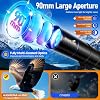
  • 90MM LARGE APERTURE & FMC OPTICS: Bring the Moon and distant scenery into brighter, clearer view with the HUGERSTAR 90600 refractor telescope. Its 90mm aperture, 600mm focal length, and fully multi-coated optics help gather more light and improve image clarity, making it a great telescope for adults, kids, and astronomy beginners.
  • 24X180X FLEXIBLE MAGNIFICATION: Explore from wide views to closer detail with the included 25mm and 10mm eyepieces and 3X Barlow lens. Start at 24X for easier target locating and focusing, then increase magnification up to 180X after the image is centered and clear. The 5X24 finder scope helps beginners aim at the Moon and distant objects with greater ease.
  • ADJUSTABLE TRIPOD & PORTABLE CARRY BAG: The aluminum tripod adjusts from 22.04 to 47.63 inches for comfortable viewing while sitting or standing. Built-in accessory slots keep eyepieces and the Barlow lens within reach, while the carry bag makes storage and transport easy for home or outdoor stargazing.
  • MOON FILTER, PHONE ADAPTER & MOON PHASE GUIDE: The moon filter helps reduce glare for more comfortable lunar viewing. The phone adapter lets you connect a smartphone to the eyepiece to capture and share views, while the included double-sided Moon Map and Moon Phase Guide makes lunar observation more fun and educational.
  • MODERN BLACK & BLUE BEGINNER TELESCOPE: The classic black telescope body with distinctive blue accents creates a clean, modern look made for exploration. Easy to assemble and simple to use, this telescope for adults, kids, and astronomy beginners is ideal for Moon viewing, daytime observation, family stargazing, camping, and outdoor learning.

Brand: HUGERSTAR


Model Name: 90600


Optical Tube Length: 60 centimeters


Eye Piece Lens Description: Kellner


Objective Lens Diameter: 9 centimeters


Telescope Mount Description: Altazimuth Mount


Product Dimensions: 26.77"D x 5.51"W x 8.66"H


Focus Type: Manual Focus


Finderscope: Straight-Through


Compatible Devices: Smartphone


Eye Piece Lens Description: Kellner


Mount: Altazimuth Mount


Focus Type: Manual Focus


Finderscope: Straight-Through


Compatible Devices: Smartphone


Coating: Fully Multi-Coated


Focal Length Description: 600 millimeters


Zoom Ratio: 24x-180x


Additional Features: Phone Adapter


Optical-Tube Length: 60 centimeters


Objective Lens Diameter: 9 centimeters


Item Dimensions D x W x H: 26.77"D x 5.51"W x 8.66"H


Brand: HUGERSTAR


Model Name: 90600


Unit Count: 1 Count


Manufacturer: HUGERSTAR


Number of Items: 1


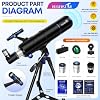
Built-In Media: 1x 10mm Eyepiece, 1x 25mm Eyepiece, 1x Barlow Lens (3x), 1x Finder Scope, 1x Finder Scope Base, 1x Moon Filter, 1x Moon Phase Guide, 1x Phone Adapter, 1x User Manual, 1x Telescope Tube, 1x Aluminium Tripod, 1x Carry Bag


Manufacturer Part Number: HGS90600Black


Warranty Description: 2 Year Manufacturer


Frequently asked questions

If you place your order now, the estimated arrival date for this product is: Monday, Oct 12

Yes, absolutely! You may return this product for a full refund within 30 days of receiving it.

To initiate a return, please visit our Returns Center.

View our full returns policy here.

  • Klarna Financing
  • Affirm Pay in 4
  • Affirm Financing
  • Afterpay Financing
  • Zip Pay in 4
  • Financing through Apple Pay
  • Financing through Google Pay
Leasing options through Acima may also be available during checkout.

Learn more about financing & leasing here.

Top Amazon Reviews


  • The HUGERSTAR refractor telescope is a genuinely solid entry point into observational astronomy.
The first thing Amazon asks when writing a review is, “What should other customers know about this product?” Here are some of the highlights: Highlights •90mm aperture with fully multi-coated optics — gathers more light for bright, clear views of the Moon, planets, and distant objects •24X–180X magnification range — includes 25mm and 10mm eyepieces plus a 3X Barlow lens for flexible viewing depth •Complete beginner kit — includes finder scope, moon filter, moon phase guide, phone adapter, tripod, and carry bag •Adjustable aluminum tripod — extends from 22 to 48 inches for sitting or standing observation •Portable design — lightweight at 8 lbs with a carry bag, perfect for backyard, camping, or travel stargazing •Phone adapter included — capture and share views directly from your smartphone Specifications •Brand: HUGERSTAR •Model: 90600 •Aperture (Objective Lens): 90mm •Focal Length: 600mm •Magnification: 24X–180X (with included eyepieces and Barlow lens) •Eyepieces Included: 25mm and 10mm (Kellner design) •Barlow Lens: 3X magnification booster •Finder Scope: 5X24 straight-through design •Mount Type: Altazimuth (manual, up-and-down / left-and-right motion) •Tripod: Aluminum, adjustable height 22–48 inches with built-in accessory slots •Optical Tube Length: 60cm (23.6 inches) •Total Weight: 8.03 lbs •Package Dimensions: 26.77" D × 5.51" W × 8.66" H •Warranty: 2-year manufacturer warranty •Price: $99.99 Durability •Fully multi-coated optics — all glass surfaces are coated to reduce reflections and maximize light transmission; these coatings are standard for quality telescopes and hold up well over years of use •Aluminum tripod construction — lightweight but structurally rigid; aluminum resists rust and corrosion better than steel, though it can dent if dropped or stressed •Kellner eyepieces — the standard mid-range optical design; simpler than premium eyepieces but reliable and less prone to optical misalignment than cheaper alternatives •Carry bag included — protects the optics during transport and storage, extending telescope life •Manual altazimuth mount — no motorized parts to fail; simple mechanical design means fewer points of failure, but users must manually track moving objects (this is normal for beginner telescopes) •Caveats: Aluminum can be dented; eyepieces and lenses can scratch if not properly stored; the finder scope bracket may loosen over time with repeated use. How Do You Use It 1. Assemble the tripod — Connect the three tripod legs and extend them to comfortable standing or sitting height (22–48 inches adjustable) 2. Attach the telescope tube — Secure the optical tube to the altazimuth mount on top of the tripod using the provided mounting bracket 3. Attach the finder scope — Install the 5X24 finder scope on the side of the telescope tube; this acts as a wide-view pointer to help you locate objects 4. Insert an eyepiece — Start with the 25mm eyepiece (lowest magnification, widest field of view) into the eyepiece holder at the bottom of the tube 5. Point and focus during daytime (optional) — aim at a distant object like a building or tree to practice focusing; turn the focus knob until the image is sharp 6. At night, locate the Moon — use the finder scope to center the Moon in its view; then look through the main eyepiece and focus using the focus knob 7. Increase magnification gradually — once the Moon is centered and in focus at 24X (25mm eyepiece), switch to the 10mm eyepiece for 60X, or insert the Barlow lens to reach up to 180X magnification 8. Use the Moon filter — screw the included filter onto the eyepiece to reduce glare if the Moon is too bright 9. Track moving objects — manually nudge the telescope left/right or up/down using the altazimuth adjustment knobs to follow the Moon or planets as they move across the sky 10. Capture images — attach your smartphone to the phone adapter and point the camera at the eyepiece to photograph lunar features or planets 11. Clean up — remove eyepieces, place them in the carry bag with the Barlow lens and finder scope, and store the telescope in the carry bag indoors What's Included •1 HUGERSTAR 90600 Telescope Tube (the main optical assembly) •1 Altazimuth Mount (the manual pointing mechanism) •1 Aluminum Tripod (adjustable 22–48 inches with accessory slots) •1x 25mm Eyepiece (24X magnification, widest field of view) •1x 10mm Eyepiece (60X magnification, closer detail) •1x 3X Barlow Lens (magnification booster; pairs with eyepieces for up to 180X) •1x 5X24 Finder Scope (wide-view pointer scope with bracket) •1x Moon Filter (reduces lunar glare) •1x Phone Adapter (connects smartphone to eyepiece for astrophotography) •1x Moon Phase Guide (double-sided, educational reference card) •1x Moon Map (double-sided lunar feature chart) •1x Carry Bag (canvas or nylon, protects telescope during transport) •1x User Manual •2-Year Manufacturer Warranty Card Not included: eyepiece cleaning kit, lens caps, dew shield, motorized tracking, or solar filters. What Is the Assembly ProcessMinimal assembly required — mostly plug-and-play: 1. Remove all components from the box — lay out the tripod legs, telescope tube, mount, eyepieces, and accessories on a clean table 2. Connect the tripod legs — the three aluminum legs connect to a central hub; typically they click or screw into place (specific mechanism depends on the tripod design, but standard for all refractor telescopes) 3. Extend the tripod height — adjust the three legs to your desired height (22–48 inches); lock the height adjustment knobs or clips 4. Attach the mount to the tripod — place the altazimuth mount bracket on top of the tripod and secure with the provided bolts (usually requires a screwdriver or hex wrench, likely included but not explicitly listed) 5. Insert the telescope tube into the mount — slide the optical tube into the mount's cradle and tighten the securing rings or bolts so it does not rotate or slip 6. Attach the finder scope bracket — mount the 5X24 finder scope to the side of the telescope tube using the provided bracket and bolts 7. Align the finder scope — point the telescope at a distant daytime object (tree, building) and center it in the main eyepiece; then adjust the finder scope bracket so the crosshairs in the finder also center on that object (this ensures accurate aiming at night) 8. Insert the eyepiece — place the 25mm eyepiece into the eyepiece holder at the base of the tube and tighten the retaining ring 9. You're ready to observe — no additional assembly needed; you can begin observing immediately Time estimate: 15–20 minutes first-time; 5 minutes on subsequent setups once you're familiar.Tools needed: Likely a small Phillips or hex screwdriver (often included in the carry bag, but not explicitly listed). What Makes It a STEM ProductA STEM product explicitly integrates Science, Technology, Engineering, and Math into hands-on learning. This telescope does:Science: •Observational astronomy — students directly observe celestial bodies, craters, planetary features, and atmospheric phenomena; this is real empirical science, not textbook diagrams •Moon phases and lunar geology — the included Moon Phase Guide teaches how Earth's position relative to the Sun and Moon creates phases; lunar observations reveal impact craters, mountains, and valleys, teaching planetary geology •Planetary science — observing Jupiter's cloud bands, Saturn's rings, or Venus's phases connects to planetary motion, orbital mechanics, and solar system structure •Light and optics — multi-coated lenses, magnification, and the Barlow lens principle teach how light behaves, bends, and combines to magnify distant objects Technology: •Optics engineering — the 90mm aperture, 600mm focal length, and lens coatings are engineering choices students can research and understand •Phone adapter and digital imaging — connecting a smartphone teaches basic astrophotography principles and digital capture •Finder scope technology — the 5X24 finder demonstrates how lower magnification and wider field of view help locate targets before higher magnification viewing Engineering: •Mechanical design — the altazimuth mount, tripod structure, and focus mechanism are engineered systems; students learn how mechanical advantage, stability, and precision alignment work •Structural problem-solving — troubleshooting why the image is blurry (focus), why objects drift (tracking), or why alignment is off teaches engineering troubleshooting •Design trade-offs — aperture size, focal length, and magnification involve design compromises; a 90mm is larger (more light) but heavier and harder to track than smaller scopes Math: •Magnification calculation — eyepiece focal length ÷ telescope focal length = magnification; with the 25mm, 10mm, and Barlow lens, students calculate different magnification levels (24X, 60X, 75X, 180X) •Angular size and resolution — understanding how far away an object is and how large it appears on the sky involves angular measurement and geometry •Coordinate systems — learning to use right ascension and declination (celestial coordinates) connects to spherical geometry and navigation •Data recording — sketching lunar features, timing planetary transits, or recording observation conditions teaches scientific documentation Real-world connection: This telescope bridges the gap between classroom learning (diagrams of the Moon, planetary orbits) and authentic scientific inquiry. Students are not just reading about astronomy — they are collecting their own data and asking their own questions ("What are those mountain ridges? Why do Jupiter's cloud bands shift? Is that a satellite or a star?"). Educational use cases: •Homeschool astronomy curricula •Middle/high school Earth science or physics projects •Outdoor STEM learning camps •Family science nights at schools •Individual curiosity-driven research Verdict: This is a genuine STEM tool, not a toy with "STEM" slapped on the packaging. It teaches real observational science, optics principles, mechanical engineering, and mathematical reasoning — all through direct, hands-on experience. What Else Potential Buyers Should Know Specification Optics Quality: Mid-Range, Not Premium The Kellner eyepieces included (25mm and 10mm) are functional but basic. They have narrower fields of view and more optical distortion at edges compared to premium designs like Plossl or wide-angle eyepieces. For a $99.99 complete kit, this is standard — but it means serious observers often upgrade eyepieces ($30–$50 each) after the first few observing sessions. Budget accordingly if you plan to expand. The Barlow Lens Trade-off The included 3X Barlow lens multiplies magnification to reach 180X, but it also reduces image brightness and can introduce optical aberrations. In practice, maximum useful magnification on most nights is 100–120X, not the advertised 180X. Atmospheric turbulence and light-gathering limits mean going beyond 120X produces dim, shimmery views. Expect realistic magnification to be lower than headline figures. Atmospheric Seeing Matters More Than You Think Even with a 90mm aperture, your viewing experience depends heavily on atmospheric conditions. On a humid, turbulent night, a $99 telescope may perform worse than a clear, dry night. Temperature equilibrium also matters — if you bring a cold telescope into warm air or vice versa, internal air currents blur the view for 30–60 minutes until temperature stabilizes. Plan for this learning curve. Refractor vs. Reflector Trade-offs This is a refractor telescope (lens-based). Advantages: low maintenance, no mirror cleaning needed, color-free images. Disadvantages: chromatic aberration (false color fringing around bright objects, especially planets), which is inherent to refractors at this focal ratio. Reflector telescopes (mirror-based) avoid this but require collimation maintenance. At $99.99, the refractor design is the right choice for beginners, but be aware the Moon and bright planets may show slight purple fringing — this is normal for refractors under 4 inches aperture. Finder Scope Alignment Is Critical The 5X24 finder scope is helpful, but it requires careful alignment on the first clear night. Many beginners skip this step and struggle for hours trying to center objects. Spend 10 minutes aligning it in daylight before your first night session — point at a distant tree, center it in the main eyepiece, then adjust the finder scope brackets until the crosshairs align. This single step makes the difference between frustration and success. Magnification Is Not Everything Marketing often emphasizes high magnification (180X), but aperture is the true measure of light-gathering. The 90mm aperture is what matters. Higher magnification is useful only after the object is centered and in focus. Many beginners jump to 180X, see a dim, blurry view, and assume the telescope is broken. Start at 24X, find the object clearly, then gradually increase magnification only if the view stays bright and clear. Phone Imaging Has Limits The included phone adapter allows smartphone astrophotography, but results are modest. Smartphone sensors are not optimized for faint light, so you can capture bright lunar details and bright planetary surfaces but not faint nebulae or distant galaxies. Expect iPhone or Android photos to be interesting but not Hubble-quality. Dedicated planetary imaging cameras ($200+) are needed for publication-quality images. 2-Year Warranty Covers Manufacturing Only The warranty protects against defects (broken lenses, optical errors, mount failures) but typically does not cover damage from mishandling, drops, or normal wear. Review the warranty terms carefully when the manual arrives. Most beginner telescope buyers never need to use the warranty — but understand what is and isn't covered. Eyepiece and Accessory Ecosystem The telescope uses standard 1.25" eyepiece threads, which means the included eyepieces can be swapped for aftermarket options. This is good news for eventual upgrades — you're not locked into HUGERSTAR-only accessories. Brands like Celestron, Meade, and generic makers produce compatible 1.25" eyepieces starting at $20–$30 each. Price vs. Competitors At $99.99, this is competitively priced. Comparable beginner refractors from established brands like Celestron AstroMaster 90AZ run $120–$150. This HUGERSTAR model undercuts them, but the trade-off is less established brand reputation and no independent user reviews. If you value known brands and warranty support, spending $30 more on a Celestron might be prudent. If you value price and are willing to take a small risk on a new brand, this offers good value. Final Thoughts The HUGERSTAR 90600 refractor telescope is a genuinely solid entry point into observational astronomy at an attractive price. Its 90mm aperture, multi-coated optics, complete accessory kit, and portable design combine to create a package that removes most barriers to getting started. For $99.99, you get everything needed to begin: eyepieces, finder scope, Moon filter, phone adapter, tripod, and educational guides. What it does well: •Moon and planetary observation are excellent and immediate gratification •Complete beginner kit — no need to buy accessories separately to get started •Portable and socially engaging — family stargazing is genuinely fun •Free shipping and fast delivery (tomorrow for Prime members) •Real STEM value — teaches optics, astronomy, and mechanical engineering •Realistic magnification range (24X–180X) covers practical use cases What gives thoughtful pause: •Zero customer reviews — you cannot learn from other buyers' real-world experience or potential defects •Brand new on Amazon (June 2026) — HUGERSTAR has no established track record for quality or customer service •Specification inconsistency (600mm vs. 550mm focal length) signals possible quality-control lapses •Mid-range optics — included Kellner eyepieces are functional but basic; serious users upgrade •Refractor chromatic aberration — purple fringing on bright objects is inherent to this design •Atmospheric seeing matters more than equipment — even premium telescopes produce poor views on turbulent nights •Phone imaging is modest — do not expect professional-quality astrophotography Who should buy this: •Families wanting to introduce kids to astronomy affordably •Adults curious about stargazing but unsure about commitment level •Beginners who prioritize Moon and planetary viewing (where this excels) •Hobbyists in reasonably dark locations willing to spend time learning the craft •Educators looking for a hands-on STEM tool under $100 Who should hesitate: •Deep-sky galaxy/nebula observers seeking faint objects (this scope excels at bright objects, not faint ones) •Buyers who demand brand reputation and verified reviews before committing •Those wanting motorized tracking or app-controlled features (this is fully manual) •Photographers expecting publication-quality astrophotography from a smartphone •People in extreme light pollution (downtown city centers) expecting dramatic views Bottom line: At $99.99 with free next-day delivery, this is a low-risk, high-engagement entry into amateur astronomy. If you want to explore the night sky, show kids real lunar craters and Saturn's rings, or try a hobby without major investment, this telescope delivers on its promises. The lack of customer reviews means you are testing a new product, but the design is sound, the price is fair, and the included accessories are comprehensive. Recommendation: If you're ready to observe now and live in a location with reasonable dark skies, order it. The Moon alone is stunning enough through this scope to justify the $99.99. If you want to research extensively and read 500 five-star reviews first, wait 2–3 months for customer feedback to accumulate. But be aware — by then, the earliest-adopter discount may not apply. ... show more
Reviewed in the United States on August 13, 2026 by Amazon Customer

  • Good beginner telescope could use better tripod head
This is a good quality beginner telescope kit. I got it for some moon and stargazing as well as checking out wildlife up here in the country. Setup was a breeze and only took about five minutes. The bag is really nice with Velcro straps that keep everything secure, and the information cards are a helpful touch for a first telescope. The phone adapter worked well with my iPhone 16 Pro Max, though if you have a thick case it’s best to take the phone out so the adapter grips better. The optics aren’t bad and give some really nice views of the moon and wildlife. The dials move smoothly with just enough resistance that they don’t get bumped out of place. My only real complaint is the lightweight tripod. No matter how tight you lock it down, once you’re dialed in it tends to drift downward a bit from the weight of the front of the scope. You can compensate somewhat with the moon, but it makes tracking smaller or more distant objects like Venus or Jupiter a little trickier. That said, it’s still a great value for anyone looking for their first telescope at a decent entry-level price. The materials feel strong and durable, and it even looks nice enough to leave set up in my home office as a decorative piece when not in use. ... show more
Reviewed in the United States on August 21, 2026 by Amazon Customer

  • Nice beginner telescope
The aperture gathers a decent amount of light for something in this size, and the focal length gives a good balance between magnification and field of view. The moon looks sharp and detailed, and you can clearly make out craters and surface features. Planets are small but visible, which is about what you should expect at this level. It comes with two eyepieces and a 3X barlow, so you can really zoom in to see more detail on the moon, or distant stars. The lower magnification is easier for beginners to start with, especially when learning how to aim and focus. The included finder scope helps a lot when trying to locate objects in the sky, and even has crosshairs to help you line up the main telescope. The tripod is lightweight but stable enough for casual backyard use. It’s not observatory-grade equipment, but for a portable setup it's fine. Everything packs up easily and the backpack makes it convenient to take camping or on trips. Setup is straightforward and doesn’t require tools. Good option for anyone new to astronomy who wants something simple that still delivers real views of the night sky without spending too much. ... show more
Reviewed in the United States on August 20, 2026 by Amazon Customer

  • Saturn
My son is trying to see saturn! He was so excited for this gift. Works great. Good clear imaging
Reviewed in the United States on August 16, 2026 by SJean9

Can't find a product?

Find it on Amazon first, then paste the link below.
Checking for best price...